


Interactions between inflammatory gene polymorphisms and HTLV-I infection for total death, incidence of cancer, and atherosclerosis-related diseases among the Japanese population
- PMID: 28576445
- PMCID: PMC5565753
- DOI: 10.1016/j.je.2016.08.017
Interactions between inflammatory gene polymorphisms and HTLV-I infection for total death, incidence of cancer, and atherosclerosis-related diseases among the Japanese population
Abstract
Background: An increased risk of total death owing to human T-lymphotropic virus type-I (HTLV-I) infection has been reported. However, its etiology and protective factors are unclear. Various studies reported fluctuations in immune-inflammatory status among HTLV-I carriers. We conducted a matched cohort study among the general population in an HTLV-I-endemic region of Japan to investigate the interaction between inflammatory gene polymorphisms and HTLV-I infection for total death, incidence of cancer, and atherosclerosis-related diseases.
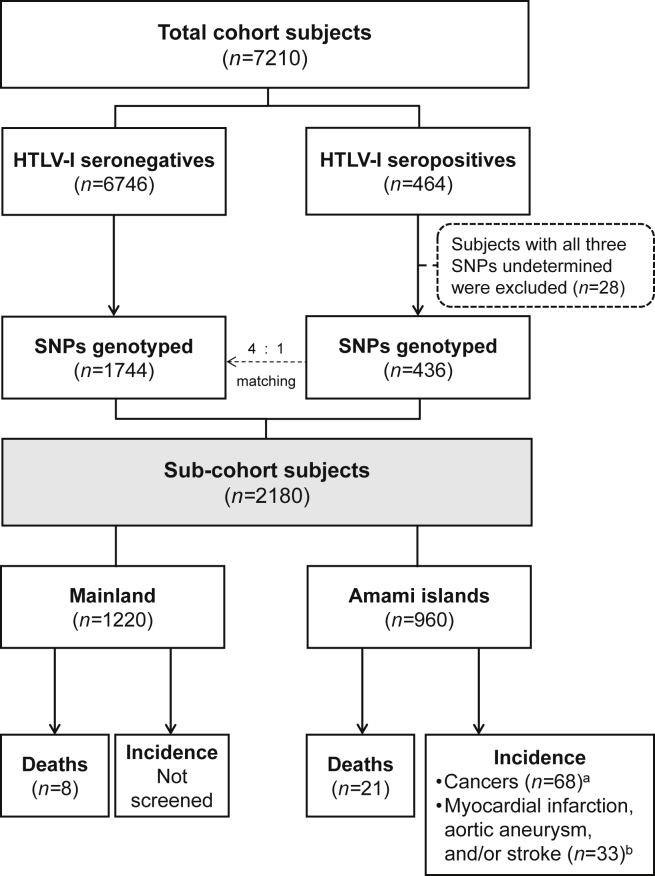
Method: We selected 2180 sub-cohort subjects aged 35-69 years from the cohort population, after matching for age, sex, and region with HTLV-I seropositives. They were followed up for a maximum of 10 years. Inflammatory gene polymorphisms were selected from TNF-α, IL-10, and NF-κB1. A Cox proportional hazard model was used to estimate the hazard ratio (HR) and the interaction between gene polymorphisms and HTLV-I for risk of total death and incidence of cancer and atherosclerosis-related diseases.
Results: HTLV-I seropositivity rate was 6.4% in the cohort population. The interaction between TNF-α 1031T/C and HTLV-I for atherosclerosis-related disease incidence was statistically significant (p = 0.020). No significant interaction was observed between IL-10 819T/C or NF-κB1 94ATTG ins/del and HTLV-I. An increased HR for total death was observed in the Amami island region, after adjustment of various factors with gene polymorphisms (HR 3.03; 95% confidence interval, 1.18-7.77).
Conclusion: The present study found the interaction between TNF-α 1031T/C and HTLV-I to be a risk factor for atherosclerosis-related disease. Further follow-up is warranted to investigate protective factors against developing diseases among susceptible HTLV-I carriers.
Keywords: Gene polymorphism; HTLV-I; Inflammation; Interaction.
Copyright © 2017 The Authors. Production and hosting by Elsevier B.V. All rights reserved.
Figures
References
-
- Proietti F.A., Carneiro-Proietti A.B., Catalan-Soares B.C., Murphy E.L. Global epidemiology of HTLV-I infection and associated diseases. Oncogene. 2005;24:6058–6068. - PubMed
-
- Kimura I. HABA (HTLV-I associated bronchiolo-alveolar disorder) Nihon Kyobu Shikkan Gakkai Zasshi. 1992;30:787–795. [in Japanese] - PubMed
MeSH terms
Substances
LinkOut - more resources
Full Text Sources
Other Literature Sources
Medical