Review
. 2017 Aug;35(8):1881-1897.
doi: 10.1002/stem.2649. Epub 2017 Jun 27.

Concise Review: Criteria for Chamber-Specific Categorization of Human Cardiac Myocytes Derived from Pluripotent Stem Cells

Affiliations
Review

Concise Review: Criteria for Chamber-Specific Categorization of Human Cardiac Myocytes Derived from Pluripotent Stem Cells

Christopher Kane et al. Stem Cells. 2017 Aug.

Abstract

Human pluripotent stem cell-derived cardiomyocytes (PSC-CMs) have great potential application in almost all areas of cardiovascular research. A current major goal of the field is to build on the past success of differentiation strategies to produce CMs with the properties of those originating from the different chambers of the adult human heart. With no anatomical origin or developmental pathway to draw on, the question of how to judge the success of such approaches and assess the chamber specificity of PSC-CMs has become increasingly important; commonly used methods have substantial limitations and are based on limited evidence to form such an assessment. In this article, we discuss the need for chamber-specific PSC-CMs in a number of areas as well as current approaches used to assess these cells on their likeness to those from different chambers of the heart. Furthermore, describing in detail the structural and functional features that distinguish the different chamber-specific human adult cardiac myocytes, we propose an evidence-based tool to aid investigators in the phenotypic characterization of differentiated PSC-CMs. Stem Cells 2017;35:1881-1897.

Keywords: Cardiac toxicology models; Chamber specificity; Heart; Heart disease models; Induced pluripotent stem cell-derived cardiac myocytes; Induced pluripotent stem cells; Maturation.


Figures

Figure 1
Figure 1
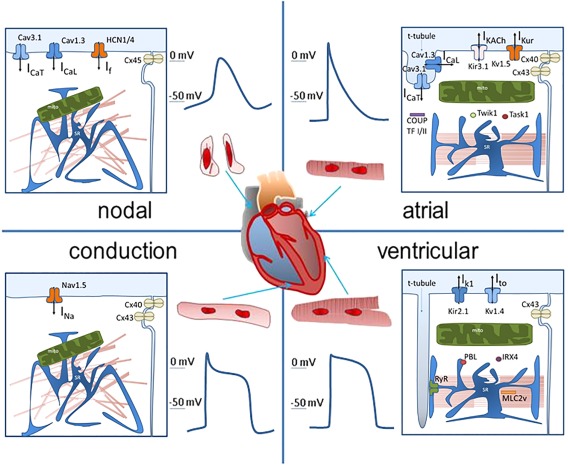
This figure shows the most commonly accepted features that identify myocytes from nodal tissue, the conduction His‐Purkinje system, working atrial, and ventricular myocardium. Each panel shows the gross morphological structure of the cells, the action potential profile, and the subcellular structure with the most common molecular markers associated with the specific function of the region. The clear distinction between regions of the heart is for classification purposes only, as cardiac myocytes from different regions show a vast spectrum of functional and structural properties, and there is significant overlap in these properties between different regions. Abbreviations: COUP, chicken ovalbumin upstream promoter; HCN, Hyperpolarization‐activated cyclic nucleotide–gated; MLC, myosin light chain; TF, transcription factor.
Figure 2
Figure 2
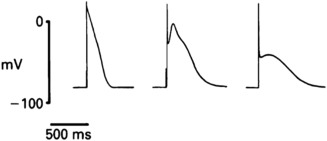
Human atrial action potentials (APs) have a spectrum of different morphologies. These APs were all recorded from human atria (adapted from 85).
Figure 3
Figure 3
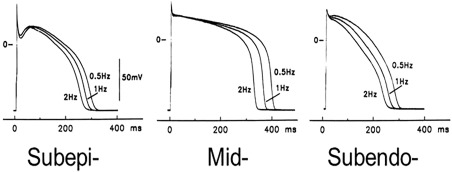
Variability of morphology of human action potentials from different regions of the ventricular wall (adapted from 105).
Figure 4
Figure 4
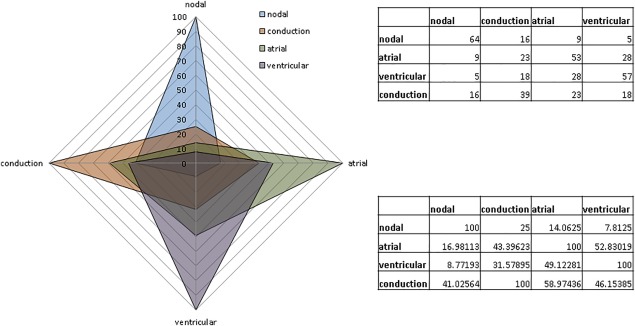
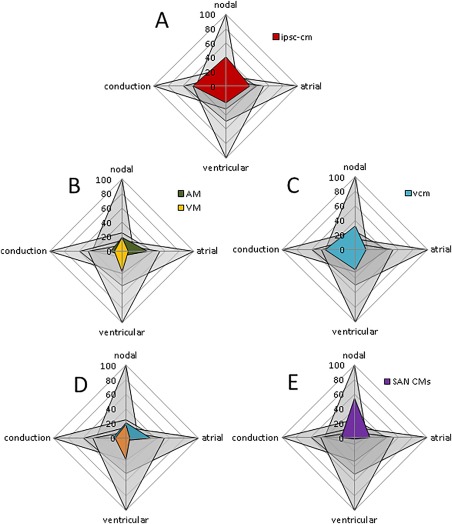
Radar chart showing the significant overlap of “specific” features when scores from the four myocyte types for each chamber‐specific template are overlaid. Nodal and ventricular myocytes (VM) present the most distinctive differences when compared, while AM and VM overlap the most. Conduction myocytes present equal overlap with the other three types. Upper table: absolute values. Lower table and chart: values are percentage of total.
Figure 5
Figure 5
Comparison of chamber‐specific properties of various induced pluripotent stem cell (iPSC)‐cardiomyocyte (CM) lines. (A): Data from global analysis of recent literature 28 are used to build the profile of human iPSC‐CMs in terms of chamber specificity. (B): Data obtained from Devalla et al., where atrial differentiation was induced by retinoic acid and atrial myocytes (AM) were obtained 10. The radar chart shows a predominant atrial differentiation in myocytes obtained with this strategy compared with ventricular myocytes (VM); however, the demonstrated degree of similarity to adult myocytes is still low and a more detailed characterization is required. (C): Data obtained from Weng et al., where a method to obtain a high percentage of ventricular‐specific CMs from PSCs is reported 11. Despite a predominant ventricular over atrial axis, several features of such specific phenotype are still lacking. In addition, the cells obtained have several features of cells from the nodal/conduction system, well over the normal overlapping area. (D): Data obtained from Josowitz et al., where AM were sorted using red fluorescent sarcolipin (red high). The remaining, non‐fluorescent myocytes (red low) were considered VM 9. (E): Data from Protze et al. showing an improved method to select PSC‐CMs with features of SA node cells 36. Abbreviations: AM, atrial myocytes; CM, cardiomyocyte; iPSC, induced pluripotent stem cell; SAN, sinoatrial node; VCM, ventricular‐specific cardiomyocytes; VM, ventricular myocytes.

References

    1. Lian X, Hsiao C, Wilson G et al. Robust cardiomyocyte differentiation from human pluripotent stem cells via temporal modulation of canonical Wnt signaling. Proc Natl Acad Sci USA 2012;109:E1848–E1857. - PMC - PubMed
    1. Zhang J, Klos M, Wilson GF et al. Extracellular matrix promotes highly efficient cardiac differentiation of human pluripotent stem cells: The matrix sandwich method. Circ Res 2012;111:1125–1136. - PMC - PubMed
    1. Burridge PW, Matsa E, Shukla P et al. Chemically defined generation of human cardiomyocytes. Nat Methods 2014;11:855–860. - PMC - PubMed
    1. Haase A, Olmer R, Schwanke K et al. Generation of induced pluripotent stem cells from human cord blood. Cell Stem Cell 2009;5:434–441. - PubMed
    1. Moretti A, Bellin M, Welling A et al. Patient‐specific induced pluripotent stem‐cell models for long‐QT syndrome. N Engl J Med 2010;363:1397–1409. - PubMed

Publication types