Review
. 2017 Jul;42(7):516-530.
doi: 10.1016/j.tibs.2017.05.001. Epub 2017 Jun 1.

Advances on the Transfer of Lipids by Lipid Transfer Proteins

Affiliations
Review

Advances on the Transfer of Lipids by Lipid Transfer Proteins

Louise H Wong et al. Trends Biochem Sci. 2017 Jul.

Abstract

Transfer of lipid across the cytoplasm is an essential process for intracellular lipid traffic. Lipid transfer proteins (LTPs) are defined by highly controlled in vitro experiments. The functional relevance of these is supported by evidence for the same reactions inside cells. Major advances in the LTP field have come from structural bioinformatics identifying new LTPs, and from the development of countercurrent models for LTPs. However, the ultimate aim is to unite in vitro and in vivo data, and this is where much progress remains to be made. Even where in vitro and in vivo experiments align, rates of transfer tend not to match. Here we set out some of the advances that might test how LTPs work.

Keywords: lipid exchange; nonvesicular traffic; oxysterol binding protein-related proteins; tubular lipid binding proteins.


Figures

Figure 1
Figure 1
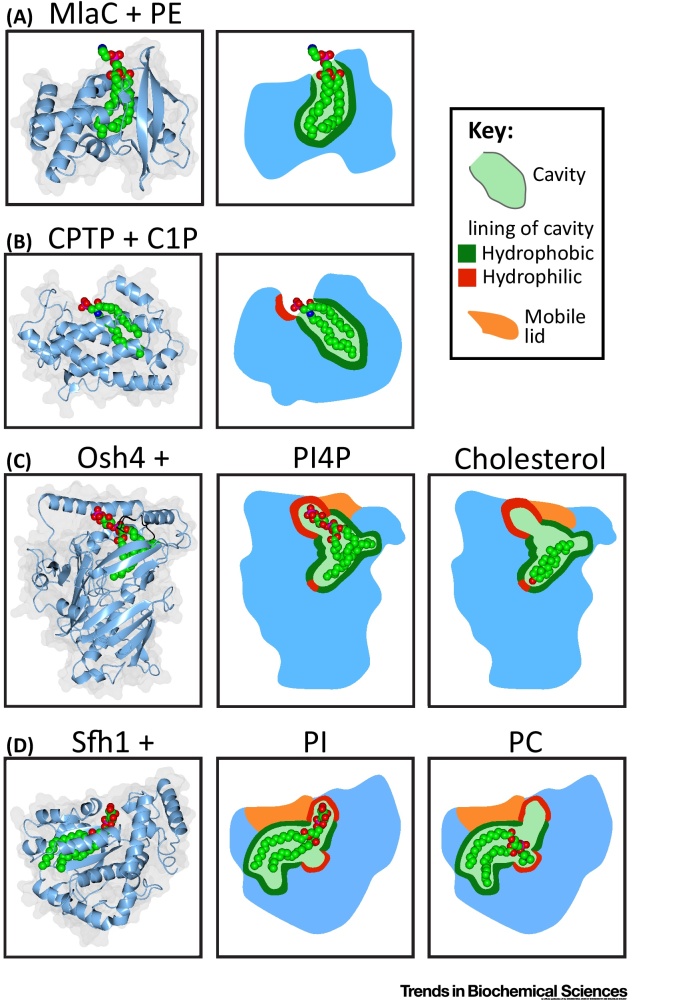
Different Modes by Which Lipid Transfer Proteins Solubilise Membrane Lipids. (A) MlaC (a periplasmic protein) crystallises with phosphatidylethanolamine (PE) but does not interact with its headgroup . (B) Ceramide 1-phosphate (C1P) transfer protein (CPTP) binds the lipid with a hydrophilic patch outside the cavity. (C) Osh4p, a yeast relative of oxysterol binding protein (OSBP), binds phosphatidylinositol-4-phosphate (PI4P) or sterol, with two internal hydrophilic patches. (D) Sfh1, a close homologue of Sec14 in yeast, binds phosphatidylinositol (PI) or phosphatidylcholine (PC), with two internal hydrophilic patches. In both (C) and (D), the lipid is almost entirely shielded from solvent access, but these lipid transfer proteins differ in that for Osh4 (C) there are conformational changes associated with different lipid occupancy, particularly in the mobile lid. By contrast, for Sec14 and homologues including Sfh1 (D), there is no significant external response to internal occupancy. Left-hand panels: ribbon diagrams with background showing space-filling profiles and lipid ligands as space-fill format (coloured by atom: C = green, O = red, N = blue, P = magenta). Other panels: cartoons with lipid binding pockets lined according to key and major ligands: one in (A) and (B); two in (C) and (D) where the ligands shown in the ribbon diagrams are PI4P and PI, respectively. Ribbon diagrams taken from PDB files with accession numbers: 2qgu, 4k8n, 1zhy, 3spw, 3b7n, and 3b7q.
Figure 2
Figure 2
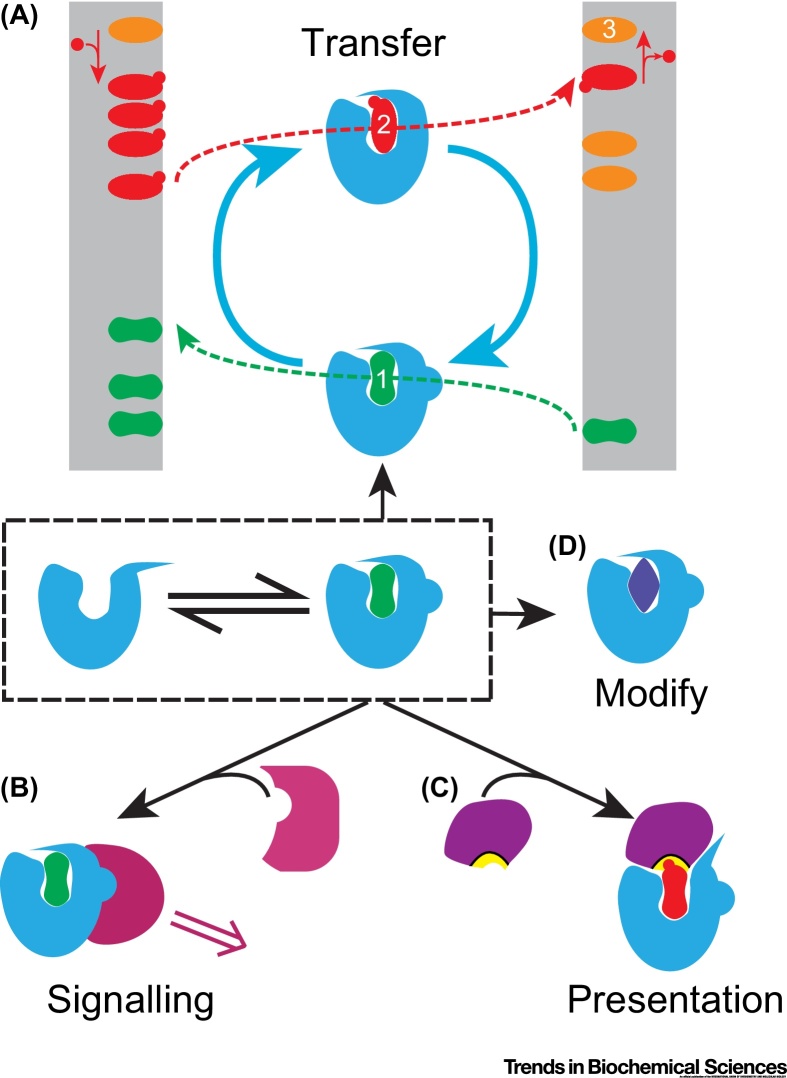
Schematic Illustrations of the Various Functions of a Lipid Binding Domain. (A) Lipid traffic by lipid transfer proteins (LTPs). Either transfer or exchange of lipid can take place at one membrane. Here a countercurrent model is shown, where one LTP (blue) exchanges two lipids (numbered 1 and 2, shown in green and red, respectively) between two membranes. In this example, a steep gradient of Lipid #2 is maintained by its synthesis from Lipid #3 (orange) on the left side, and conversion back to Lipid #3 on the right side. Such a gradient can drive the counterexchange of Lipid #1 up a gradient, albeit this gradient is less steep than that of Lipid #2. This has been shown for oxysterol binding protein (OSBP) homologues, where Lipid #2 is phosphatidylinositol-4-phosphate, Lipid #3 is phosphatidylinositol, and Lipid #1 can be either sterol or phosphatidylserine . (B) LTP as a sensor: An LTP directly senses a lipid if it changes conformation upon binding a lipid and passes that information to a binding partner. Here an interaction is shown between a signalling protein and lipid-bound LTP, whereas the non-lipid-bound form does not interact. This might lead to lipid-dependent signalling, as has been shown for OSBP . Lipid-dependent conformations could also be important for lipid transfer reactions, for example, in membrane targeting (not shown). (C) LTP as a presenter: the LTP–lipid interaction exposes part of the lipid (typically the headgroup) to other proteins, for example, an enzyme (purple) that modifies the lipid (turns from green to red). This applies to the presentation of glycosphingolipids to hydrolytic enzymes by GM2 activator protein (GM2AP) . LTPs that enclose lipid inside a cavity, such as Sec14, may still present lipids as they enter or leave the cavity (not shown) . (D) LTP with an additional lipid modifying function: a protein that can solubilise a lipid ligand will thereby have properties of an LTP; the same protein may also act as a lipid modifying enzyme with other substrates, as is the case for GM2AP when it interacts with phosphatidylcholine and platelet activating factor .
Figure 3
Figure 3
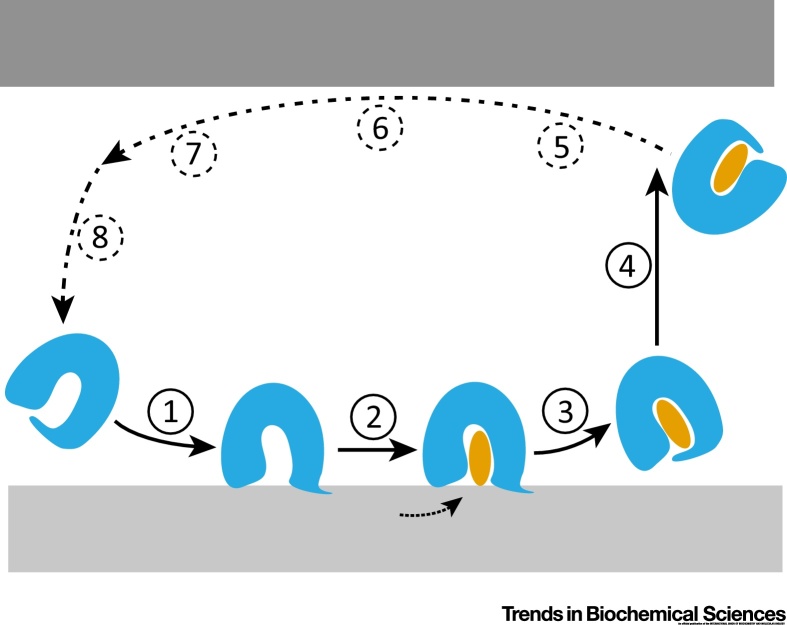
The Minimal Number of Steps in a Lipid Transfer Reaction. The overall lipid transfer reaction can be dissected into eight substeps. 1: lipid transfer protein (LTP) binds to donor membrane. This step may be regulated by lipid occupancy and membrane composition to reduce irrelevant membrane interactions. 2: Lipid extraction; or, if the LTP works as a lipid exchanger, swapping of lipids. 3: LTP–lipid complex dissociates away from the membrane. The occupancy of the pocket can also influence release of the LTP. 4: Diffusion between membranes, until the LTP encounters the acceptor membrane. Steps 5–8 are essentially as 1–4, but at the acceptor site. Steps 1–3 and 5–7 should involve conformational changes (e.g., the closing of a lid after membrane dissociation of an LTP–lipid complex), which could make reverse reactions unfavourable. Additional intermediates (protein conformations) are also possible.
Figure 4
Figure 4
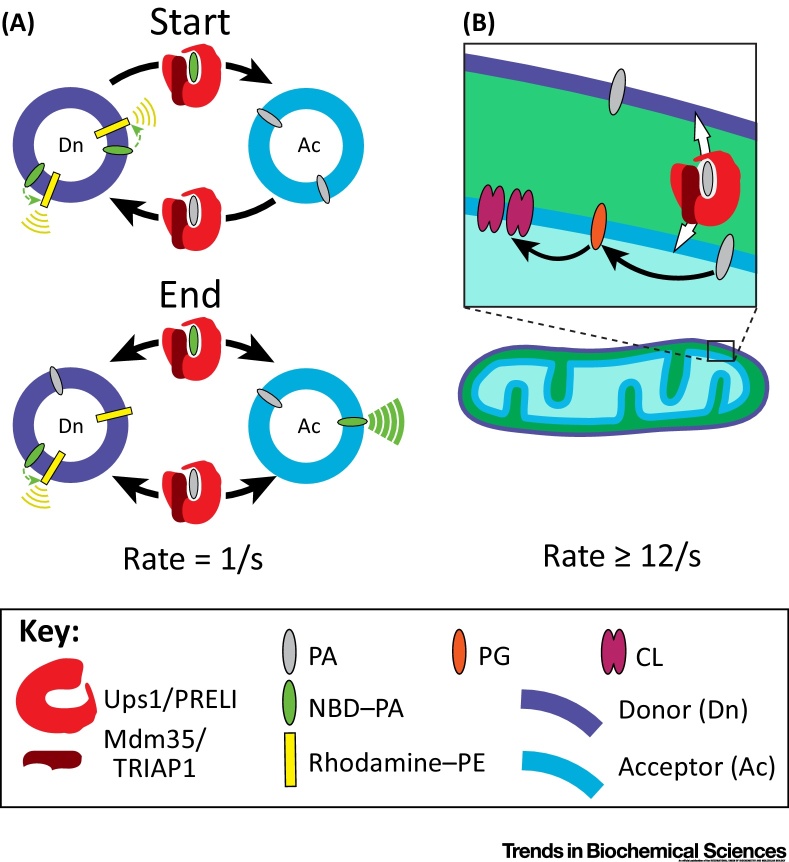
Discrepancies between Rates of Lipid Transfer Protein (LTP) Transfer In Vitro and In Vivo. (A) In vitro rates of phosphatidic acid (PA) transfer by Ups1/Mdm35. In highly reproducible, well-controlled assays by Watanabe et al., the calculated rate at which the LTP moves PA from any one liposome to another = 1/s (details in Box 2A). This is the upper limit for net traffic. At ‘Start’, the measured emission from 7-nitro-2-1,3-benzoxadiazol-4-yl (NBD)–PA is inhibited as it undergoes Förster resonance energy transfer (FRET) with rhodamine–phosphatidylethanolamine (PE), which emits at 585 nm (yellow signal). Note that although NBD–PA and rhodamine–PE are diffusing freely in the donor membrane, they are illustrated close together to indicate the proximity for FRET, which is ≤2 nm. As the reaction progresses to ‘End’, the measured NBD fluorescence increases as NBD–PA is moved to acceptor liposomes lacking rhodamine–PE, where it emits at 535 nm (green signal). (B) Estimate of in vivo rate of PA import into mitochondria in budding yeast. Cardiolipin (CL) is made in the mitochondrial matrix from a phosphatidylglycerol (PG) and a cytidine diphosphate diacylglycerol, each of which is made from one imported PA molecule. The lower limit of in vivo PA transfer by Ups1 is estimated to be 12/s (details in Box 2B). This is >12-fold faster than the rate measured in (A). See Box 2 for potential sources of error. Abbreviations: Ac, acceptor; Dn, donor; PRELI, proteins of relevant evolutionary and lymphoid interest (in yeast called Ups for ‘unprocessed Mgm1’); TRIAP1, TP53-regulated inhibitor of apoptosis-1 (Mdm35 in yeast).

References

    1. Wirtz K.W., Zilversmit D.B. Exchange of phospholipids between liver mitochondria and microsomes in vitro. J. Biol. Chem. 1968;243:3596–3602. - PubMed
    1. Daum G. Intracellular transfer of phospholipids in the yeast, Saccharomyces cerevisiae. Biochim. Biophys. Acta. 1986;878:93–101. - PubMed
    1. Pagano R.E. Lipid traffic in eukaryotic cells: mechanisms for intracellular transport and organelle-specific enrichment of lipids. Curr. Opin. Cell Biol. 1990;2:652–663. - PubMed
    1. Helmkamp G.M., Jr Phospholipid exchange between membranes. Purification of bovine brain proteins that preferentially catalyze the transfer of phosphatidylinositol. J. Biol. Chem. 1974;249:6382–6389. - PubMed
    1. Chiapparino A. The orchestra of lipid-transfer proteins at the crossroads between metabolism and signaling. Prog. Lipid Res. 2016;61:30–39. - PubMed

Publication types

LinkOut - more resources