


Suite of simple metrics reveals common movement syndromes across vertebrate taxa
- PMID: 28580149
- PMCID: PMC5452391
- DOI: 10.1186/s40462-017-0104-2
Suite of simple metrics reveals common movement syndromes across vertebrate taxa
Abstract
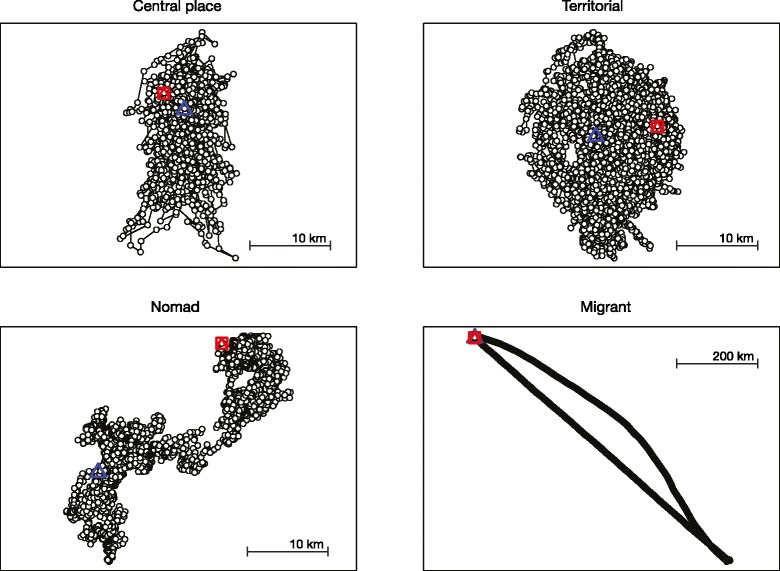
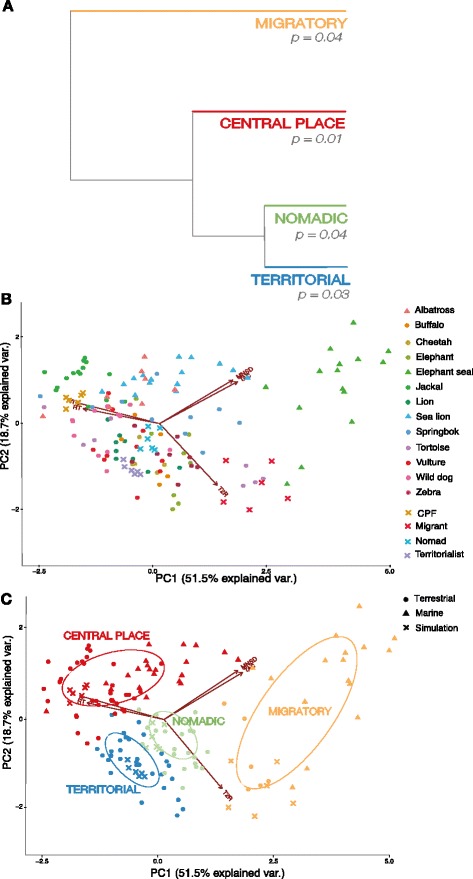
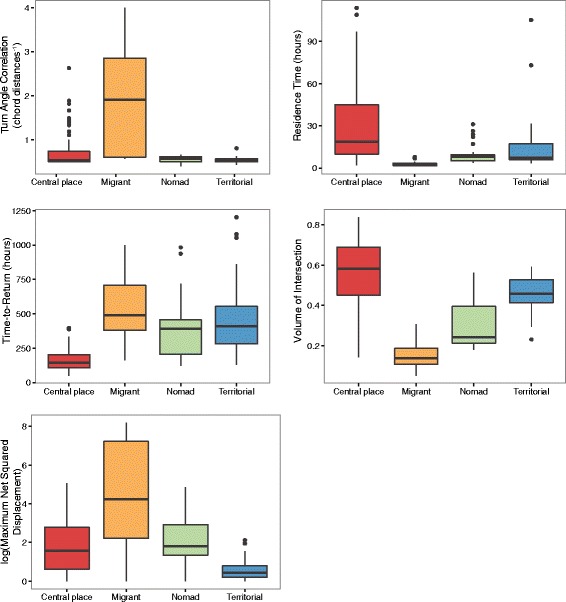
Background: Because empirical studies of animal movement are most-often site- and species-specific, we lack understanding of the level of consistency in movement patterns across diverse taxa, as well as a framework for quantitatively classifying movement patterns. We aim to address this gap by determining the extent to which statistical signatures of animal movement patterns recur across ecological systems. We assessed a suite of movement metrics derived from GPS trajectories of thirteen marine and terrestrial vertebrate species spanning three taxonomic classes, orders of magnitude in body size, and modes of movement (swimming, flying, walking). Using these metrics, we performed a principal components analysis and cluster analysis to determine if individuals organized into statistically distinct clusters. Finally, to identify and interpret commonalities within clusters, we compared them to computer-simulated idealized movement syndromes representing suites of correlated movement traits observed across taxa (migration, nomadism, territoriality, and central place foraging).
Results: Two principal components explained 70% of the variance among the movement metrics we evaluated across the thirteen species, and were used for the cluster analysis. The resulting analysis revealed four statistically distinct clusters. All simulated individuals of each idealized movement syndrome organized into separate clusters, suggesting that the four clusters are explained by common movement syndrome.
Conclusions: Our results offer early indication of widespread recurrent patterns in movement ecology that have consistent statistical signatures, regardless of taxon, body size, mode of movement, or environment. We further show that a simple set of metrics can be used to classify broad-scale movement patterns in disparate vertebrate taxa. Our comparative approach provides a general framework for quantifying and classifying animal movements, and facilitates new inquiries into relationships between movement syndromes and other ecological processes.
Keywords: Central place foraging; Classification scheme; Cluster analysis; GPS data; Migration; Movement ecology; Nomadism; Territoriality.
Figures
References
-
- Hanski I. Metapopulation dynamics. Nature. 1998;395:41–49. doi: 10.1038/23876. - DOI
-
- Clobert J, Danchin E, Dhondt AA, Nichols JD, editors. Dispersal. Oxford: Oxford University Press; 2001.
-
- Swingland IR, Greenwood PJ, editors. The ecology of animal movement. Oxford, UK: Oxford: Clarendon Press; 1983.
-
- Lawton JH, Jones CG. Linking species and ecosystems: Organisms as ecosystem engineers. In: Jones CG, Lawton JH, editors. Linking Species and Ecosystems. Boston: Springer; 1995. p. 141–50.
Grants and funding
LinkOut - more resources
Full Text Sources
Other Literature Sources
Miscellaneous
