. 2017 Jun 1;73(Pt 6):503-508.
doi: 10.1107/S2059798317004181. Epub 2017 Apr 20.

Trends in the Electron Microscopy Data Bank (EMDB)

Affiliations

Trends in the Electron Microscopy Data Bank (EMDB)

Ardan Patwardhan. Acta Crystallogr D Struct Biol. .

Abstract

Recent technological advances, such as the introduction of the direct electron detector, have transformed the field of cryo-EM and the landscape of molecular and cellular structural biology. This study analyses these trends from the vantage point of the Electron Microscopy Data Bank (EMDB), the public archive for three-dimensional EM reconstructions. Over 1000 entries were released in 2016, representing almost a quarter of the total number of entries (4431). Structures at better than 6 Å resolution now represent one of the fastest-growing categories, while the share of annually released tomography-related structures is approaching 20%. The use of direct electron detectors is growing very rapidly: they were used for 70% of the structures released in 2016, in contrast to none before 2011. Microscopes from FEI have an overwhelming lead in terms of usage, and the use of the RELION software package continues to grow rapidly after having attained a leading position in the field. China is rapidly emerging as a major player in the field, supplementing the US, Germany and the UK as the big four. Similarly, Tsinghua University ranks only second to the MRC Laboratory for Molecular Biology in terms of involvement in publications associated with cryo-EM structures at better than 4 Å resolution. Overall, the numbers point to a rapid democratization of the field, with more countries and institutes becoming involved.

Keywords: EMDB; Electron Microscopy Data Bank; cryo-EM; direct electron detector; electron tomography; resolution.


Figures
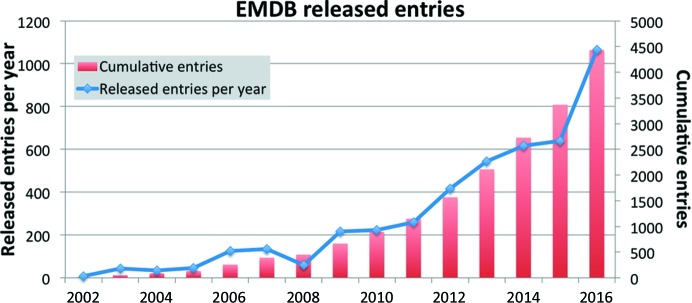
Figure 1
Figure 1
EMDB released entries. The cumulative number of released entries is shown as red bars with the y axis on the right-hand side. The number of entries released annually is shown as a blue marked line with the y axis on the left-hand side.
Figure 2
Figure 2
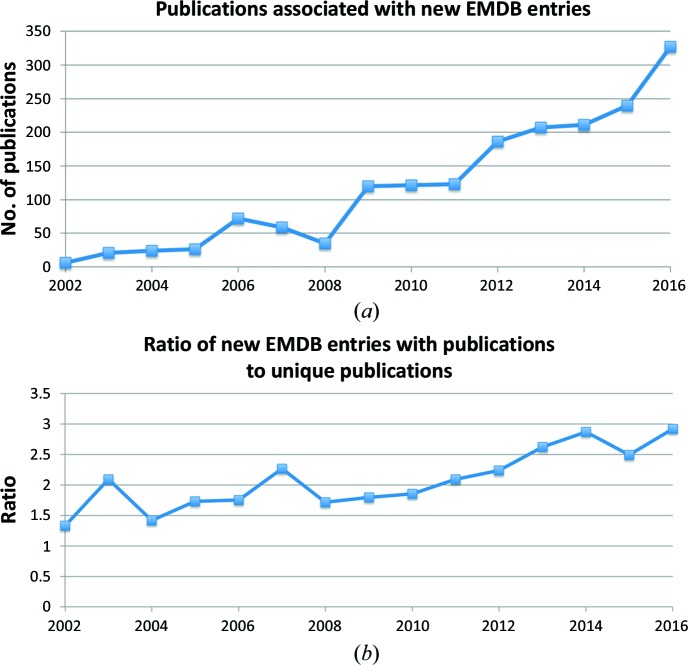
Analysis of publications associated with EMDB entries. (a) Count of the number of unique primary citations associated with new EMDB entries. (b) Ratio of the number of new EMDB entries with associated publications to the number of unique publications.
Figure 3
Figure 3
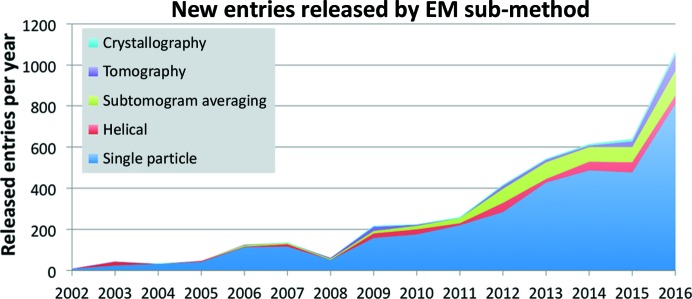
EMDB entries by EM sub-method. Stacked graph showing the number of annually released EMDB entries by sub-method category: single-particle (blue), helical (red), sub-tomogram averaging (green), tomography (purple) and crystallography (light blue).
Figure 4
Figure 4
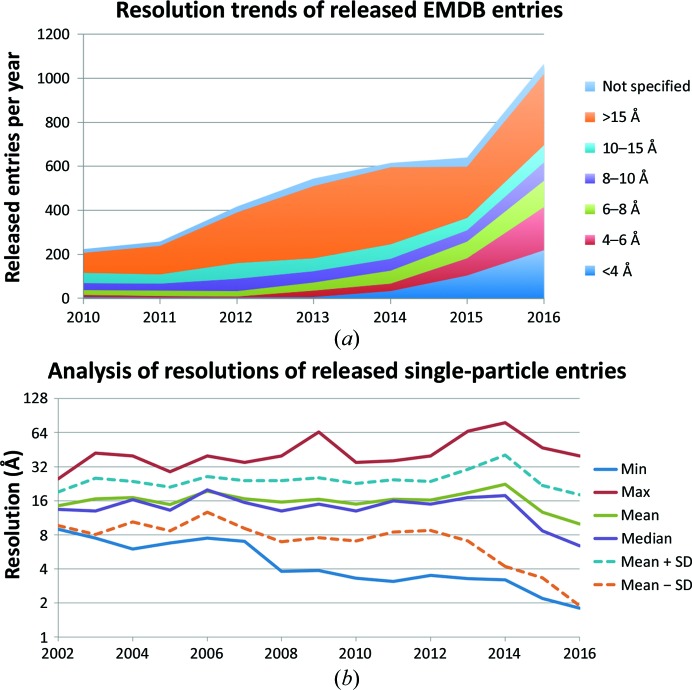
Reported resolutions of EMDB entries. (a) Resolution trends of released EMDB entries. Stacked graph comprised of the number of released entries separated into different resolution bands. (b) Statistical analysis of released EMDB entries from single-particle experiments.
Figure 5
Figure 5
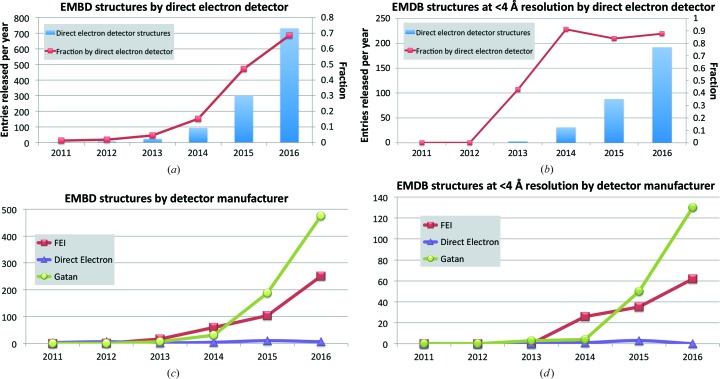
Direct electron-detector usage in EMDB entries. (a) Blue bars represent the number of released EMDB entries obtained using direct electron detectors (y axis on the left-hand side) and the red marked line represents the fraction of the total (y axis on the right-hand side). (b) The same as (a) but for structures at better than 4 Å resolution. (c) Trends for the three major direct electron-detector manufacturers: FEI, Direct Electron and Gatan. (d) The same as (c) but for structures at better than 4 Å resolution.
Figure 6
Figure 6
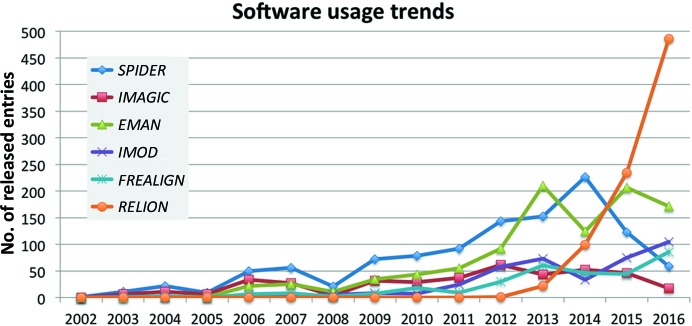
Usage trends for a selection of major EM software packages. It should be noted that the packages are not mutually exclusive and that more than one package may have been used in the same experiment.
Figure 7
Figure 7
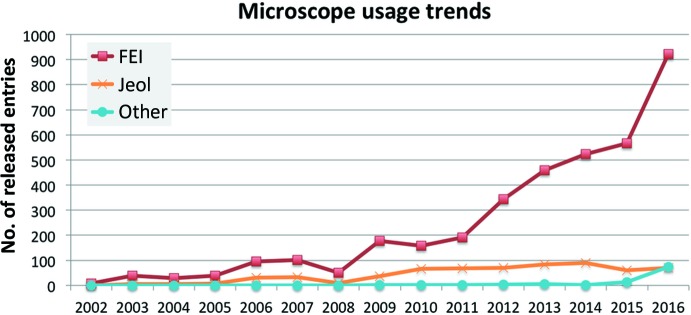
Microscope-usage trends based on microscope manufacturer. It should be noted that a substantial proportion of the ‘Other’ category are in fact FEI microscopes that have been classified incorrectly in the EMDB deposition process. There are entries where more than one microscope has been specified; however, the number of such entries is quite small and less than a handful involve the use of microscopes from different manufacturers.

References

    1. Bai, X.-C., McMullan, G. & Scheres, S. H. W. (2015). Trends Biochem. Sci. 40, 49–57. - PubMed
    1. Danev, R. & Baumeister, W. (2016). Elife, 5, e13046. - PMC - PubMed
    1. Davies, K. M., Strauss, M., Daum, B., Kief, J. H., Osiewacz, H. D., Rycovska, A., Zickermann, V. & Kühlbrandt, W. (2011). Proc. Natl Acad. Sci. USA, 108, 14121–14126. - PMC - PubMed
    1. Eisenstein, E. (2016). Nature Methods, 13, 19–22. - PubMed
    1. Grigorieff, N. (2007). J. Struct. Biol. 157, 117–125. - PubMed