. 2017 Jun 5:8:15707.
doi: 10.1038/ncomms15707.

Synergistic cooperation promotes multicellular performance and unicellular free-rider persistence

Affiliations

Synergistic cooperation promotes multicellular performance and unicellular free-rider persistence

William W Driscoll et al. Nat Commun. .

Abstract

The evolution of multicellular life requires cooperation among cells, which can be undermined by intra-group selection for selfishness. Theory predicts that selection to avoid non-cooperators limits social interactions among non-relatives, yet previous evolution experiments suggest that intra-group conflict is an outcome, rather than a driver, of incipient multicellular life cycles. Here we report the evolution of multicellularity via two distinct mechanisms of group formation in the unicellular budding yeast Kluyveromyces lactis. Cells remain permanently attached following mitosis, giving rise to clonal clusters (staying together); clusters then reversibly assemble into social groups (coming together). Coming together amplifies the benefits of multicellularity and allows social clusters to collectively outperform solitary clusters. However, cooperation among non-relatives also permits fast-growing unicellular lineages to 'free-ride' during selection for increased size. Cooperation and competition for the benefits of multicellularity promote the stable coexistence of unicellular and multicellular genotypes, underscoring the importance of social and ecological context during the transition to multicellularity.


Conflict of interest statement

The authors declare no competing financial interests.

Figures
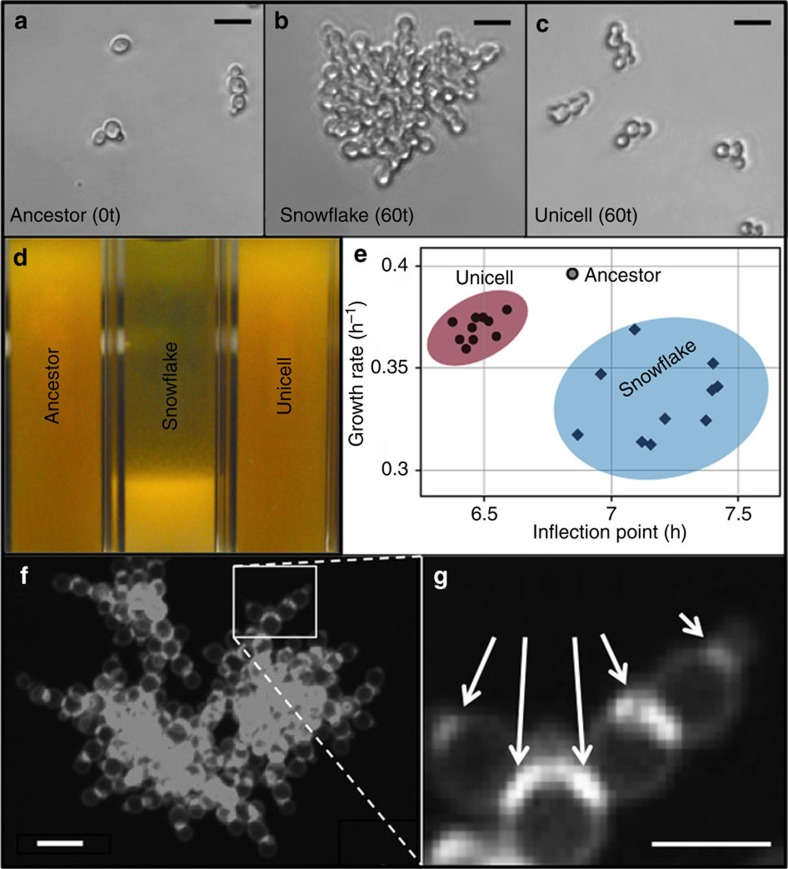
Figure 1
Figure 1. Morphological diversity of evolved K. lactis populations.
(a) Ancestral cells (strain Y-1140) typically occur as dyads or single cells, with occasional clusters of <8 cells. (b) All populations quickly evolved multicellular (‘snowflake') strains, which occur almost exclusively as large clusters (Supplementary Data 1). (c) Derived unicells resemble the ancestral form and were present in all ten populations at the end of the experiment. (d) Visual comparison of settling in 3 ml overnight cultures after 10 m in ancestral, unicellular and snowflake isolates. (e) Growth parameters of ancestral (open circle; n=1), derived snowflake (n=10) and derived unicellular (n=10) lineages. Points show mean parameter values estimated by fitting four parameter Gompertz models to each of four replicate populations per isolate. Both inflection point (t(18.0)=−11.13, P<0.0001 and maximum growth rate are significantly different between derived snowflakes and unicells (t(18.0)=5.72, P<0.0001; Supplementary Data 2); shaded ellipses show 95% CI. (f) Calcofluor white fluorescence of a group of three snowflakes. (g) Cell attachment within snowflakes occurs at bud scars (areas of heightened fluorescence, indicated by white arrows), reflecting continued association of daughter cells following division. All scale bars, 10 μm.
Figure 2
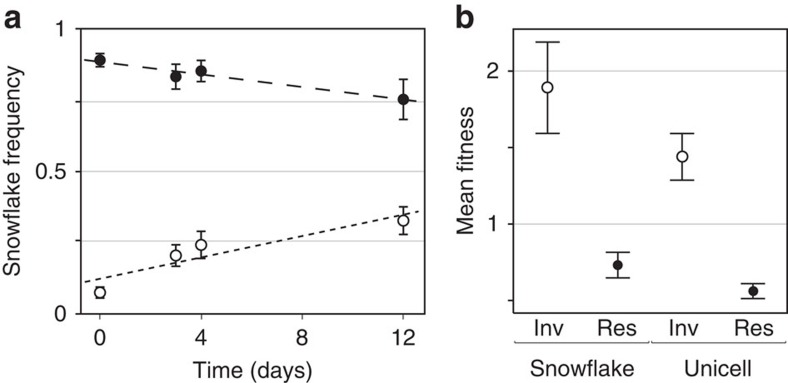
Figure 2. Stable coexistence of evolved unicellular and snowflake isolates.
Invasion from rarity experiments were conducted using pairs of snowflake and unicells isolated from each of the ten evolved populations after 60 transfers. (a) Time series of mean snowflake (SF) frequencies in populations initiated with snowflakes as invaders (open markers; n=10) and residents (closed markers; n=10). Error bars denote 95% CI. It is noteworthy that data represent SF frequencies in two separate treatments. (b) Selection favours invaders across all populations. The fitness of each phenotype is the geometric mean of its relative fitness calculated before and after the final round of settling selection. Markers show the (arithmetic) mean of fitness within both phenotypes as invaders (open markers) and residents (closed markers), and error bars denote the 95% CI. Across all ten populations and two separate mutual invasion experiments, both unicells and snowflakes have significantly higher fitness as invaders than as residents (Tukey's HSD, n=40, P<0.0001; Supplementary Data 3).
Figure 3
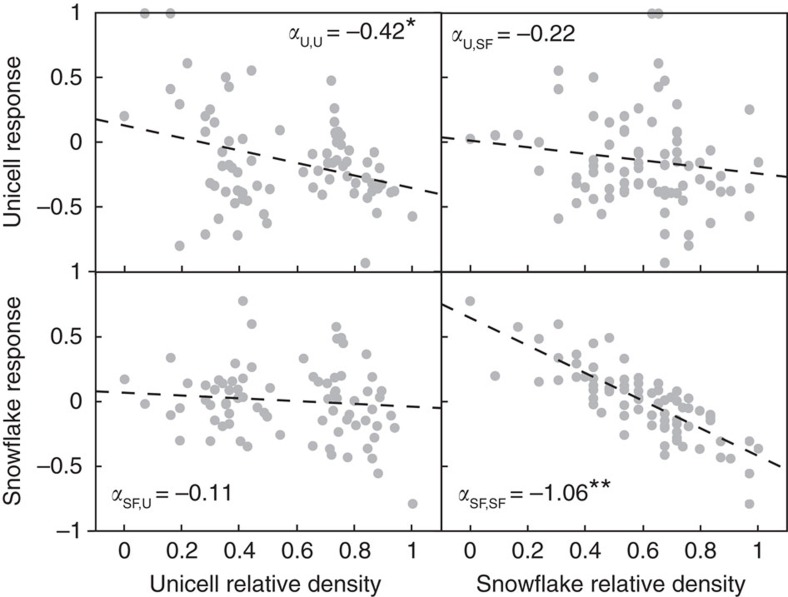
Figure 3. Competition during settling is strongest within phenotypes.
Snowflake (SF) and unicell (U) numerical responses to settling (that is, the log ratio of density after and before settling, m) have been standardized and centered around zero (y axis) and relative density represents the log density (CFU ml−1), scaled from 0 to 1 (x axis). Dashed lines show the prediction from the model response mi=ci+αii Ni+αij Nj, (fit by ordinary least squares) where c is the intercept, α are competition coefficients, i is the focal phenotype, j the opposite phenotype and N is log density of each phenotype before selection. Settling performance declined significantly with increasing abundance of like phenotypes for both unicells (P=0.0038) and snowflakes (P<0.0001), whereas neither cross-phenotype competitive effect was significant (SF effect on unicells: P=0.2, unicell effect on SF: P=0.12; see Supplementary Data 3 for all parameter estimates).
Figure 4
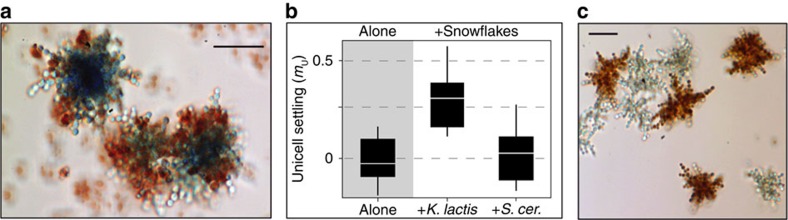
Figure 4. Unicellular K. lactis benefit by associating with multicellular conspecifics.
(a) Unicells (stained red) reversibly adhere to conspecific snowflakes (stained green). (b) Unicells that fail to increase when settling alone mU=−0.01, 95% CI (−0.14, 0.12)) improve settling performance in mixture with conspecific snowflakes (mU=0.30, (0.18, 0.43)). However, this benefit disappears when settling with heterospecific snowflakes (S. cerevisiae) (mU=0.02, (−0.10, 0.15)). The central line is the median, boxes are inter-quartile ranges and whiskers show the range of measured mU values. (c) Multi-snowflake settling aggregates readily form by indiscriminate attachment among non-relatives during settling. (Pictured are oppositely stained, independently evolved snowflake isolates from Y8 (red) and Y9 (blue) populations.). All scale bars, 25 μm.
Figure 5
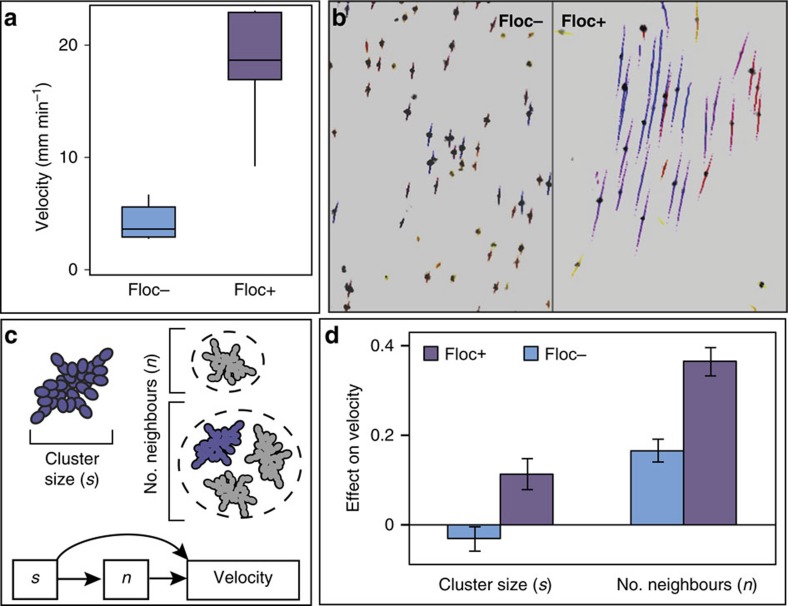
Figure 5. Flocculation increases K. lactis snowflake settling velocity.
(a) Disruption of flocculation (Floc−) reduces average snowflake settling velocity relative to settling without floc disruption (Floc+). Central lines show medians, boxes are inter-quartile ranges, and whiskers show the full range of settling velocities observed under each condition. (b) Images taken from representative settling videos, in which tracks show snowflake position across 20 frames (=1 s). Track colours correspond to relative velocity. It is noteworthy that only ∼ 5% of snowflake clusters are visible, so individual clusters need not be physically touching to belong to the same floc. (c) Path diagram illustrating structural equation model used to estimate the contributions of focal cluster size (diameter) and number of neighbouring clusters (grey) to the settling velocity of a focal cluster (violet). (d) The positive effect of neighbours on settling velocity is reduced when flocculation is disrupted. Shown are mean estimates for the contributions of snowflake cluster diameter and number of neighbouring snowflakes to settling in Floc+ and Floc− conditions; error bars denote 95% CI.
Figure 6
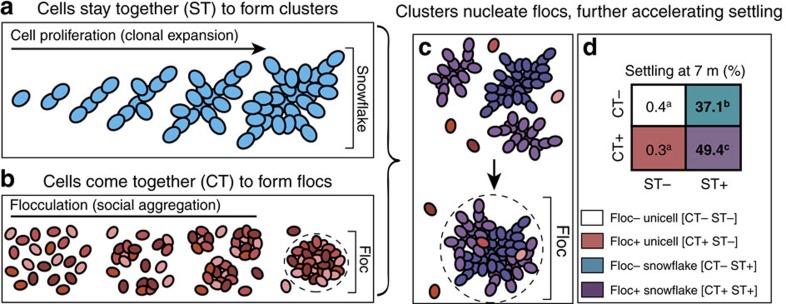
Figure 6. Synergy of different paths to multicellularity in K. lactis.
Blue, red and violet cells indicate non-flocculent snowflakes, flocculent unicells and flocculent snowflakes, respectively, and different shades denote distinct genotypes within each phenotype. (a) Snowflake clusters form by cell proliferation, resulting in discrete groups of permanently attached clonemates. (b) Yeast flocs arise through reversible social aggregation, resulting in social groups that may include different genotypes. (c) Flocculation is accelerated by multicellular clusters, amplifying and extending benefits of cluster formation. The settling velocity of snowflake clusters increases through floc-mediated cooperation with neighbouring snowflakes; however, cooperative settling may also benefit flocculent unicellular free riders. (d) Synergy between cluster and floc formation increases the extent of settling after 7 m in derived K. lactis suspensions. Bold numbers indicate treatments with significant settling (matched pairs t-test, n=3, P<0.05) and letters denote statistically different groups (Tukey's HSD, n=12, P<0.0001) after 7 m. Flocculation significantly increases settling in multicellular populations (P<0.0001), but does not influence settling in unicellular populations over the duration of standard settling selection (P=1).
Figure 7
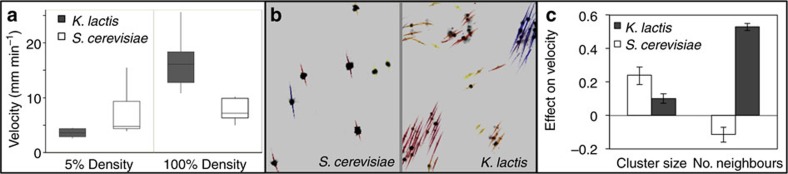
Figure 7. Contrasting interactions among multicellular neighbours in K. lactis and S. cerevisiae.
(a) The settling velocity of K. lactis snowflake clusters increases dramatically in high (100%) compared with low (5%) density conditions (Tukey's HSD: P<0.0001), whereas S. cerevisiae cluster velocity did not significantly differ between density treatments (P=0.305). Central lines show medians, boxes are interquartile ranges and whiskers show the full range of observed settling velocities. (b) Distinct settling behaviours are evident in settling videos, which show solitary S. cerevisiae snowflakes and cohesive groups of K. lactis snowflakes. Images taken from representative high-density settling videos, in which tracks show snowflake position across 20 frames (=1 s) and track colours reflect relative cluster velocity. It is noteworthy that only 5% of clusters are stained, so visible clusters need not appear to touch to be physically associated. (c) Contrasting interactions among neighbouring snowflakes differentiate competitive and cooperative settling. Focal snowflake cluster size is the primary determinant of settling velocity in multicellular S. cerevisiae, whereas neighbouring snowflakes overwhelmingly contribute to rapid settling in K. lactis. Neighbouring clusters actually reduce settling velocity in S. cerevisiae, consistent with local competition among snowflakes via hindered settling. Error bars denote the 95% CI.

References

    1. Maynard Smith J. & Szathmaáry E. The Major Transitions in Evolution Oxford Univ. Press (1995).
    1. Merlo L. M. F., Pepper J. W., Reid B. J. & Maley C. C. Cancer as an evolutionary and ecological process. Nat. Rev. Cancer 6, 924–935 (2006). - PubMed
    1. Leigh E. G. Genes bees and ecosystems: the evolution of a common interest among individuals. Trends Ecol. Evol. 6, 257–262 (1991). - PubMed
    1. Aktipis C. A. et al. Cancer across the tree of life: cooperation and cheating in multicellularity. Philos. Trans. R. Soc. B Biol. Sci. 370, 20140219 (2015). - PMC - PubMed
    1. Frank S. A. Natural selection. VII. History and interpretation of kin selection theory. J. Evol. Biol. 26, 1151–1184 (2013). - PubMed

Publication types

Substances