


Recent advances in nanodisc technology for membrane protein studies (2012-2017)
- PMID: 28581067
- PMCID: PMC5751705
- DOI: 10.1002/1873-3468.12706
Recent advances in nanodisc technology for membrane protein studies (2012-2017)
Abstract
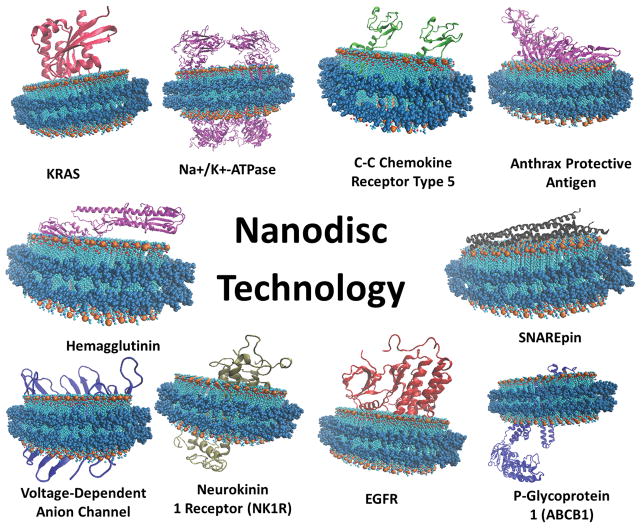
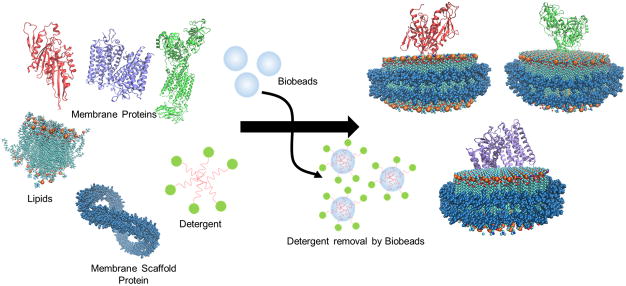
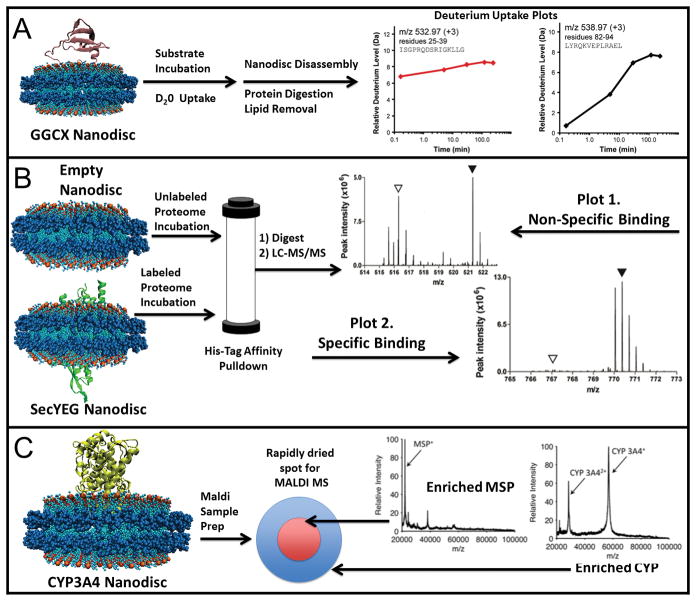
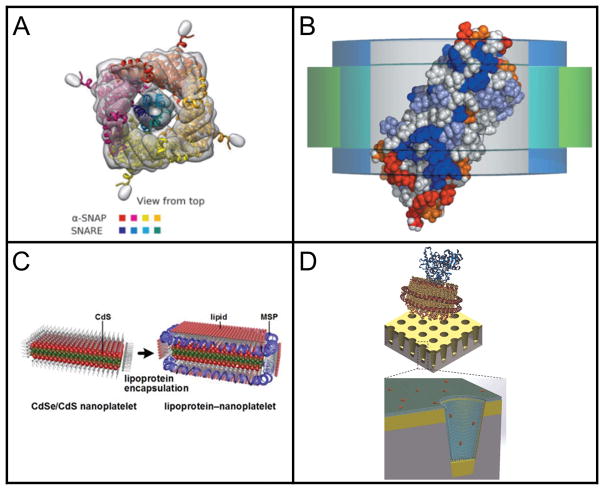
Historically, the main barrier to membrane protein investigations has been the tendency of membrane proteins to aggregate (due to their hydrophobic nature), in aqueous solution as well as on surfaces. The introduction of biomembrane mimetics has since stimulated momentum in the field. One such mimetic, the nanodisc (ND) system, has proved to be an exceptional system for solubilizing membrane proteins. Herein, we critically evaluate the advantages and imperfections of employing nanodiscs in biophysical and biochemical studies. Specifically, we examine the techniques that have been modified to study membrane proteins in nanodiscs. Techniques discussed here include fluorescence microscopy, solution-state/solid-state nuclear magnetic resonance, electron microscopy, small-angle X-ray scattering, and several mass spectroscopy methods. Newer techniques such as SPR, charge-sensitive optical detection, and scintillation proximity assays are also reviewed. Lastly, we cover how nanodiscs are advancing nanotechnology through nanoplasmonic biosensing, lipoprotein-nanoplatelets, and sortase-mediated labeling of nanodiscs.
Keywords: ESI; FRET; MALDI; NMR; SPR; electron microscopy; isotope labeling; lipid bilayer; membrane protein; nanodisc.
© 2017 Federation of European Biochemical Societies.
References
-
- Lee SC, Knowles TJ, Postis VLG, Jamshad M, Parslow RA, Lin YP, Goldman A, Sridhar P, Overduin M, Muench SP, Dafforn TR. A method for detergent-free isolation of membrane proteins in their local lipid environment. Nature protocols. 2016;11:1149–1162. - PubMed
-
- Shenkarev ZO, Lyukmanova EN, Paramonov AS, Panteleev PV, Balandin SV, Shulepko MA, Mineev KS, Ovchinnikova TV, Kirpichnikov MP, Arseniev AS. Lipid-protein nanodiscs offer new perspectives for structural and functional studies of water-soluble membrane-active peptides. Acta Naturae. 2014;6:84–94. - PMC - PubMed
-
- Hein C, Henrich E, Orbán E, Dötsch V, Bernhard F. Hydrophobic supplements in cell-free systems: Designing artificial environments for membrane proteins. Engineering in Life Sciences. 2014;14:365–379.
Publication types
MeSH terms
Substances
Grants and funding
LinkOut - more resources
Full Text Sources
Other Literature Sources
