


QSAR-driven design, synthesis and discovery of potent chalcone derivatives with antitubercular activity
- PMID: 28582669
- PMCID: PMC6031314
- DOI: 10.1016/j.ejmech.2017.05.026
QSAR-driven design, synthesis and discovery of potent chalcone derivatives with antitubercular activity
Abstract
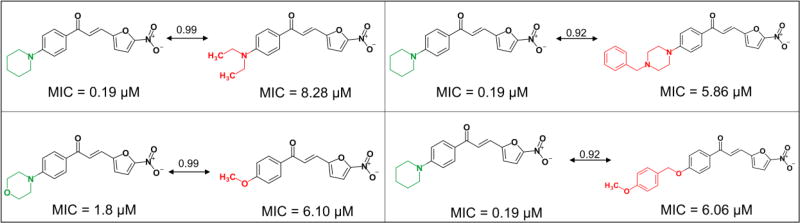
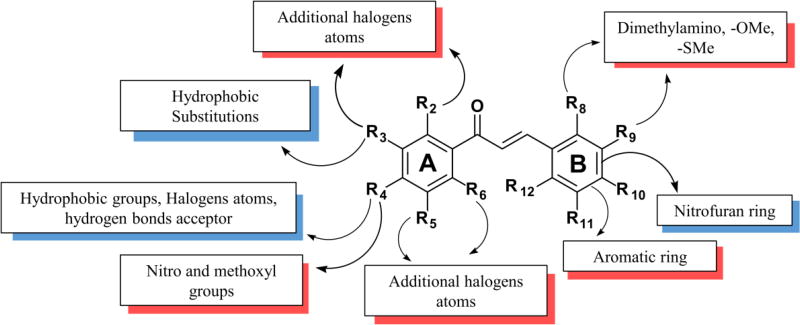
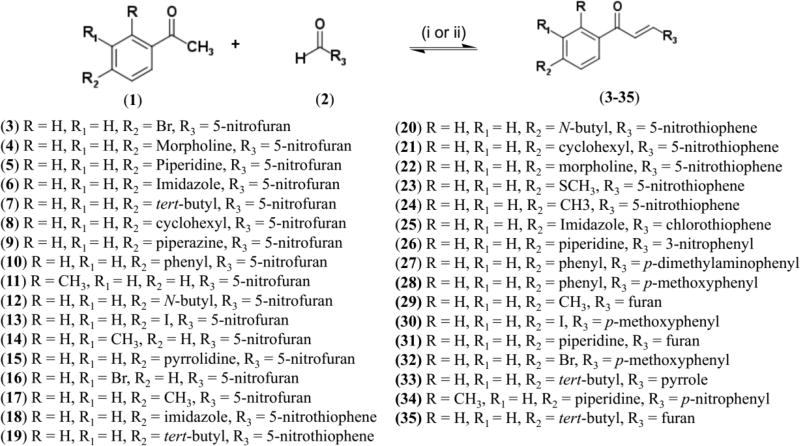
New anti-tuberculosis (anti-TB) drugs are urgently needed to battle drug-resistant Mycobacterium tuberculosis strains and to shorten the current 6-12-month treatment regimen. In this work, we have continued the efforts to develop chalcone-based anti-TB compounds by using an in silico design and QSAR-driven approach. Initially, we developed SAR rules and binary QSAR models using literature data for targeted design of new heteroaryl chalcone compounds with anti-TB activity. Using these models, we prioritized 33 compounds for synthesis and biological evaluation. As a result, 10 heteroaryl chalcone compounds (4, 8, 9, 11, 13, 17-20, and 23) were found to exhibit nanomolar activity against replicating mycobacteria, low micromolar activity against nonreplicating bacteria, and nanomolar and micromolar against rifampin (RMP) and isoniazid (INH) monoresistant strains (rRMP and rINH) (<1 μM and <10 μM, respectively). The series also show low activity against commensal bacteria and generally show good selectivity toward M. tuberculosis, with very low cytotoxicity against Vero cells (SI = 11-545). Our results suggest that our designed heteroaryl chalcone compounds, due to their high potency and selectivity, are promising anti-TB agents.
Keywords: Anti-TB agents; Chalcone; In silico design; Nitroaromatic compounds; QSAR; Tuberculosis.
Copyright © 2017 Elsevier Masson SAS. All rights reserved.
Figures
References
-
- Palmer BD, Sutherland HS, Blaser A, Kmentova I, Franzblau SG, Wan B, Wang Y, Ma Z, Denny Wa, Thompson AM. Synthesis and Structure-Activity Relationships for Extended Side Chain Analogues of the Antitubercular Drug (6 S)-2-Nitro-6-{[4-(trifluoromethoxy)benzyl]oxy}-6,7-dihydro-5 H-imidazo[2,1-b][1,3]oxazine (PA-824) J. Med. Chem. 2015;58:3036–3059. doi: 10.1021/jm501608q. - DOI - PubMed
-
- Martins F, Santos S, Ventura C, Elvas-Leitão R, Santos L, Vitorino S, Reis M, Miranda V, Correia HF, Aires-de-Sousa J, Kovalishyn V, Latino DaRS, Ramos J, Viveiros M. Design, synthesis and biological evaluation of novel isoniazid derivatives with potent antitubercular activity. Eur. J. Med. Chem. 2014;81:119–138. doi: 10.1016/j.ejmech.2014.04.077. - DOI - PubMed
-
- WHO. [accessed October 28, 2015];Global Tuberculosis 2015. 2015 http://www.who.int/tb/publications/global_report/en/
MeSH terms
Substances
Grants and funding
LinkOut - more resources
Full Text Sources
Other Literature Sources
Molecular Biology Databases
Research Materials
Miscellaneous
