


SCN5A Genetic Polymorphisms Associated With Increased Defibrillator Shocks in Brugada Syndrome
- PMID: 28584071
- PMCID: PMC5669154
- DOI: 10.1161/JAHA.116.005009
SCN5A Genetic Polymorphisms Associated With Increased Defibrillator Shocks in Brugada Syndrome
Abstract
Background: Brugada syndrome (BrS) is an inherited primary arrhythmia disorder leading to sudden cardiac arrest. SCN5A, encoding the α-subunit of the cardiac sodium channel (Nav1.5), is the most common pathogenic gene of BrS. An implantable cardioverter defibrillator (ICD) is the standard treatment for secondary prevention. This study aimed to evaluate association of the SCN5A variant with this cardiac conduction disturbance and appropriate ICD shock therapy in Thai symptomatic BrS patients with ICD implants.
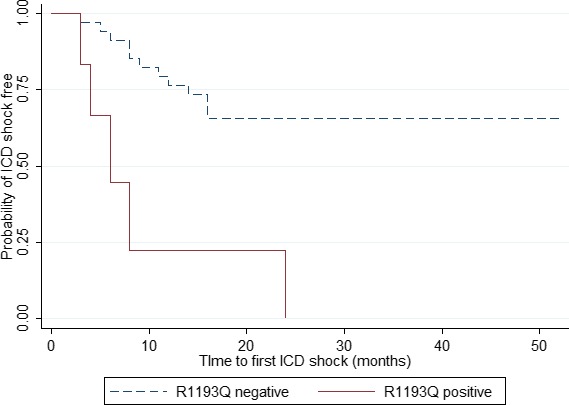
Methods and results: Symptomatic BrS patients diagnosed at university hospital were enrolled from 2008 to 2011. The primary outcome of the study was an appropriate ICD shock defined as having non-pacing-associated ICD shock after the occurrence of ventricular tachycardia or ventricular fibrillation. Associations between SCN5A polymorphisms, cardiac conduction disturbance, and potential confounding factors associated with appropriate ICD shock therapy were analyzed. All 40 symptomatic BrS patients (median age, 43 years) with ICD implantations were followed for 24 months. There were 16 patients (40%) who had the appropriate ICD shock therapy after ICD treatment. An independent factor associated with appropriate ICD shock therapy was SCN5A-R1193Q with an adjusted hazard ratio of 10.550 (95% CI, 1.631-68.232).
Conclusions: SCN5A-R1193Q is associated with cardiac conduction disturbances. It may be a genetic marker associated with ventricular arrhythmia leading to appropriate ICD shock therapy in symptomatic BrS patients with ICD treatment. Because of the small sample size of study population and the appropriate ICD shock outcome, further large studies are needed to confirm the results of this study.
Keywords: Brugada syndrome; SCN5A R1193Q; appropriate implantable cardioverter defibrillator shock therapy; genetics; implantable cardioverter defibrillator.
© 2017 The Authors. Published on behalf of the American Heart Association, Inc., by Wiley.
Figures
References
-
- Priori SG, Wilde AA, Horie M, Cho Y, Behr ER, Berul C, Blom N, Brugada J, Chiang CE, Huikuri H, Kannankeril P, Krahn A, Leenhardt A, Moss A, Schwartz PJ, Shimizu W, Tomaselli G, Tracy C. HRS/EHRA/APHRS expert consensus statement on the diagnosis and management of patients with inherited primary arrhythmia syndromes: document endorsed by HRS, EHRA, and APHRS in May 2013 and by ACCF, AHA, PACES, and AEPC in June 2013. Heart Rhythm. 2013;10:1932–1963. - PubMed
-
- Berne P, Brugada J. Brugada syndrome 2012. Circ J. 2012;76:1563–1571. - PubMed
-
- Nademanee K, Veerakul G, Nimmannit S, Chaowakul V, Bhuripanyo K, Likittanasombat K, Tunsanga K, Kuasirikul S, Malasit P, Tansupasawadikul S, Tatsanavivat P. Arrhythmogenic marker for the sudden unexplained death syndrome in Thai men. Circulation. 1997;96:2595–2600. - PubMed
-
- Tatsanavivat P, Chirawatkul A, Klungboonkrong V, Chaisiri S, Jarerntanyaruk L, Munger RG, Saowakontha S. Sudden and unexplained deaths in sleep (Lai Tai) of young men in rural northeastern Thailand. Int J Epidemiol. 1992;21:904–910. - PubMed
-
- Brugada J, Brugada R, Brugada P. Pharmacological and device approach to therapy of inherited cardiac disease associated with cardiac arrhythmias and sudden death. J Electrocardiol. 2000;33:41–47. - PubMed
MeSH terms
Substances
LinkOut - more resources
Full Text Sources
Other Literature Sources
Medical
Miscellaneous
