


Gene regulatory networks and cell lineages that underlie the formation of skeletal muscle
- PMID: 28584083
- PMCID: PMC5468682
- DOI: 10.1073/pnas.1610605114
Gene regulatory networks and cell lineages that underlie the formation of skeletal muscle
Abstract
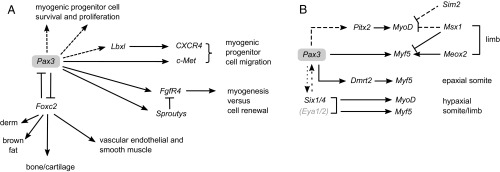
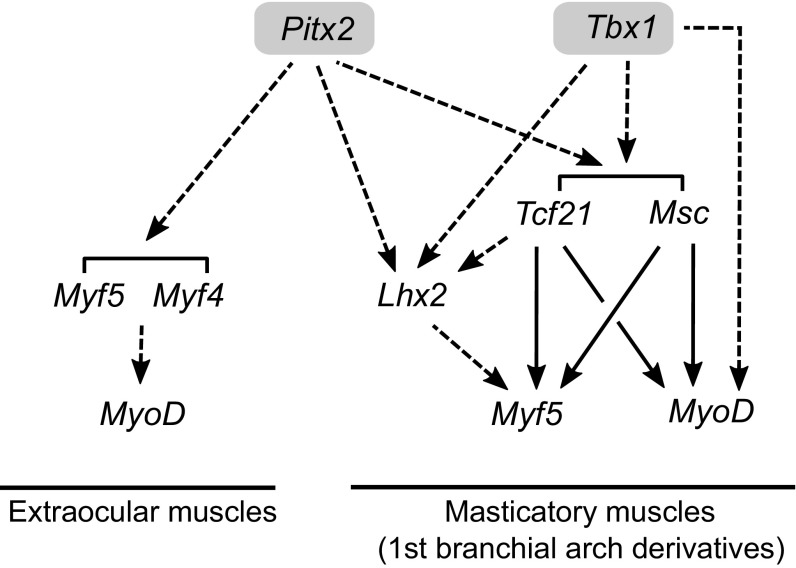
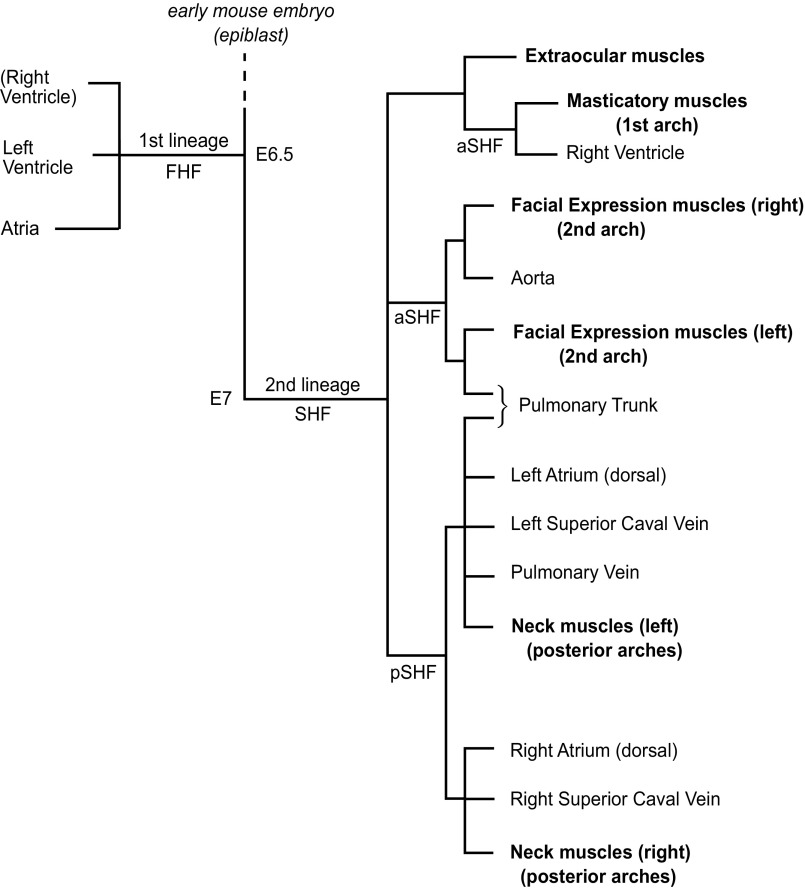
Skeletal muscle in vertebrates is formed by two major routes, as illustrated by the mouse embryo. Somites give rise to myogenic progenitors that form all of the muscles of the trunk and limbs. The behavior of these cells and their entry into the myogenic program is controlled by gene regulatory networks, where paired box gene 3 (Pax3) plays a predominant role. Head and some neck muscles do not derive from somites, but mainly form from mesoderm in the pharyngeal region. Entry into the myogenic program also depends on the myogenic determination factor (MyoD) family of genes, but Pax3 is not expressed in these myogenic progenitors, where different gene regulatory networks function, with T-box factor 1 (Tbx1) and paired-like homeodomain factor 2 (Pitx2) as key upstream genes. The regulatory genes that underlie the formation of these muscles are also important players in cardiogenesis, expressed in the second heart field, which is a major source of myocardium and of the pharyngeal arch mesoderm that gives rise to skeletal muscles. The demonstration that both types of striated muscle derive from common progenitors comes from clonal analyses that have established a lineage tree for parts of the myocardium and different head and neck muscles. Evolutionary conservation of the two routes to skeletal muscle in vertebrates extends to chordates, to trunk muscles in the cephlochordate Amphioxus and to muscles derived from cardiopharyngeal mesoderm in the urochordate Ciona, where a related gene regulatory network determines cardiac or skeletal muscle cell fates. In conclusion, Eric Davidson's visionary contribution to our understanding of gene regulatory networks and their evolution is acknowledged.
Keywords: cell lineages; gene regulatory networks; muscle origins; second heart field; skeletal myogenesis.
Conflict of interest statement
The author declares no conflict of interest.
Figures
References
-
- Buckingham M, Vincent SD. Distinct and dynamic myogenic populations in the vertebrate embryo. Curr Opin Genet Dev. 2009;19(5):444–453. - PubMed
-
- Buckingham M, Rigby PWJ. Gene regulatory networks and transcriptional mechanisms that control myogenesis. Dev Cell. 2014;28(3):225–238. - PubMed
-
- Buckingham M, Relaix F. PAX3 and PAX7 as upstream regulators of myogenesis. Semin Cell Dev Biol. 2015;44:115–125. - PubMed
-
- Lagha M, et al. Pax3:Foxc2 reciprocal repression in the somite modulates muscular versus vascular cell fate choice in multipotent progenitors. Dev Cell. 2009;17(6):892–899. - PubMed
Publication types
MeSH terms
LinkOut - more resources
Full Text Sources
Other Literature Sources
