. 2017 Jun 20;114(25):6629-6634.
doi: 10.1073/pnas.1704745114. Epub 2017 Jun 5.

Temperature variability is integrated by a spatially embedded decision-making center to break dormancy in Arabidopsis seeds

Affiliations

Temperature variability is integrated by a spatially embedded decision-making center to break dormancy in Arabidopsis seeds

Alexander T Topham et al. Proc Natl Acad Sci U S A. .

Abstract

Plants perceive and integrate information from the environment to time critical transitions in their life cycle. Some mechanisms underlying this quantitative signal processing have been described, whereas others await discovery. Seeds have evolved a mechanism to integrate environmental information by regulating the abundance of the antagonistically acting hormones abscisic acid (ABA) and gibberellin (GA). Here, we show that hormone metabolic interactions and their feedbacks are sufficient to create a bistable developmental fate switch in Arabidopsis seeds. A digital single-cell atlas mapping the distribution of hormone metabolic and response components revealed their enrichment within the embryonic radicle, identifying the presence of a decision-making center within dormant seeds. The responses to both GA and ABA were found to occur within distinct cell types, suggesting cross-talk occurs at the level of hormone transport between these signaling centers. We describe theoretically, and demonstrate experimentally, that this spatial separation within the decision-making center is required to process variable temperature inputs from the environment to promote the breaking of dormancy. In contrast to other noise-filtering systems, including human neurons, the functional role of this spatial embedding is to leverage variability in temperature to transduce a fate-switching signal within this biological system. Fluctuating inputs therefore act as an instructive signal for seeds, enhancing the accuracy with which plants are established in ecosystems, and distributed computation within the radicle underlies this signal integration mechanism.

Keywords: distributed control; dormancy; seed; signal integration; variability.


Conflict of interest statement

The authors declare no conflict of interest.

Figures
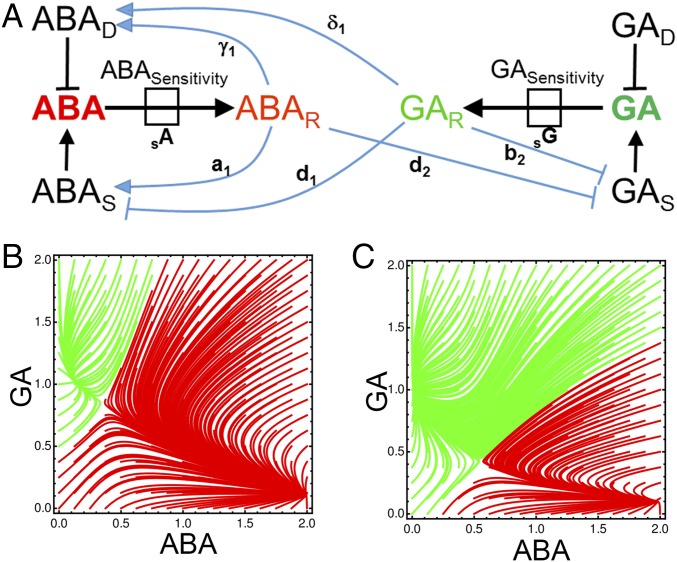
Fig. 1.
Fig. 1.
Mathematical model of hormone metabolic interactions underlying fate switching in Arabidopsis seeds. (A) Schematic outlining the relationships between the components of the hormone metabolic model. The hormone ABA is shown in red and bold, and the hormone GA is shown in green and bold. The response to each of these hormones, each comprising expression of several genes, is denoted by the subscript R (ABAR and GAR). The degradation of each hormone is indicated by the subscript D (ABAD and GAD), synthesis is indicated by the subscript S (ABAS and GAS), and sensitivity is written in full (ABASensitivity and GASensitivity). The directions of the arrows in the model are defined using microarray data describing ABA and GA application to Arabidopsis seeds (17, 47) and the associated gene expression changes for components representing each component (SI Appendix, Supplementary Fig. 1). GA degrading gene expression (GA 2-oxidase) was not detected at significant levels in germinating or dormant seeds. Attractor basins describing the dynamics of metabolic poise under a dynamic model parameterized by observations for deeply dormant seeds (B) and less dormant seeds (C) are shown. Axes indicate ABA and GA hormone abundance, and trajectories give the dynamics of the system starting from a given point and converging on one of two stable states.
Fig. 2.
Fig. 2.
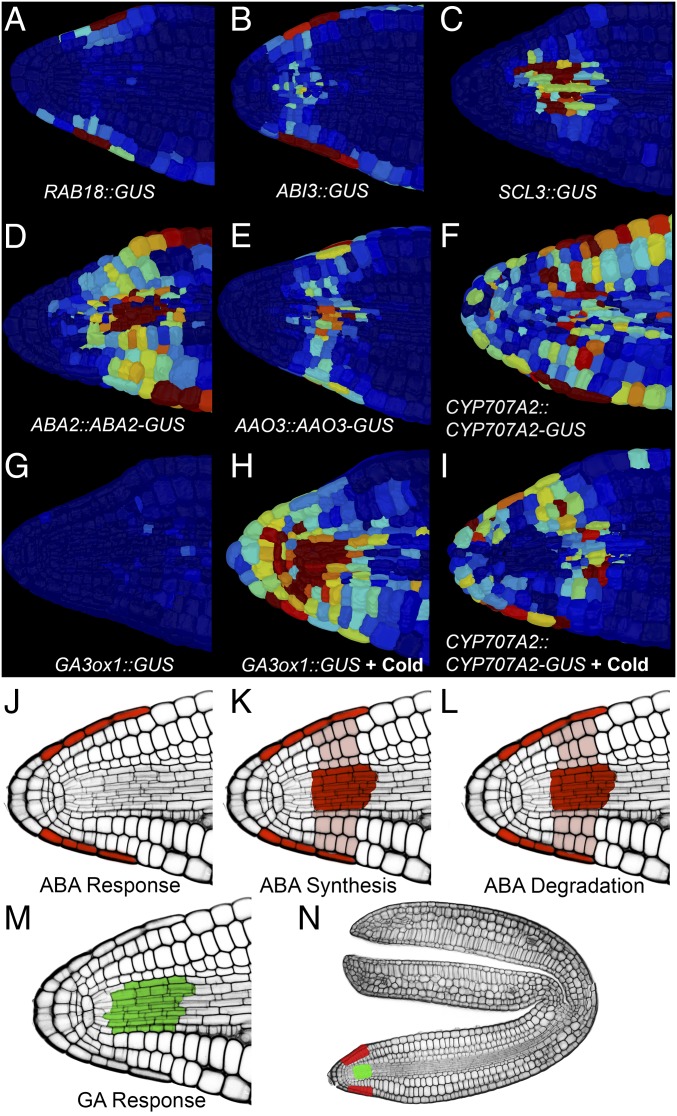
Cellular basis for developmental fate switching in primary dormant Arabidopsis seeds. The single-cell distribution of the ABA-responsive RAB18 promoter (A), the promoter of the ABA response-promoting transcription factor ABI3 (B), the GA-response proxy SCL3 promoter (C), the ABA synthesis proteins ABA2 (D) and AAO3 (E), the ABA degrading protein CYP707A2 (F), and the promoter activity of the GA synthesis enzyme GA3ox1 (G) in primary dormant embryos are shown. (H) GA3ox1 promoter activity following 1 d at 4 °C. (I) Same as H for CYP707A2 protein abundance. Schematics indicating ABA response (J), ABA synthesis (K), ABA degradation (L), and GA response (M) in the Arabidopsis radicle are shown. (N) Whole-embryo highlighting of the subset of cells enriched for ABA response (red) and GA response (green).
Fig. 3.
Fig. 3.
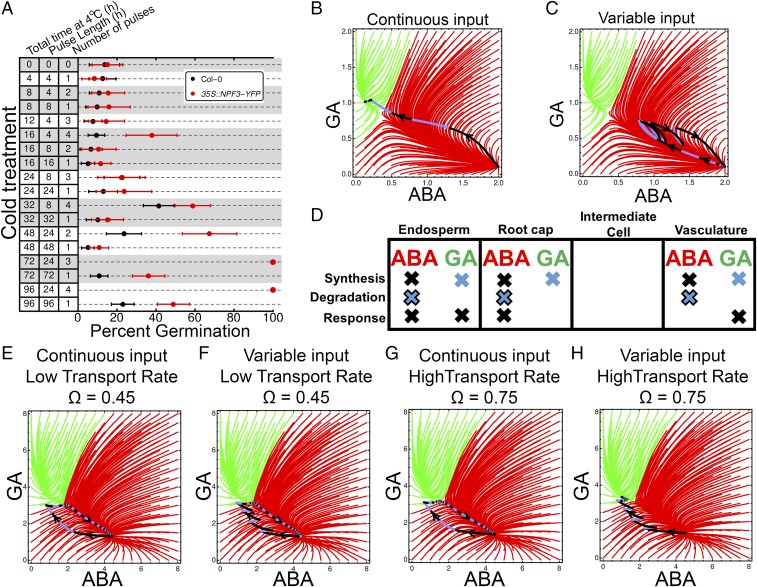
Influence of interrupted cold treatment on developmental fate switching in dormant Arabidopsis seeds. (A) Percentage germination of wild-type Col-0 and 35S::NPF3-YFP seeds with continuous or interrupted cold (4 °C) for varying lengths of time, each counted 16 d after the start of the experiment. Single-region models with continuous virtual cold input (B) and interrupted cold input (C) are shown. (D) Schematic depicting the modeled distribution of metabolic components across the four-region model, motivated by our results on spatial localization of these components. Dark crosses indicate constitutively present components, pure blue crosses indicate components induced in response to cold (GA synthesis), and blue crosses with a dark outline represent constitutively present ABA degradation that is further induced in response to the cold (18). Dynamic behavior of the four-region model with continuous input and a low hormone transport rate (0.45) (E), variable input with a low hormone transport rate (F), continuous input and a high hormone transport rate (0.75) (G), and variable input and a high hormone transport rate (H) is illustrated. For the same total cold exposure, only a varying environment (sensed by communicating, separate compartments) breaks dormancy. Intervals of temperature treatment time in B, C, and EH are indicated by different colors on the line drawn on the attractor basin, which depicts the trajectory of the system, alternating between black and blue, with each representing a single unit of time. Each continuous temperature and alternating temperature time unit is indicated using this same color scheme. Error bars in A indicate the 95% confidence interval.

References

    1. Domagalska MA, Leyser O. Signal integration in the control of shoot branching. Nat Rev Mol Cell Biol. 2011;12:211–221. - PubMed
    1. Angel A, Song J, Dean C, Howard M. A Polycomb-based switch underlying quantitative epigenetic memory. Nature. 2011;476:105–108. - PubMed
    1. Boss PK, Bastow RM, Mylne JS, Dean C. Multiple pathways in the decision to flower: Enabling, promoting, and resetting. Plant Cell. 2004;16(Suppl):S18–S31. - PMC - PubMed
    1. Finch-Savage WE, Leubner-Metzger G. Seed dormancy and the control of germination. New Phytol. 2006;171:501–523. - PubMed
    1. Finch-Savage WE, Bassel GW. Seed vigour and crop establishment: Extending performance beyond adaptation. J Exp Bot. 2016;67:567–591. - PubMed

Publication types

MeSH terms