


Effect of soy isoflavones supplement on climacteric symptoms, bone biomarkers, and quality of life in Korean postmenopausal women: a randomized clinical trial
- PMID: 28584579
- PMCID: PMC5449379
- DOI: 10.4162/nrp.2017.11.3.223
Effect of soy isoflavones supplement on climacteric symptoms, bone biomarkers, and quality of life in Korean postmenopausal women: a randomized clinical trial
Abstract
Background/objectives: Soy isoflavones are expected to improve menopausal symptoms and osteoporosis in women. However, their efficacy is still inconclusive, and there was limited data for postmenopausal women in South Korea. We examined the effects of soy isoflavones on climacteric symptoms, bone biomarkers, and quality of life in Korean postmenopausal women.
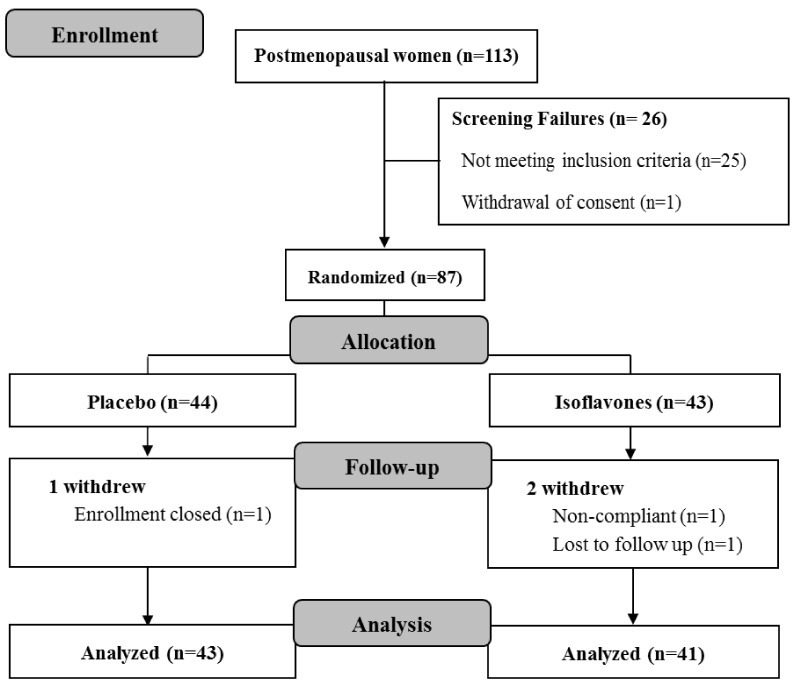
Subjects/methods: A randomized, double-blind study design was used. Eighty-seven participants who had undergone natural menopause were randomly administered either 70 mg/day isoflavones (n = 43) or placebo (n = 41) for 12 weeks. We assessed the Kupperman index for climacteric symptoms and the menopause-specific quality of life (MENQOL) questionnaire for quality of the life. Biomarkers of bone metabolism were also measured in serum bone-specific alkaline phosphatase (BALP), osteocalcin (OC), N- and C-terminal cross-linking telopeptides of type I collagen (NTx, CTx), and urine-deoxypyridinolin (u-DPD).
Results: Scores of the Kupperman index were decreased in both the isoflavones group (-7.0 ± 15.8, P = 0.0074) and placebo group (-6.3 ± 14.6, P = 0.0064) during the intervention, but no significant difference was noted between the groups. Regarding the bone formation markers, the level of serum BALP increased by 6.3 ± 4.1% (P = 0.004) and OC increased by 9.3 ± 6.2% (P < 0.001), meanwhile those of the placebo were not changed. For the bone resorption markers, NTx, CTx, and u-DPD were not significantly different in either group. MENQOL was significant decreased in the isoflavone group (-0.6 ± 0.5) and placebo group (-0.6 ± 0.4), with a significant difference between groups (P = 0.0228).
Conclusions: Our study suggests that 70 mg isoflavones supplement has beneficial effects on bone formation markers; however, it showed no benefit compared to the placebo on climacteric symptoms or quality of life.
Keywords: Isoflavones; bone; climacteric; postmenopause; quality of life.
Conflict of interest statement
CONFLICTS OF INTEREST: The authors declare no potential conflict of interests.
Figures
References
-
- Han KK, Soares JM, Jr, Haidar MA, de Lima GR, Baracat EC. Benefits of soy isoflavone therapeutic regimen on menopausal symptoms. Obstet Gynecol. 2002;99:389–394. - PubMed
-
- Nahas EA, Nahas-Neto J, Orsatti FL, Carvalho EP, Oliveira ML, Dias R. Efficacy and safety of a soy isoflavone extract in postmenopausal women: a randomized, double-blind, and placebo-controlled study. Maturitas. 2007;58:249–258. - PubMed
-
- Ferrari A. Soy extract phytoestrogens with high dose of isoflavones for menopausal symptoms. J Obstet Gynaecol Res. 2009;35:1083–1090. - PubMed
-
- Albertazzi P, Steel SA, Bottazzi M. Effect of pure genistein on bone markers and hot flushes. Climacteric. 2005;8:371–379. - PubMed
-
- Cancellieri F, De Leo V, Genazzani AD, Nappi C, Parenti GL, Polatti F, Ragni N, Savoca S, Teglio L, Finelli F, Nichelatti M. Efficacy on menopausal neurovegetative symptoms and some plasma lipids blood levels of an herbal product containing isoflavones and other plant extracts. Maturitas. 2007;56:249–256. - PubMed
LinkOut - more resources
Full Text Sources
Other Literature Sources
