


Prevalence, incidence and correlates of HSV-2 infection in an HIV incidence adolescent and adult cohort study in western Kenya
- PMID: 28586396
- PMCID: PMC5460811
- DOI: 10.1371/journal.pone.0178907
Prevalence, incidence and correlates of HSV-2 infection in an HIV incidence adolescent and adult cohort study in western Kenya
Abstract
Background: Herpes simplex virus type 2 (HSV-2) infections are associated with increased risk of HIV transmission. We determined HSV-2 prevalence, incidence and associated risk factors, incidence among persons with indeterminate results, and prevalence of HSV-2/HIV co-infection among young adults (18-34 years) and adolescents (16-17 years) enrolled in an HIV incidence cohort study in western Kenya.
Methods: Participants (n = 1106; 846 adults) were screened and those HIV-1 negative were enrolled and followed-up quarterly for one year. HSV-2 was assessed using the Kalon enzyme immunoassay. HSV-2 incidence was calculated separately among HSV-2 seronegative participants and those indeterminate at baseline. Logistic regression was used to estimate the odds of HSV-2 infection and Poisson regression was used to assess HSV-2 incidence and associated factors.
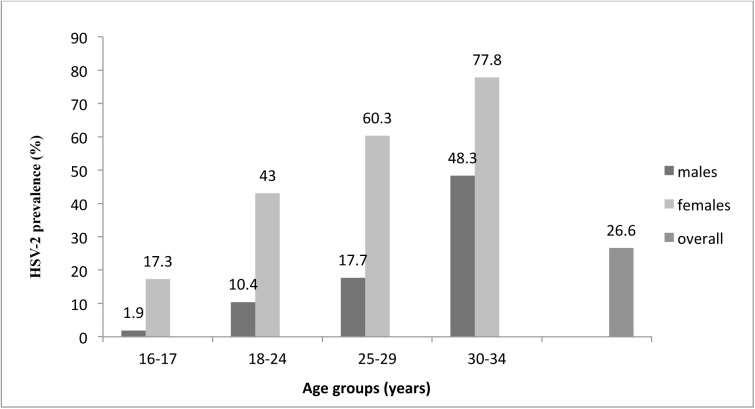
Results: Overall, HSV-2 prevalence was 26.6% [95% confidence interval (CI): 23.9-29.4] and was higher in adults (31.5% [95% CI: 28.3-34.9]) than adolescents (10.7% [95% CI: 7.1-15.3]). Factors associated with prevalent HSV-2 included female gender, increasing age, HIV infection, history of sexually transmitted infection, low level of education, multiple sexual partners, and being married, divorced, separated or widowed. Overall HSV-2 incidence was 4.0 per 100 person-years (/100PY) 95% CI: 2.7-6.1 and was higher in adults (4.5/100PY) and females (5.1/100PY). In multivariable analysis only marital status was associated with HSV-2 incidence. Among 45 participants with indeterminate HSV-2 results at baseline, 22 seroconverted, resulting in an incidence rate of 53.2 /100PY [95% CI: 35.1-80.9]. Inclusion of indeterminate results almost doubled the overall incidence rate to 7.8 /100 PY [95% CI: 5.9-10.5]. Prevalence of HIV/HSV-2 co-infection was higher in female adults than female adolescents (17.1 [95% CI: 13.6-21.0] versus 3.4 [95% CI: 1.1-7.8]).
Conclusion: The high incidence rate among persons with indeterminate results underscores the public health concerns for HSV-2 spread and underreporting of the HSV-2 burden. Careful consideration is needed when interpreting HSV-2 serology results in these settings.
Conflict of interest statement
Figures
References
-
- Paz-Bailey G, Ramaswamy M, Hawkes SJ, Geretti AM. Herpes simplex virus type 2: epidemiology and management options in developing countries. Sex Transm Infect. 2007; 83(1):16–22. doi: 10.1136/sti.2006.020966 - DOI - PMC - PubMed
-
- WHO. World Health Organization. Herpes simplex virus type 2 programmatic and research priorities in developing countries. 2001
-
- Kaiser R, Bunnell R, Hightower A, Kim AA, Cherutich P, Mwangi M, et al. Factors associated with HIV infection in married or cohabitating couples in Kenya: results from a nationally representative study. PLoS One. 2011. 6: e17842 doi: 10.1371/journal.pone.0017842 - DOI - PMC - PubMed
-
- Wald A, Link K. Risk of human immunodeficiency virus infection in herpes simplex virus type 2-seropositive persons: a meta-analysis. J Infect Dis. 2002; 185: 45–52. doi: 10.1086/338231 - DOI - PubMed
MeSH terms
LinkOut - more resources
Full Text Sources
Other Literature Sources
Medical
