. 2017 Jun 3;18(6):1189.
doi: 10.3390/ijms18061189.

Stability of BDNF in Human Samples Stored Up to 6 Months and Correlations of Serum and EDTA-Plasma Concentrations

Affiliations

Stability of BDNF in Human Samples Stored Up to 6 Months and Correlations of Serum and EDTA-Plasma Concentrations

Maryna Polyakova et al. Int J Mol Sci. .

Abstract

Brain-derived neurotrophic factor (BDNF), an important neural growth factor, has gained growing interest in neuroscience, but many influencing physiological and analytical aspects still remain unclear. In this study we assessed the impact of storage time at room temperature, repeated freeze/thaw cycles, and storage at -80 °C up to 6 months on serum and ethylenediaminetetraacetic acid (EDTA)-plasma BDNF. Furthermore, we assessed correlations of serum and plasma BDNF concentrations in two independent sets of samples. Coefficients of variations (CVs) for serum BDNF concentrations were significantly lower than CVs of plasma concentrations (n = 245, p = 0.006). Mean serum and plasma concentrations at all analyzed time points remained within the acceptable change limit of the inter-assay precision as declared by the manufacturer. Serum and plasma BDNF concentrations correlated positively in both sets of samples and at all analyzed time points of the stability assessment (r = 0.455 to rs = 0.596; p < 0.004). In summary, when considering the acceptable change limit, BDNF was stable in serum and in EDTA-plasma up to 6 months. Due to a higher reliability, we suggest favoring serum over EDTA-plasma for future experiments assessing peripheral BDNF concentrations.

Keywords: BDNF; EDTA-plasma; acceptable change limit; brain-derived neurotrophic factor; inter-assay precision; serum; stability.


Conflict of interest statement

The authors declare no conflict of interest.

Figures
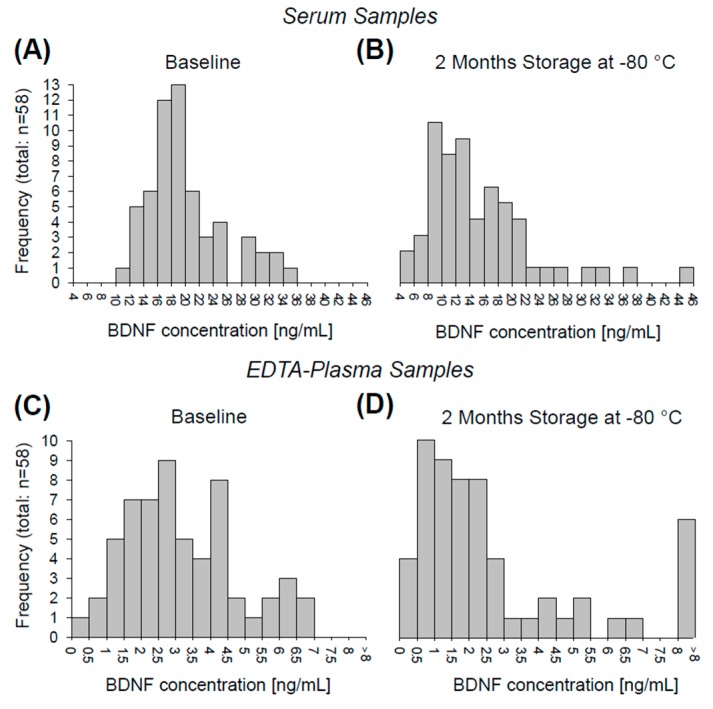
Figure A1
Figure A1
Histograms for BDNF concentrations in serum and EDTA-plasma at “Baseline” (T1) (A,C) and “2 months storage at −80 °C” (T4) (B,D). BDNF: brain-derived neurotrophic factor, EDTA: ethylenediaminetetraacetic acid.
Figure A2
Figure A2
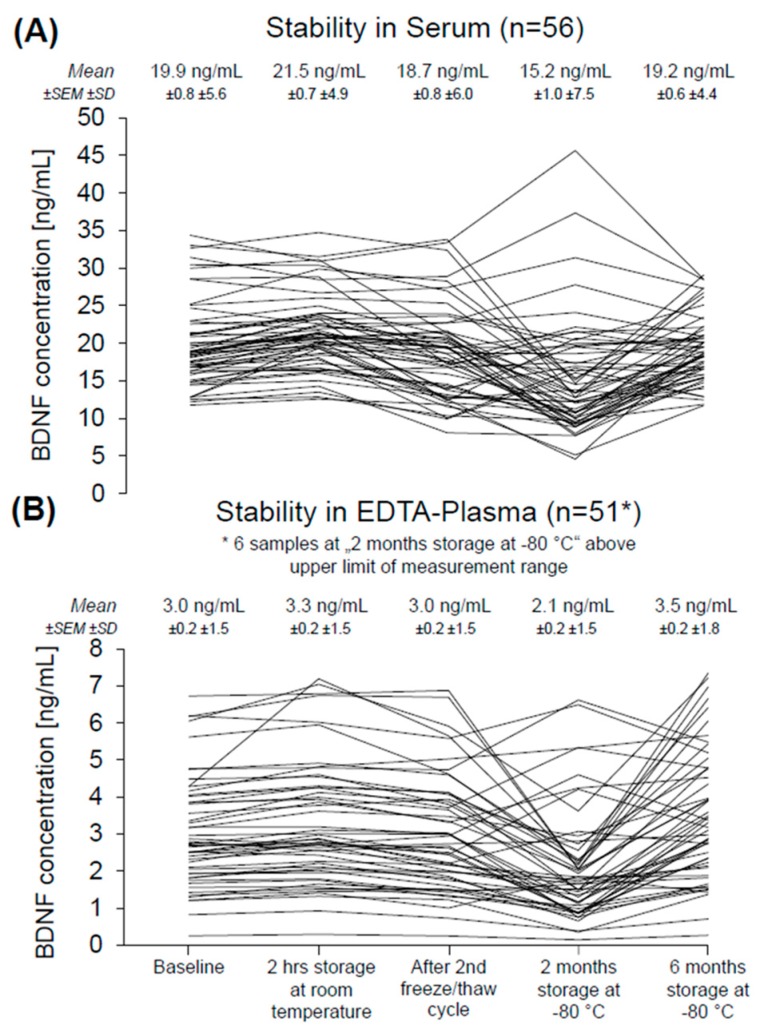
Individual changes in serum (A) and EDTA-plasma (B) BDNF from “Baseline” (T1) to “6 months storage at −80 °C” (T5). BDNF: brain-derived neurotrophic factor, EDTA: ethylenediaminetetraacetic acid, hrs: hours.
Figure A3
Figure A3
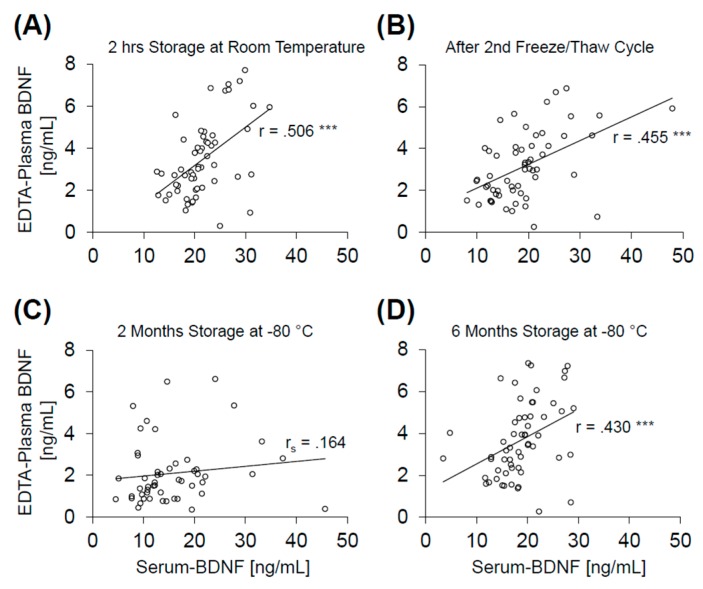
Correlations of serum and EDTA-plasma BDNF concentrations for time points (A) “2 hrs storage at room temperature” (T2), (B) “After 2nd freeze/thaw cycle” (T3), (C) “2 months storage at −80 °C” (T4), (D) “6 months storage at −80 °C” (T5). BDNF: brain-derived neurotrophic factor, EDTA: ethylenediaminetetraacetic acid, hrs: hours.
Figure 1
Figure 1
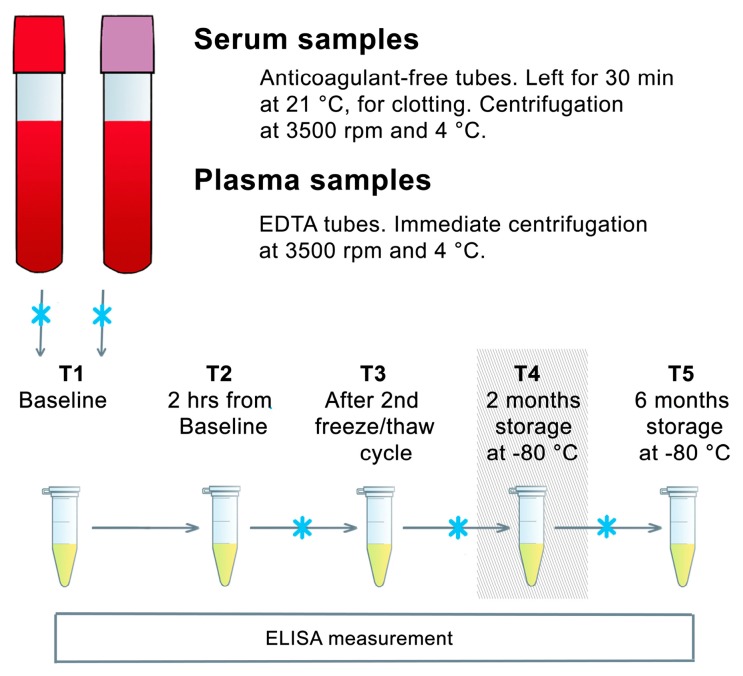
Schematic design of the stability study. T1 to T5 represent time points for BDNF measurements. Blue crosses signify freezing at −80 °C. The grey box at T4 indicates the time point which was excluded from the analysis due to a measurement error. BDNF: brain-derived neurotrophic factor, EDTA: ethylenediaminetetraacetic acid, ELISA: enzyme-linked immunosorbent assay, hrs: hours, min: minutes, rpm: rounds per minute, T: time point.
Figure 2
Figure 2
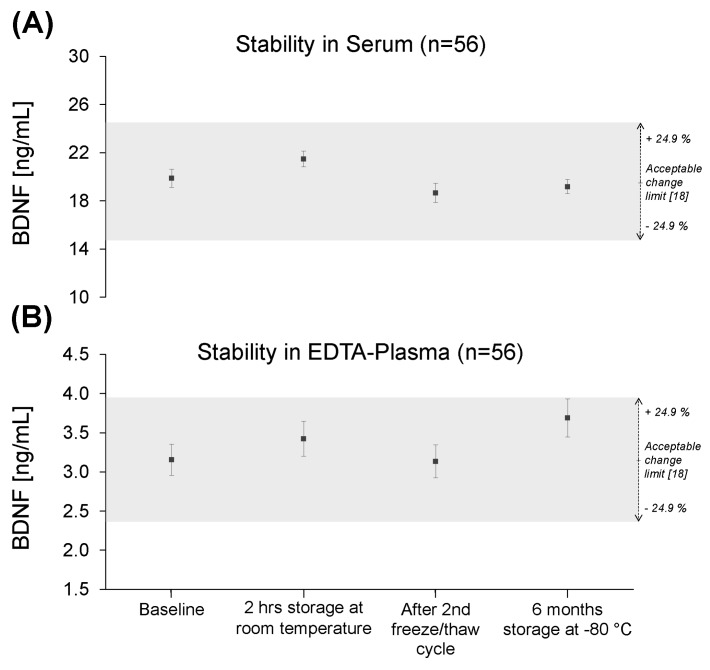
BDNF concentrations at “Baseline” (T1), “2 hrs storage at room temperature” (T2), “After 2nd freeze/thaw cycle” (T3), and “6 months storage at −80 °C” (T5). (A) Serum samples, (B) EDTA-plasma samples. Grey box: 24.9% acceptable change limit as calculated with the inter-assay precision declared by the manufacturer of the BDNF ELISA kit [20]. All error bars are SEM. BDNF: brain-derived neurotrophic factor, EDTA: ethylenediaminetetraacetic acid, ELISA: enzyme-linked immunosorbent assay, hrs: hours, SEM: standard error of the mean.
Figure 3
Figure 3
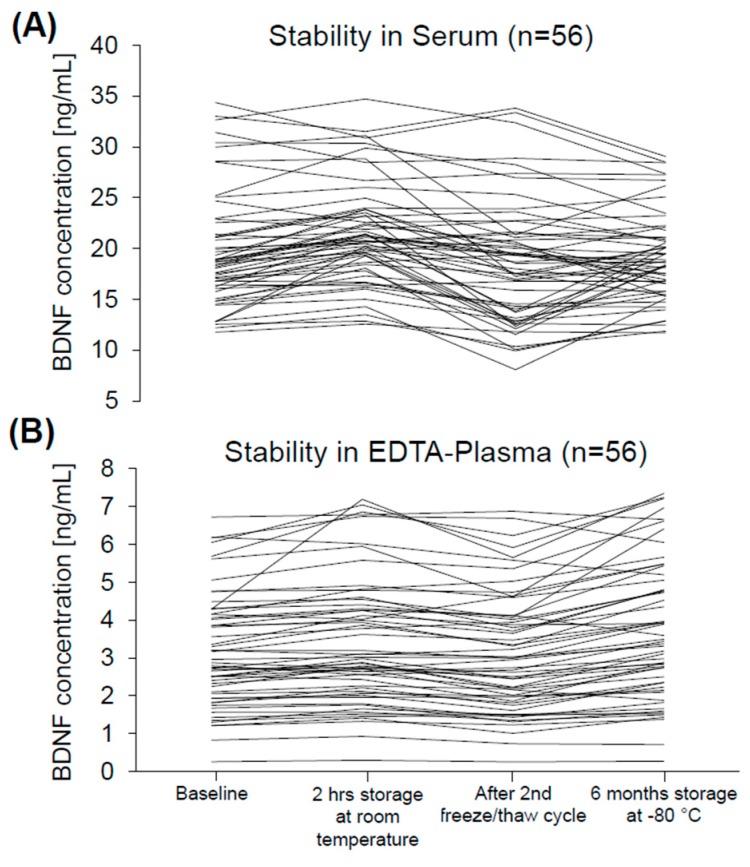
Individual changes in serum (A) and EDTA-plasma (B) BDNF at “Baseline” (T1), “2 hrs storage at room temperature” (T2), “After 2nd freeze/thaw cycle” (T3), and “6 months storage at −80 °C” (T5). BDNF: brain-derived neurotrophic factor, EDTA: ethylenediaminetetraacetic acid, hrs: hours.
Figure 4
Figure 4
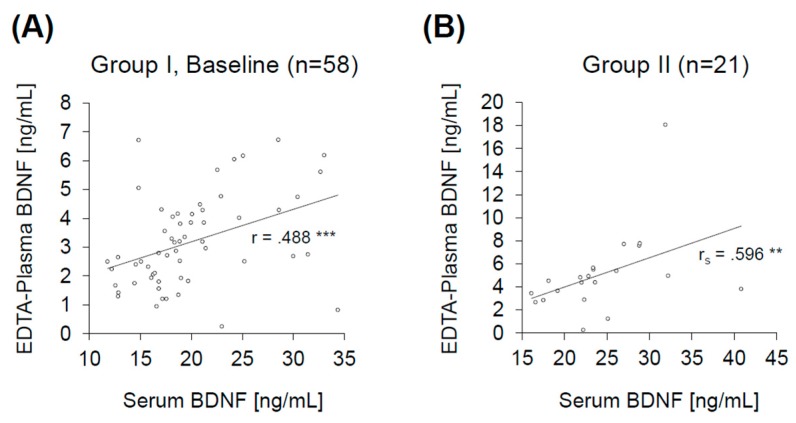
Correlations of serum and EDTA-plasma BDNF in Group I (“Baseline”, T1) (A) and Group II (B). BDNF: brain-derived neurotrophic factor; EDTA: ethylenediaminetetraacetic acid. ** p < 0.01, *** p < 0.001.

References

    1. Fernandes B.S., Gama C.S., Cereser K.M., Yatham L.N., Fries G.R., Colpo G., de Lucena D., Kunz M., Gomes F.A., Kapczinski F. Brain-derived neurotrophic factor as a state-marker of mood episodes in bipolar disorders: A systematic review and meta-regression analysis. J. Psychiatr. Res. 2011;45:995–1004. doi: 10.1016/j.jpsychires.2011.03.002. - DOI - PubMed
    1. Polyakova M., Stuke K., Schuemberg K., Mueller K., Schoenknecht P., Schroeter M.L. BDNF as a biomarker for successful treatment of mood disorders: A systematic & quantitative meta-analysis. J. Affect. Disord. 2015;174:432–440. - PubMed
    1. Molendijk M.L., Spinhoven P., Polak M., Bus B.A., Penninx B.W., Elzinga B.M. Serum BDNF concentrations as peripheral manifestations of depression: Evidence from a systematic review and meta-analyses on 179 associations (n = 9484) Mol. Psychiatry. 2013;19:791–800. doi: 10.1038/mp.2013.105. - DOI - PubMed
    1. Tsuchimine S., Sugawara N., Ishioka M., Yasui-Furukori N. Preanalysis storage conditions influence the measurement of brain-derived neurotrophic factor levels in peripheral blood. Neuropsychobiology. 2014;69:83–88. doi: 10.1159/000358061. - DOI - PubMed
    1. Polacchini A., Metelli G., Francavilla R., Baj G., Florean M., Mascaretti L.G., Tongiorgi E. A method for reproducible measurements of serum BDNF: Comparison of the performance of six commercial assays. Sci. Rep. 2015;5:17989. doi: 10.1038/srep17989. - DOI - PMC - PubMed

Substances

LinkOut - more resources