. 2017 Jun;13(6):3417-3423.
doi: 10.3892/etm.2017.4426. Epub 2017 May 4.

Suppressive effect of microRNA-138 on the proliferation and invasion of osteosarcoma cells via targeting SIRT1

Affiliations

Suppressive effect of microRNA-138 on the proliferation and invasion of osteosarcoma cells via targeting SIRT1

Zhenchao Yuan et al. Exp Ther Med. 2017 Jun.

Retraction in

Abstract

MicroRNAs (miRs), a class of small non-coding RNAs, function as key regulators in gene expression through binding to the 3'-untranslated region (UTR) of their target mRNA, which further leads to translational repression or mRNA degradation. Recently, miR-138 has been found to have a tumor suppressive role in a variety of human malignancies. However, the exact role of miR-138 in regulating the malignant phenotypes of osteosarcoma (OS) has remained to be elucidated. In the present study, reverse-transcription PCR analysis showed that the expression of miR-138 was markedly reduced in OS tissues compared to that in matched adjacent non-tumorous tissues. Furthermore, it was also downregulated in several common OS cell lines, when compared with that in a normal human osteoblast cell line. Overexpression of miR-138 suppressed cell proliferation and invasion and led to a significant decrease in the protein expression of sirtuin 1 (SIRT1), which was further identified as a direct target gene of miR-138 in MG63 cells. Moreover, restoration of SIRT1 expression reversed the suppressive effects of miR-138 on MG63 cell proliferation and invasion. Finally, the expression of SIRT1 was found to be significantly upregulated in OS tissues compared to that in matched adjacent tissues, and SIRT1 levels were inversely correlated with the miR-138 levels in OS tissues. Therefore, the present study demonstrated that miR-138 has a role in inhibiting OS cell proliferation and invasion via directly targeting SIRT1, and suggested that the miR-138/SIRT1 axis may become a promising therapeutic target for OS.

Keywords: invasion; microRNA-138; osteosarcoma; proliferation; sirtuin 1.


Figures
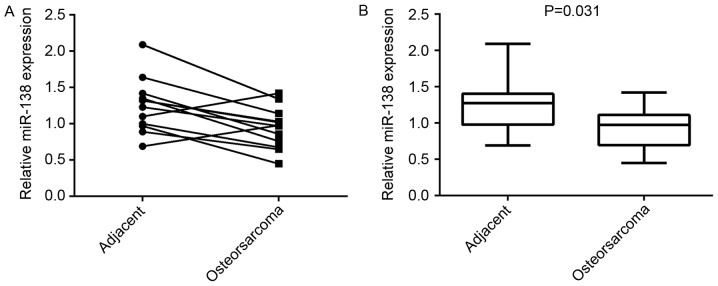
Figure 1.
Figure 1.
The expression levels of miR-138 in a total of 12 osteosarcoma tissues and their matched adjacent non-tumor tissues were examined by reverse-transcription quantitative polymerase chain reaction analysis. (A) Individual data-points within groups and (B) quantified box plots are shown. miR, microRNA.
Figure 2.
Figure 2.
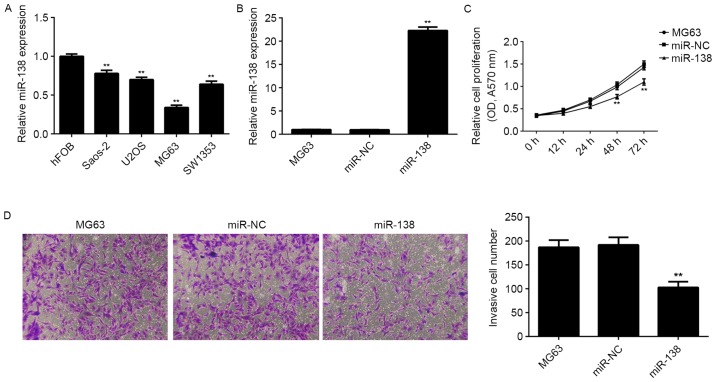
(A) The expression levels of miR-138 in osteosarcoma cell lines (Saos-2, U2OS, MG63 and SW1353) as well as in the human osteoblast cell line hFOB were examined by RT-qPCR. **P<0.01 vs. hFOB. (B) RT-qPCR analysis was performed to examine the miR-138 levels in MG63 cells transfected with miR-NC or miR-138 mimics. Non-transfected MG63 cells were used as controls. (C) An MTT assay and (D) a Transwell assay were used to examine the cell proliferation and invasion, respectively. Magnification, ×200. **P<0.01 vs. MG63. RT-qPCR, reverse-transcription quantitative polymerase chain reaction analysis; miR, micro RNA; miR-NC, scramble miR; OD, optical density.
Figure 3.
Figure 3.
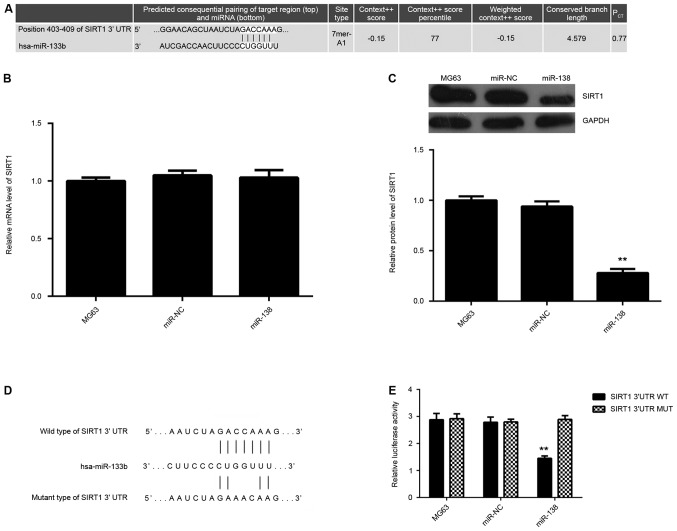
(A) Targetscan software was used to predict SIRT1 as a potential target of miR-138. (B) Reverse-transcription quantitative polymerase chain reaction and (C) western blot analysis were used to examine the mRNA and protein levels, respectively, of SIRT1 in MG63 cells transfected with miR-NC or miR-138 mimics. Non-transfected MG63 cells were used as controls. (D) Luciferase reporter vectors containing a WT or MUT sequence of the SIRT1 3′-UTR were constructed. (E) The luciferase activity was significantly decreased in MG63 cells co-transfected with the reporter vector containing the WT sequence of the SIRT1 3′UTR and miR-138 mimics, but showed no difference in cells co-transfected with the reporter vector containing the MUT sequence of the SIRT1 3′UTR and miR-138 mimics, when compared to the control group. **P<0.01 vs. MG63. miR, micro RNA; miR-NC, scramble miR; hsa, Homo sapiens; UTR, untranslated region; SIRT1, sirtuin 1; WT, wild-type; MUT, mutant type.
Figure 4.
Figure 4.
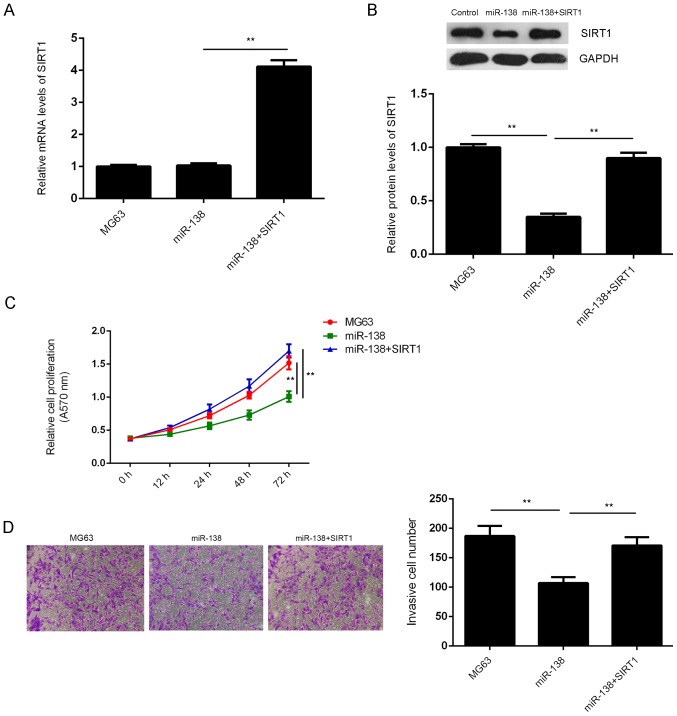
(A) Reverse-transcription quantitative polymerase chain reaction and (B) western blot analysis were used to examine the mRNA and protein levels of SIRT1 in MG63 cells transfected with miR-138 mimics, or co-transfected with miR-138 mimics and SIRT1 open reading frame expression plasmid, respectively. (C) MTT assay and (D) Transwell assay were used to examine the cell proliferation and invasion, respectively. Magnification, ×200. **P<0.01. miR, microRNA; SIRT1, sirtuin 1; OD, optical density.
Figure 5.
Figure 5.
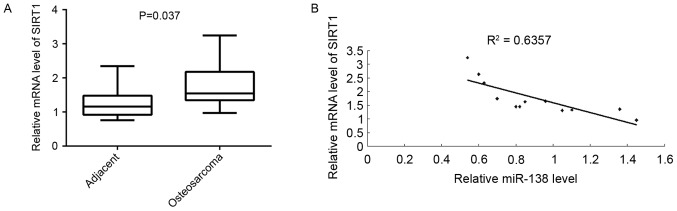
(A) Reverse-transcription quantitative polymerase chain reaction was used to examine the mRNA expression of SIRT1 in a total of 12 osteosarcoma tissues and their matched adjacent non-tumor tissues. (B) SIRT1 levels were inversely correlated with the miR-138 levels in osteosarcoma tissues. miR, microRNA, SIRT1, sirtuin 1.

References

    1. Thompson LD. Osteosarcoma. Ear Nose Throat J. 2013;92:288–290. - PubMed
    1. Wu X, Zhong D, Gao Q, Zhai W, Ding Z, Wu J. MicroRNA-34a inhibits human osteosarcoma proliferation by downregulating ether à go-go 1 expression. Int J Med Sci. 2013;10:676–682. doi: 10.7150/ijms.5528. - DOI - PMC - PubMed
    1. Murray E, Hernychová L, Scigelova M, Ho J, Nekulova M, O'Neill JR, Nenutil R, Vesely K, Dundas SR, Dhaliwal C, et al. Quantitative proteomic profiling of pleomorphic human sarcoma identifies CLIC1 as a dominant pro-oncogenic receptor expressed in diverse sarcoma types. J Proteome Res. 2014;13:2543–2559. doi: 10.1021/pr4010713. - DOI - PubMed
    1. Lu J, Getz G, Miska EA, Alvarez-Saavedra E, Lamb J, Peck D, Sweet-Cordero A, Ebert BL, Mak RH, Ferrando AA, et al. MicroRNA expression profiles classify human cancers. Nature. 2005;435:834–838. doi: 10.1038/nature03702. - DOI - PubMed
    1. Ambros V. The functions of animal microRNAs. Nature. 2004;431:350–355. doi: 10.1038/nature02871. - DOI - PubMed

Publication types