


Endovascular treatment of wide-neck intracranial bifurcation aneurysms with 'Y'-configuration, double Neuroform® stents-assisted coiling technique: Experience in a single center
- PMID: 28587530
- PMCID: PMC5684913
- DOI: 10.1177/1591019917708568
Endovascular treatment of wide-neck intracranial bifurcation aneurysms with 'Y'-configuration, double Neuroform® stents-assisted coiling technique: Experience in a single center
Abstract
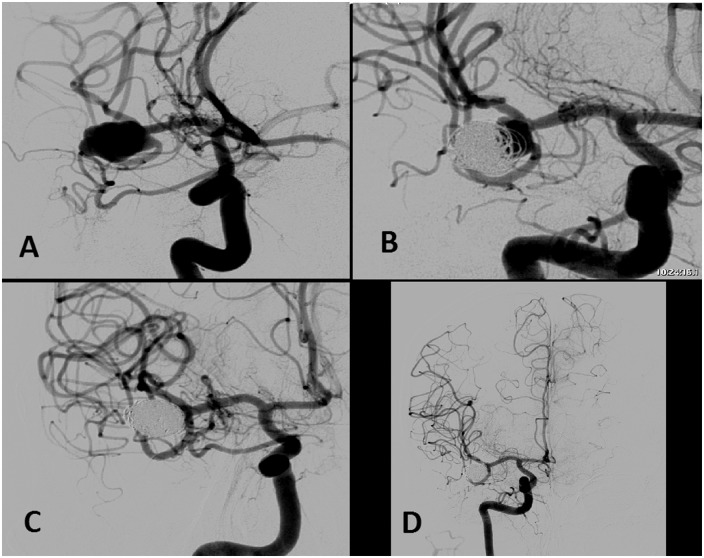
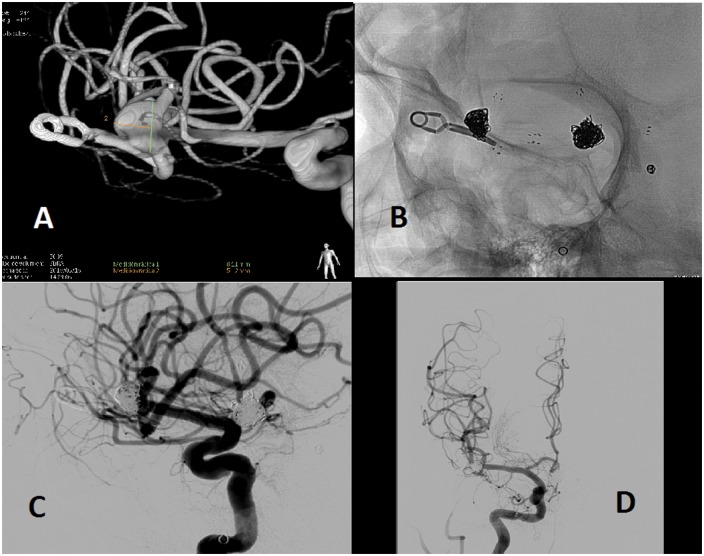
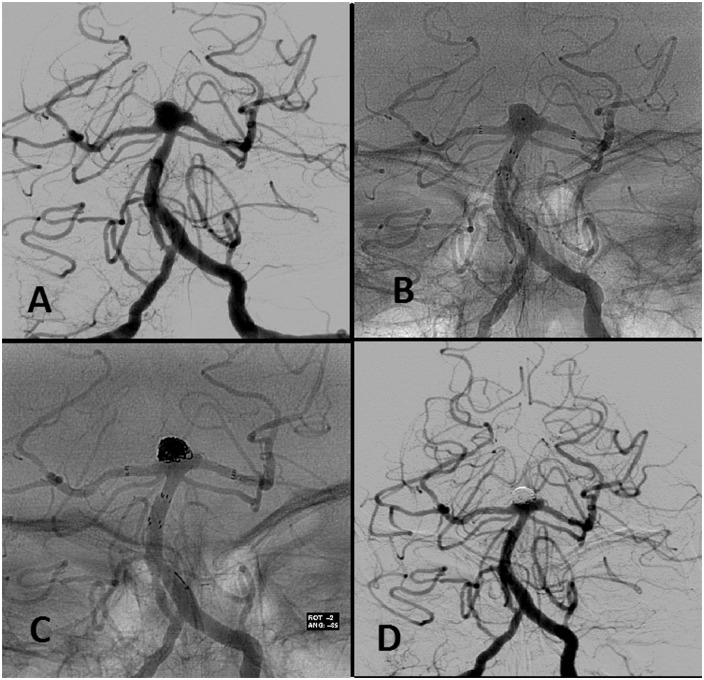
Background Intracranial wide-neck aneurysms at the arterial bifurcations, especially in the aneurysms where the bifurcating branches emanate directly from the base of the aneurysm, have been particularly difficult on which to perform endovascular treatment. The 'Y'-configuration, double stent-assisted coil embolization is an option for the treatment of these difficult aneurysms, allowing the closure of the aneurysm, preserving the parent arteries. Material and methods In a nine-year period, 546 intracranial aneurysms in 493 patients were treated at our center by endovascular approach. We have reviewed the medical records and arteriographies from November 2007 to January 2017 of 45 patients who were treated using 'Y'-configuration double Neuroform® stent-assisted coil embolization. Results All patients were successfully treated. The location of the aneurysms were: middle cerebral artery (MCA) 20 (44.4%), anterior communicating artery (AComA) 17 (37.7%), basilar four (8.9%), internal carotid artery (ICA) bifurcation three (6.6%) and posterior communicating artery (PComA) one (2.2%). The mRS at hospital discharge was: mRS 0: 42 (93.3%), mRS 1: 1 (2.2%), mRS 2: 1 (2.2%) and mRS 5: 1 (2.2%). The Modified Raymond-Roy Occlusion Classification, in the control at six months, was: Class I: 41 (91.1%), Class II: 2 (4.4%), Class IIIa: 1 (2.2%) and Class IIIb: 1 (2.2%). Forty-four (97.8%) patients had a good outcome (mRS < 2) at six months. One (2.2%) patient had a poor outcome (mRS > 2) at six months that was due to sequelae of SAH. There was no mortality at six months. Conclusions This technique is safe and effective for the endovascular treatment of difficult wide-neck bifurcation aneurysms, allowing the stable closure of the aneurysm, preserving the parent arteries.
Keywords: Intracranial aneurysm; Neuroform; bifurcation aneurysm; coils; intracranial stent; ‘Y’ stenting; ‘Y’-configuration stenting.
Figures
References
-
- Fiorella D, Albuquerque FC, Deshmukh VR, et al. Usefulness of the Neuroform stent for the treatment of cerebral aneurysms: Results at initial (3–6 mo) follow-up. Neurosurgery 2005; 56: 1191–1202. - PubMed
-
- Lylyk P, Ferrario A, Pasbón B, et al. Buenos Aires experience with the Neuroform self-expanding stent for the treatment of intracranial aneurysms. J Neurosurg 2005; 102: 235–241. - PubMed
-
- Lubicz B, Leclerc X, Levivier M, et al. Retractable self-expandable stent for endovascular treatment of wide-necked intracranial aneurysms: Preliminary experience. Neurosurgery 2006; 58: 451–457. - PubMed
MeSH terms
LinkOut - more resources
Full Text Sources
Other Literature Sources
Medical
Miscellaneous
