Moderate alcohol consumption as risk factor for adverse brain outcomes and cognitive decline: longitudinal cohort study
- PMID: 28588063
- PMCID: PMC5460586
- DOI: 10.1136/bmj.j2353
Moderate alcohol consumption as risk factor for adverse brain outcomes and cognitive decline: longitudinal cohort study
Abstract
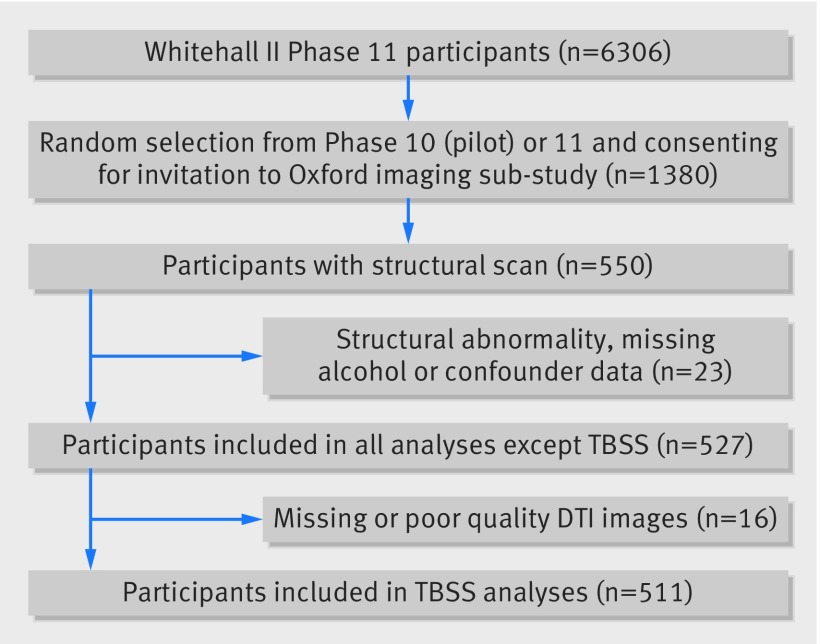
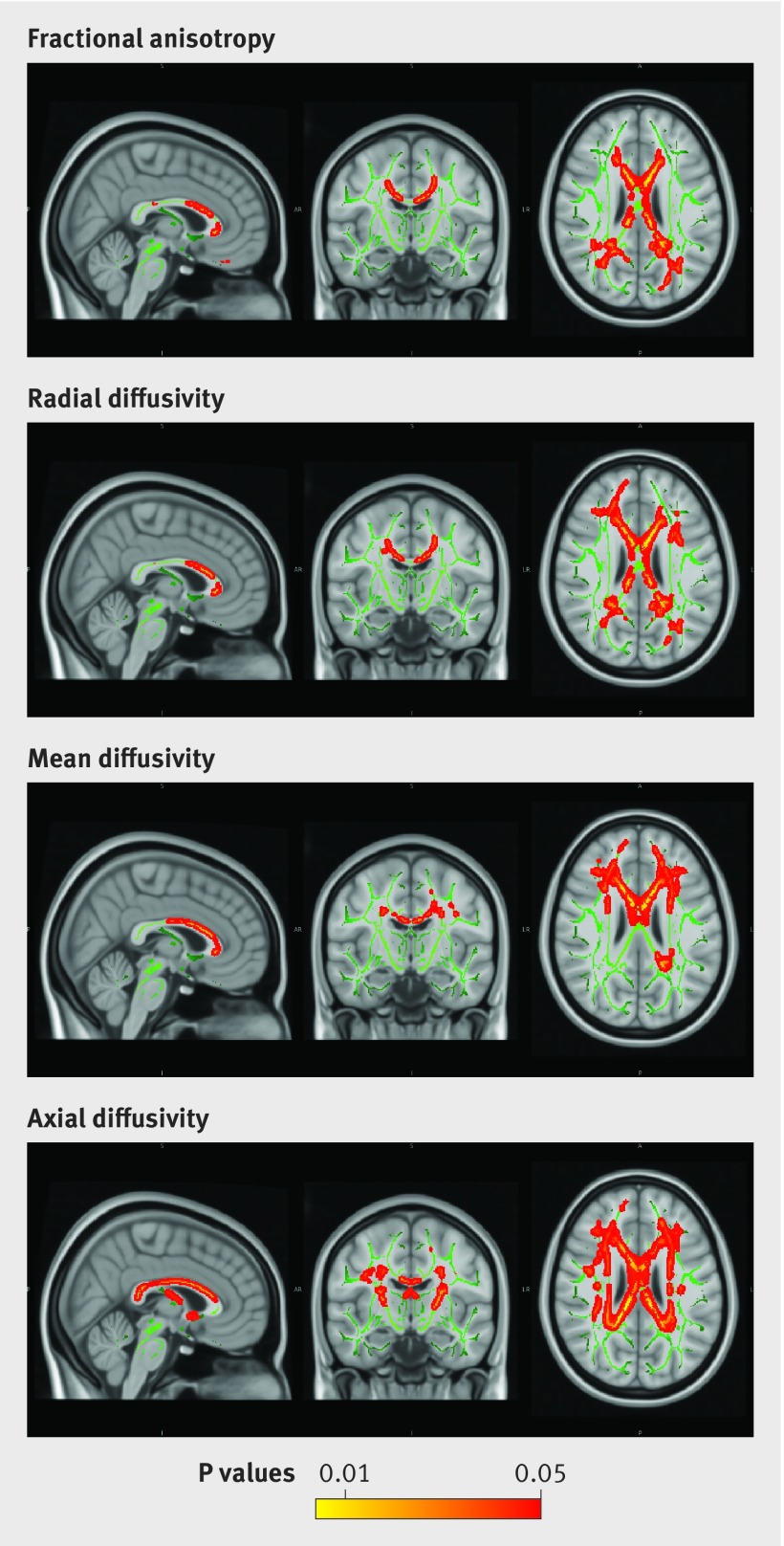
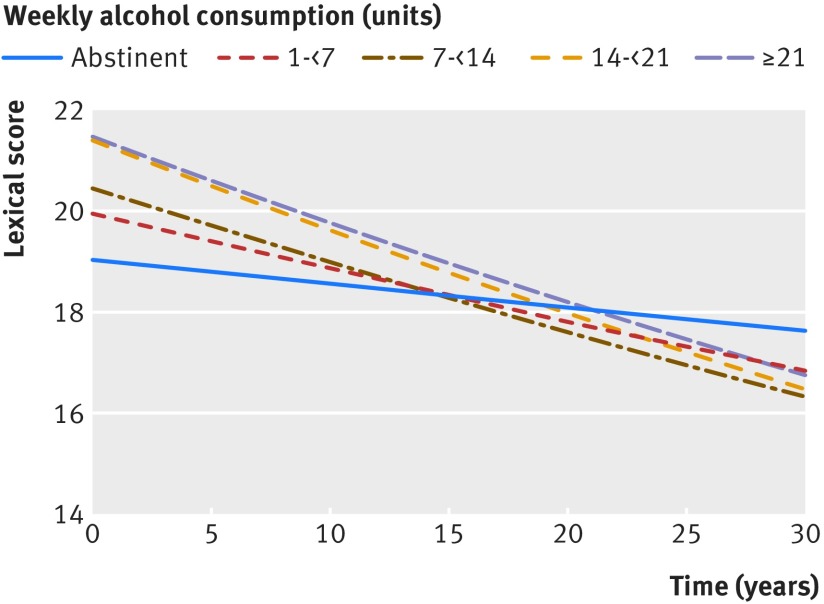
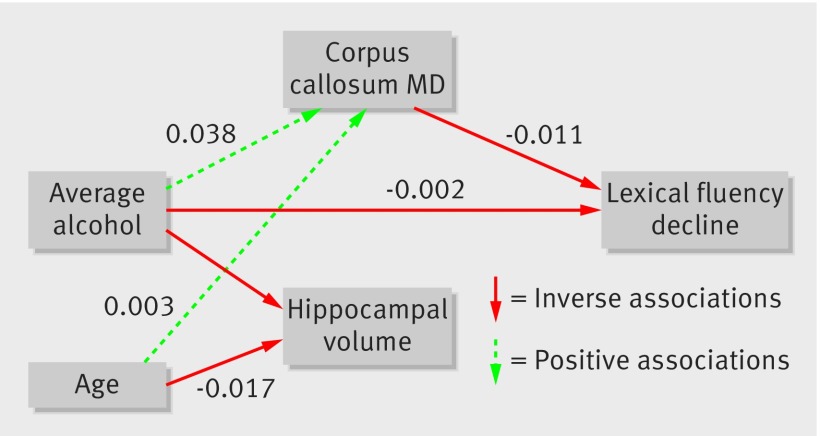
Objectives To investigate whether moderate alcohol consumption has a favourable or adverse association or no association with brain structure and function.Design Observational cohort study with weekly alcohol intake and cognitive performance measured repeatedly over 30 years (1985-2015). Multimodal magnetic resonance imaging (MRI) was performed at study endpoint (2012-15).Setting Community dwelling adults enrolled in the Whitehall II cohort based in the UK (the Whitehall II imaging substudy).Participants 550 men and women with mean age 43.0 (SD 5.4) at study baseline, none were "alcohol dependent" according to the CAGE screening questionnaire, and all safe to undergo MRI of the brain at follow-up. Twenty three were excluded because of incomplete or poor quality imaging data or gross structural abnormality (such as a brain cyst) or incomplete alcohol use, sociodemographic, health, or cognitive data.Main outcome measures Structural brain measures included hippocampal atrophy, grey matter density, and white matter microstructure. Functional measures included cognitive decline over the study and cross sectional cognitive performance at the time of scanning.Results Higher alcohol consumption over the 30 year follow-up was associated with increased odds of hippocampal atrophy in a dose dependent fashion. While those consuming over 30 units a week were at the highest risk compared with abstainers (odds ratio 5.8, 95% confidence interval 1.8 to 18.6; P≤0.001), even those drinking moderately (14-21 units/week) had three times the odds of right sided hippocampal atrophy (3.4, 1.4 to 8.1; P=0.007). There was no protective effect of light drinking (1-<7 units/week) over abstinence. Higher alcohol use was also associated with differences in corpus callosum microstructure and faster decline in lexical fluency. No association was found with cross sectional cognitive performance or longitudinal changes in semantic fluency or word recall.Conclusions Alcohol consumption, even at moderate levels, is associated with adverse brain outcomes including hippocampal atrophy. These results support the recent reduction in alcohol guidance in the UK and question the current limits recommended in the US.
Published by the BMJ Publishing Group Limited. For permission to use (where not already granted under a licence) please go to http://group.bmj.com/group/rights-licensing/permissions.
Conflict of interest statement
Competing interests: All authors have completed the ICMJE uniform disclosure form at www.icmje.org/coi_disclosure.pdf and declare: grant support for the submitted work is detailed above; no financial relationships with any organisations that might have an interest in the submitted work in the previous three years; no other relationships or activities that could appear to have influenced the submitted work.
Figures
Comment in
-
Alcohol consumption and brain health.BMJ. 2017 Jun 6;357:j2645. doi: 10.1136/bmj.j2645. BMJ. 2017. PMID: 28588039 Free PMC article.
-
Evidence for benefit of low-dose alcohol.Can Fam Physician. 2017 Dec;63(12):916-917. Can Fam Physician. 2017. PMID: 29237628 Free PMC article. No abstract available.
References
-
- Organization WH. Global status report on alcohol and health.World Health Organization, 2014.
-
- Connor JP, Haber PS, Hall WD. Alcohol use disorders. Lancet 2015;387:988-98.pmid:26343838. - PubMed
-
- Leon DA, McCambridge J. Liver cirrhosis mortality rates in Britain from 1950 to 2002: an analysis of routine data. Lancet 2006;367:52-6. 10.1016/S0140-6736(06)67924-5 pmid:16399153. - DOI - PubMed
-
- HM Government. The government’s alcohol strategy.Stationary Office, 2012.
-
- Stampfer MJ, Colditz GA, Willett WC, Speizer FE, Hennekens CH. A prospective study of moderate alcohol consumption and the risk of coronary disease and stroke in women. N Engl J Med 1988;319:267-73. 10.1056/NEJM198808043190503 pmid:3393181. - DOI - PubMed
Publication types
MeSH terms
Grants and funding
LinkOut - more resources
Full Text Sources
Other Literature Sources
Medical