. 2017 May;8(3):139-147.
doi: 10.1159/000468192. Epub 2017 Apr 14.

Variable Penetrance of the 15q11.2 BP1-BP2 Microduplication in a Family with Cognitive and Language Impairment

Affiliations

Variable Penetrance of the 15q11.2 BP1-BP2 Microduplication in a Family with Cognitive and Language Impairment

Antonio Benítez-Burraco et al. Mol Syndromol. 2017 May.

Abstract

The 15q11.2 BP1-BP2 region is found duplicated or deleted in people with cognitive, language, and behavioral impairment. We report on a family (a father and 3 male twin siblings) that presents with a duplication of the 15q11.2 BP1-BP2 region and a variable phenotype: the father and the fraternal twin are normal carriers, whereas the monozygotic twins exhibit severe language and cognitive delay as well as behavioral disturbances. The genes located within the duplicated region are involved in brain development and function, and some of them are related to language processing. The probands' phenotype may result from changes in the expression level of some of these genes important for cognitive development.

Keywords: Cognitive delay; Copy number variations; Language impairment; Microduplication 15q11.2 BP1–BP2; Variable penetrance.


Figures
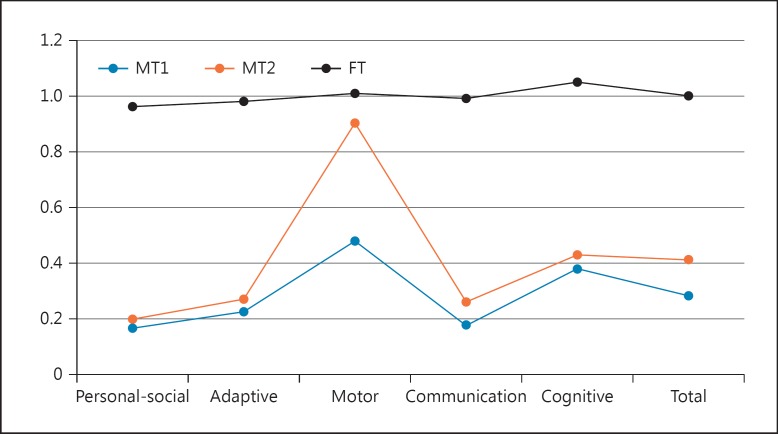
Fig. 1
Fig. 1
A comparison of the probands' developmental profiles at the age of 7 years/8 months according to the Battelle Developmental Inventories. In order to make more reliable comparisons, the resulting scores are shown as relative values referred to the expected scores according to the chronological age of the child. FT, fraternal twin; MT1, monozygotic twin 1; MT2, monozygotic twin 2.
Fig. 2
Fig. 2
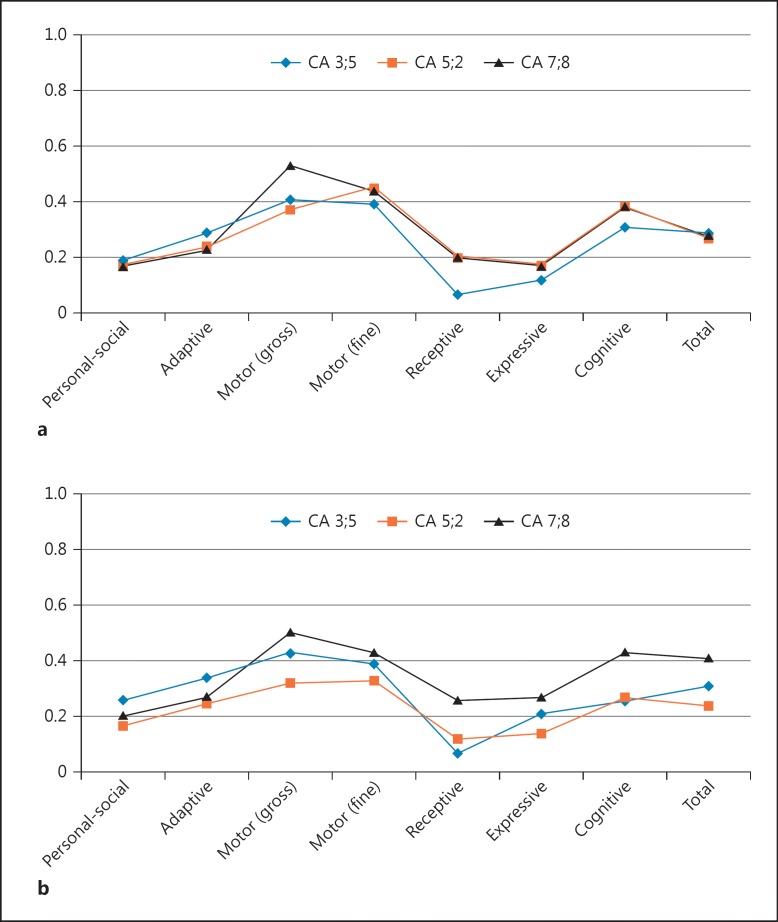
Changes in the developmental profiles of the monozygotic twins 1 (a) and 2 (b) from 3 years/5 months to 7 years/ 8 months according to the Battelle Developmental Inventories. In order to make more reliable comparisons, the resulting scores are shown as relative values referred to the expected scores according to the chronological age of the child. CA, chronological age.
Fig. 3
Fig. 3
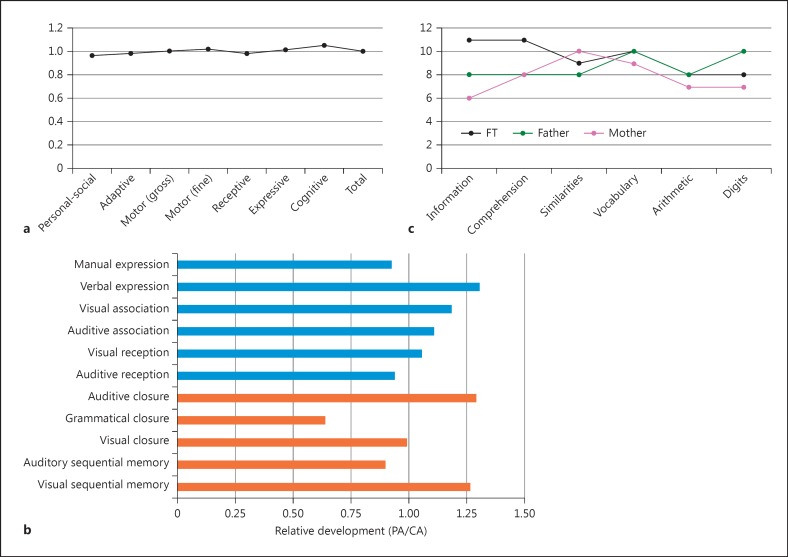
Developmental profile and language abilities of the fraternal twin at 7 years/8 months. a Developmental profile according to the Battelle Developmental Inventories. b Developmental profile according to the Illinois Test of Psycholinguistic Abilities. c Developmental profile according to the verbal component of the WISC-IV (for comparison, the figure includes the parents' profiles according to the verbal component of the WAIS-III). CA, chronological age; PA, psychological age.
Fig. 4
Fig. 4
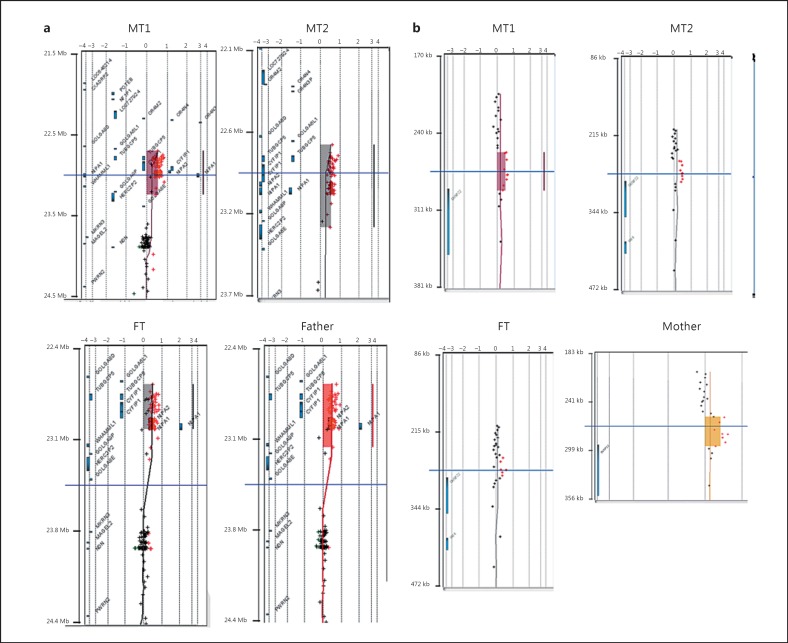
Array CGH and duplicated genes in the probands. a Array CGH of the probands' chromosome 15 showing a microduplication at 15q11.2. b Array CGH of the probands' chromosome 6 showing a microduplication at 6p25.3.

References

    1. Abdelmoity AT, LePichon JB, Nyp SS, Soden SE, Daniel CA, Yu S. 15q11.2 proximal imbalances associated with a diverse array of neuropsychiatric disorders and mild dysmorphic features. J Dev Behav Pediatr. 2012;33:570–576. - PubMed
    1. Baer D, Wolf M, Risley R. Some current dimensions of applied behavior analysis. J Appl Behav Anal. 1968;1:91–97. - PMC - PubMed
    1. Ballesteros S, Cordero A. ITPA: Test Illinois de Aptitudes Psicolingüísticas. Madrid: TEA Ediciones; 2004.
    1. Bondy AS, Frost LA. The picture exchange communication system. Semin Speech Lang. 1998;19:373–388. - PubMed
    1. Burnside RD, Pasion R, Mikhail FM, Carroll AJ, Robin NH, et al. Microdeletion/microduplication of proximal 15q11.2 between BP1 and BP2: a susceptibility region for neurological dysfunction including developmental and language delay. Hum Genet. 2011;130:517–528. - PMC - PubMed

LinkOut - more resources