. 2016 Nov 9;1(3):e000111.
doi: 10.1136/bmjgh-2016-000111. eCollection 2016.

Long shadow of fear in an epidemic: fearonomic effects of Ebola on the private sector in Nigeria

Affiliations

Long shadow of fear in an epidemic: fearonomic effects of Ebola on the private sector in Nigeria

Sulzhan Bali et al. BMJ Glob Health. .

Abstract

Background: The already significant impact of the Ebola epidemic on Guinea, Liberia and Sierra Leone, was worsened by a fear of contagion that aggravated the health crisis. However, in contrast to other Ebola-affected countries, Nigeria fared significantly better due to its swift containment of the disease. The objective of our study was to describe the impact of Ebola on the Nigerian private sector. This paper introduces and defines the term fearonomic effect as the direct and indirect economic effects of both misinformation as well as fear-induced aversion behaviour, exhibited by individuals, organisations or countries during an outbreak or an epidemic.

Methods: This study was designed as a cross-sectional mixed-methods study that used semistructured in-depth interviews and a supporting survey to capture the impact of Ebola on the Nigerian private sector after the outbreak. Themes were generated from the interviews on the direct and indirect impact of Ebola on the private sector; the impact of misinformation and fear-based aversion behaviour in the private sector.

Results: Our findings reveal that the fearonomic effects of Ebola included health service outages and reduced healthcare usage as a result of misinformation and aversion behaviour by both patients and providers. Although certain sectors (eg, health sector, aviation sector, hospitality sector) in Nigeria were affected more than others, no business was immune to Ebola's fearonomic effects. We describe how sectors expected to prosper during the outbreak (eg, pharmaceuticals), actually suffered due to the changes in consumption patterns and demand shocks.

Conclusion: In a high-stressor epidemic-like setting, altered consumption behaviour due to distorted disease perception, misinformation and fear can trigger short-term economic cascades that can disproportionately affect businesses and lead to financial insecurity of the poorest and the most vulnerable in a society.


Conflict of interest statement

Competing interests: None declared.

Figures
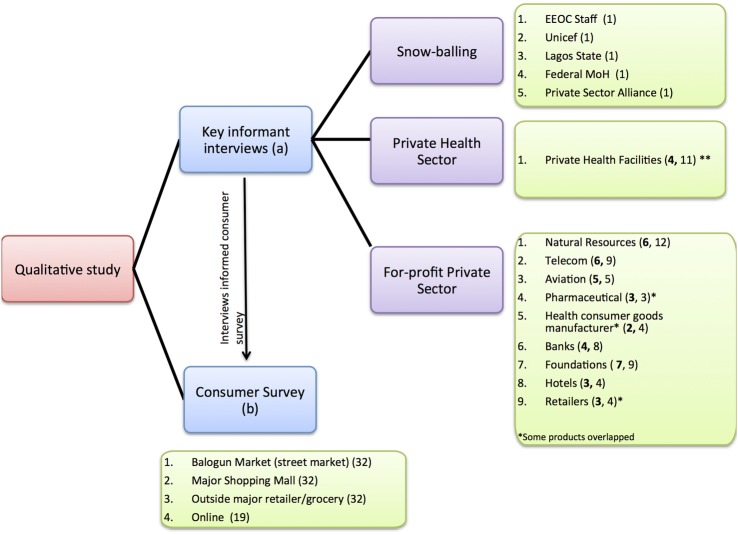
Figure 1
Figure 1
Study Design: This study was designed as a cross-sectional mixed-methods study and conducted in Lagos, Nigeria from May to September 2015. The numbers in the figure represents the number of businesses or stakeholders interviewed (in bold) and the number of persons interviewed respectively for each sector. (*) Product overlap, for example, sanitizers (**) Includes private sector hospital owned by Oil & Gas company that serves both public sector staff and private sector staff, includes both Ebola affected hospitals in Lagos.
Figure 2
Figure 2
Social media, television, and radio were top sources of information during the Ebola outbreak in Nigeria (n=110). We asked respondents about how did they source their information on Ebola during the outbreak. The respondents ticked all that applied among the given choices. About 71% respondents mention social media as a source of information, 67% mentioned television as a source of information, while 52% and 47% mentioned friends and radio hosts as source of information. NGOs, non-governmental organisations.
Figure 3
Figure 3
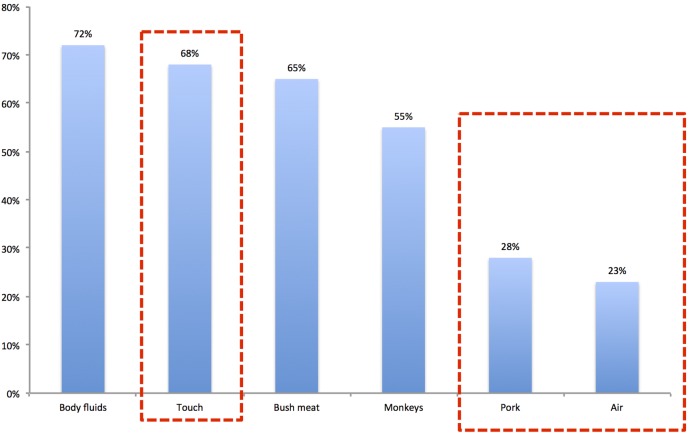
How is Ebola transmitted? The respondents were asked to tick all that applied on how Ebola is transmitted (n=110). Red dotted lines highlight prevailing misinformation on the transmission of Ebola. About 68% respondents thought Ebola is transmitted through touch, while 28% and 23% respondents thought Ebola was transmitted through pork and air respectively. All three instances reflect the hysteria and misinformation on the transmission of Ebola.
Figure 4
Figure 4
Altered behaviour due to fear of Ebola. Respondents were asked Yes or No, to questions on altered social habits, behaviour or visits to certain businesses during the Nigerian Ebola outbreak. Respondents were asked to tick all that applied if due to Ebola outbreak they performed the aforementioned activities. Numbers in blue represent percentage of respondents that said yes (n =105) while red represents the percentage of respondents that answered no. (* ) Refers to themes that were reported in the interviews.
Figure 5
Figure 5
Framework describing the fearonomic effect of an Ebola on businesses and economy Misinformation, disease's case fatality rate, perception of disease due to media hype, knowledge gap due to disease being new to the area or a new/emerging disease are all factors that amplify fearonomic effects of an epidemic by enhancing misinformation and/or fear-based aversion behaviour. We define fearonomic effects as the direct and the indirect economic effects of both misinformation and fear-induced aversion behaviour, exhibited by individuals, organizations, or countries during an outbreak or epidemic.
Figure 6
Figure 6
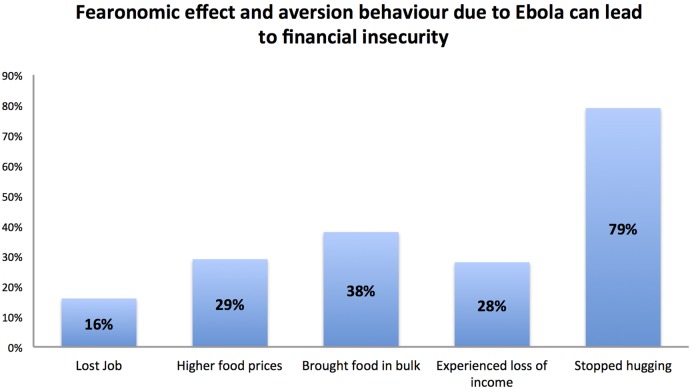
Fearonomic effects of an infectious disease outbreak or epidemic can lead to financial insecurity due to fear and aversion behaviour. Respondents were asked if because of Ebola they experienced any of the aforementioned options between July and October 2014 (n =110). About 16% respondents reported losing jobs due to the Ebola outbreak, 29% respondents reported higher food prices in 2014 due to Ebola outbreak, 38% respondents reported they brought food in bulk amount due to Ebola outbreak, 28% respondents reported loss of income due to the Ebola outbreak and 79% respondents reported they stopped hugging due to the Ebola outbreak.
Figure 7
Figure 7
Change in consumer consumption behaviour during the Nigerian Ebola outbreak (n =114). Respondents were asked questions if they brought certain commodities or products more or less or same during the Ebola outbreak. Blue signifies increase in purchase, red signifies decrease in purchase, while grey represents no change in purchasing habit. Numbers represents percentage of respondents out of the total respondents. The green dotted lines highlight products consumed more than usual that was also reported in the interviews. Red dotted lines highlight products consumed less than usual that were reported in the interviews as well.

References

    1. Kinsman J. “A time of fear”: local, national, and international responses to a large Ebola outbreak in Uganda. Global Health 2012;8:15 10.1186/1744-8603-8-15 - DOI - PMC - PubMed
    1. Ogoina D. Behavioural and emotional responses to the 2014 Ebola outbreak in Nigeria: a narrative review. Int Health 2016;8:5–12. 10.1093/inthealth/ihv065 - DOI - PubMed
    1. Gonsalves G, Staley P. Panic, paranoia, and public health—the AIDS epidemic's lessons for Ebola. N Engl J Med 2014;371:2348–9. 10.1056/NEJMp1413425 - DOI - PubMed
    1. Hickson M, McDonald M, Meijer C et al. Fear and stigma: the epidemic within the SARS outbreak. Emerg Infect Dis 2004;10:358–63. - PMC - PubMed
    1. World Bank. The economic impact of the 2014 Ebola epidemic: short and medium term estimates for West Africa. Washington, DC: World Bank Group 2014. http://documents.worldbank.org/curated/en/524521468141287875/The-economi....

LinkOut - more resources