


Generalization of Extinguished Fear to Untreated Fear Stimuli after Exposure
- PMID: 28589965
- PMCID: PMC5686487
- DOI: 10.1038/npp.2017.119
Generalization of Extinguished Fear to Untreated Fear Stimuli after Exposure
Abstract
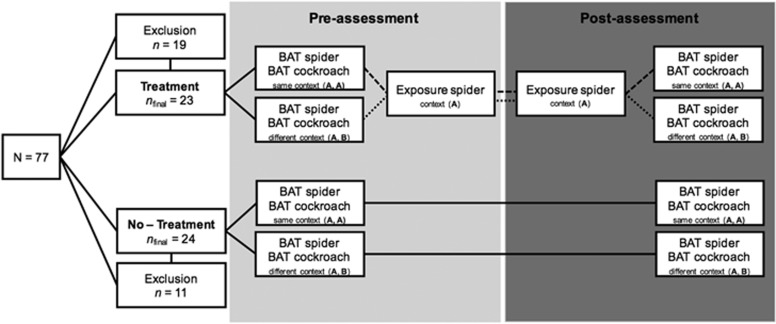
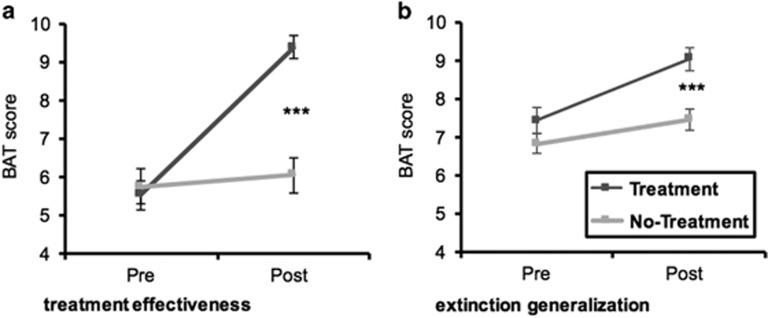
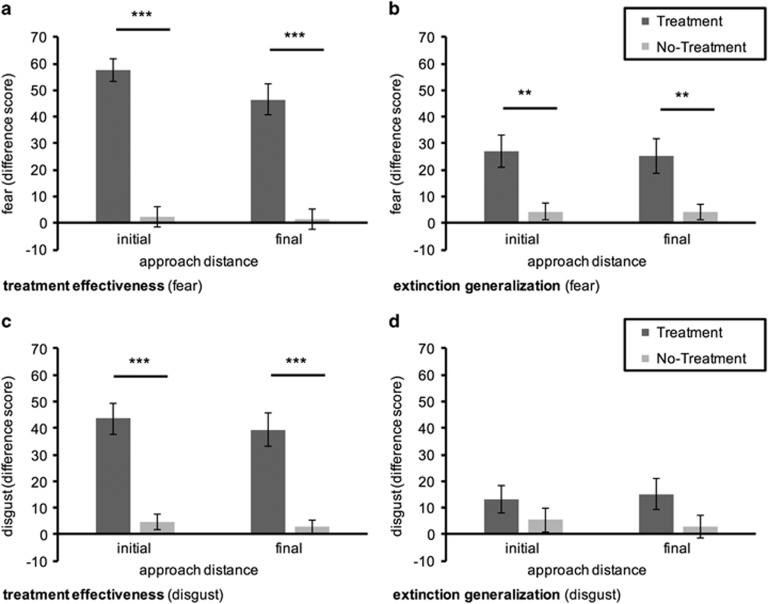
Exposure therapy is highly effective in treating excessive fear related to specific objects and/or situations. However, patients with anxiety disorders often display a generalization of fear responses toward conceptually and perceptually related stimuli and situations. It is unclear whether the beneficial effects of exposure on fear reduction toward treated fear stimuli can extend to untreated fear stimuli. Here, we investigated whether basic principles of extinction generalization apply to exposure. Spider-phobic participants were randomly assigned to either two sessions of exposure treatment (n=23) with spiders or no-treatment (n=24). Prior to and after treatment, behavioral approach tests (BATs) were conducted to examine avoidance, fear and disgust responses toward the treated phobic stimulus (spider as the extinction stimulus). Likewise, BATs with the untreated fear stimulus (cockroach) were conducted to dissect the generalization of treatment effects. Treatment was highly effective in increasing approach behavior toward both treated and untreated fear stimuli. Generalization of treatment effects were evident on the behavioral (approach distance during the BAT), subjective (fear levels during the BAT) and psychophysiological level (heart rate during the BAT). However, a stronger decline in disgust was only evident for the treated fear stimulus. Notably, the herein attained generalization effects were not context-dependent. Hence, exposure therapy for spider phobia was effective in reducing fear of untreated stimuli which share common fear-evoking characteristics with spiders but were never presented during the respective exposure treatment. These findings provide clinical evidence for extinction generalization across different fear-evoking stimuli mediated via exposure.
Figures
References
-
- Arntz A, Lavy E, van den Berg G, van Rijsoort S (1993). Negative beliefs of spider phobics: a psychometric evaluation of the spider phobia beliefs questionnaire. Adv Behav Res Ther 15: 257–277.
-
- Baeyens F, Diaz E, Ruiz G (2005). Resistance to extinction of human evaluative conditioning using a between-subjects design. Cogn Emot 19: 245–268. - PubMed
-
- Barlow DH (1988) Anxiety and its Disorders: The Nature and Treatment of Anxiety and Panic. Guilford Press: New York.
-
- Botella C, Breton-Lopez J, Quero S, Banos R, Garcia-Palacios A (2010). Treating cockroach phobia with augmented reality. Behav Ther 41: 401–413. - PubMed
-
- Bouton ME (2002). Context, ambiguity, and unlearning: sources of relapse after behavioral extinction. Biol Psychiatry 52: 976–986. - PubMed
Publication types
MeSH terms
LinkOut - more resources
Full Text Sources
Other Literature Sources
Medical
