


Pregnancy incidence and outcomes in women with perinatal HIV infection
- PMID: 28590327
- PMCID: PMC5508851
- DOI: 10.1097/QAD.0000000000001552
Pregnancy incidence and outcomes in women with perinatal HIV infection
Abstract
Objectives: To estimate the incidence of first pregnancy in women living with perinatally acquired HIV (PHIV) in the United Kingdom and to compare pregnancy management and outcomes with age-matched women with behaviourally acquired HIV (BHIV).
Design: The National Study of HIV in Pregnancy and Childhood is a comprehensive, population-based surveillance study that collects demographic and clinical data on all pregnant women living with HIV, their children, and all HIV-infected children in the United Kingdom and Ireland.
Methods: The incident rate ratio of first pregnancy was calculated for all women of reproductive age who had been reported to the National Study of HIV in Pregnancy and Childhood as vertically infected children. These women and their pregnancies were compared to age-matched pregnant women with BHIV.
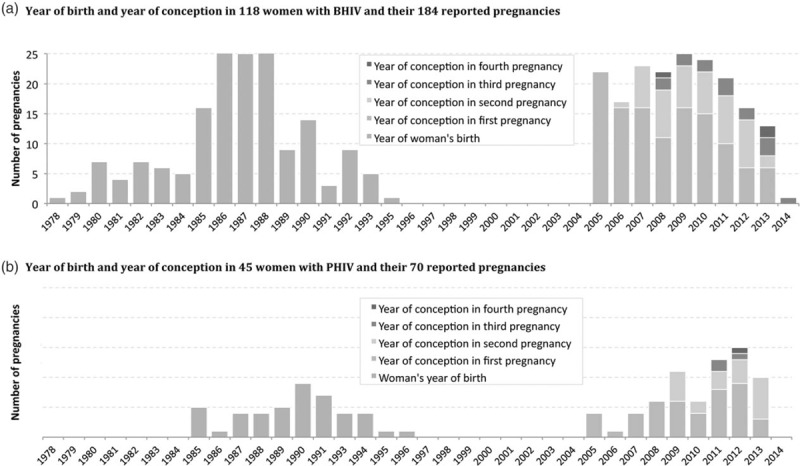
Results: Of the 630 women with PHIV reported in the United Kingdom as children, 7% (45) went on to have at least one pregnancy, with 70 pregnancies reported. The incident rate ratio of first pregnancy was 13/1000 woman-years. The BHIV comparison group comprised 118 women (184 pregnancies). Women with PHIV were more likely to be on combined antiretroviral therapy at conception and have a lower baseline CD4 cell count (P < 0.01 for both). In adjusted analysis, PHIV and a low baseline CD4 cell count were risk factors for detectable viral load near delivery; older age at conception and being on combined antiretroviral therapy at conception reduced this risk.
Conclusion: Women with PHIV in the United Kingdom have a low pregnancy incidence, but those who become pregnant are at risk of detectable viral load near delivery, reflecting their often complex clinical history, adherence, and drug resistance issues.
Figures
References
-
- UNAIDS. Global Report: UNAIDS report on the global AIDS epidemic 2013: WHO; 2013. Available at: http://www.unaids.org/en/media/unaids/contentassets/documents/epidemiolo... [Accessed 20 March 2014]
-
- Judd A, Doerholt K, Tookey PA, Sharland M, Riordan A, Menson E, et al. Collaborative HIV paediatric study (CHIPS); national study of HIV in pregnancy and childhood (NSHPC). Morbidity, mortality, and response to treatment by children in the United Kingdom and Ireland with perinatally acquired HIV infection during 1996–2006: planning for teenage and adult care. Clin Infect Dis 2007; 45:918–924. - PubMed
-
- WHO. WHO | Global update on the health sector response to HIV, 2014: World Health Organization; 2014. Available at: http://www.who.int/hiv/pub/progressreports/update2014/en/ [Accessed 28 July 2014]
-
- Bamford A, Lyall H. Paediatric HIV grows up: recent advances in perinatally acquired HIV. Arch Dis Child 2015; 100:183–188. - PubMed
Publication types
MeSH terms
Grants and funding
LinkOut - more resources
Full Text Sources
Other Literature Sources
Medical
Research Materials
