Review
. 2017 Jul 17;9(7):574-583.
doi: 10.1039/c7ib00014f.

An engineering design approach to systems biology

Affiliations
Review

An engineering design approach to systems biology

Kevin A Janes et al. Integr Biol (Camb). .

Abstract

Measuring and modeling the integrated behavior of biomolecular-cellular networks is central to systems biology. Over several decades, systems biology has been shaped by quantitative biologists, physicists, mathematicians, and engineers in different ways. However, the basic and applied versions of systems biology are not typically distinguished, which blurs the separate aspirations of the field and its potential for real-world impact. Here, we articulate an engineering approach to systems biology, which applies educational philosophy, engineering design, and predictive models to solve contemporary problems in an age of biomedical Big Data. A concerted effort to train systems bioengineers will provide a versatile workforce capable of tackling the diverse challenges faced by the biotechnological and pharmaceutical sectors in a modern, information-dense economy.


Figures
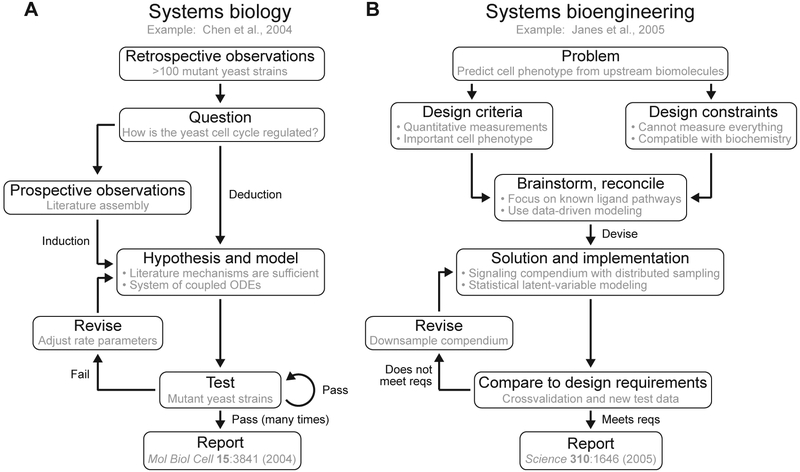
Fig. 1
Fig. 1
Workflows for systems biology and systems bioengineering. (A) The scientific method applied to systems biology. (B) Engineering design approach applied to systems bioengineering. The gray text provides example case studies, selected from Arkin and Schaffer, 2011.
Fig. 2
Fig. 2
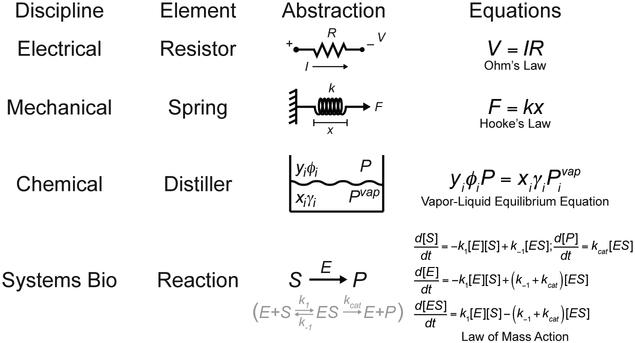
Representative operational elements of engineering. In electrical engineering, Ohm’s Law states that current (I) is proportional to voltage (V) according to the resistance (R) of the element. In mechanical engineering, Hooke’s Law states that displacement (x) is proportional to applied force (F) according to the spring constant (k) of the element. In chemical engineering, the vapor-liquid equilibrium equation relates pressure (P) to the mole fraction of the ith component in the liquid (xi) and vapor (yi) phases based on its fugacity coefficient (φi), activity coefficient (γi), and vapor pressure (pivap). In systems bioengineering, the law of mass action is required to describe the conversion of substrate (S) to product (P) catalyzed by an enzyme (E) and involving an enzyme-substrate intermediate (ES). The kinetics of the reaction involve a system of differential equations with rate parameters describing reversible ES formation (k1, k−1) and catalytic conversion (kcat).
Fig. 3
Fig. 3
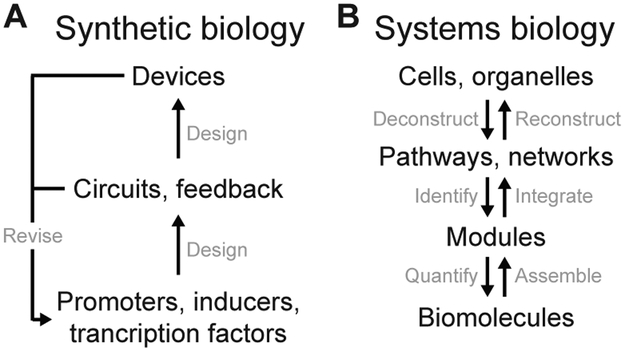
Different intersections of biology and engineering. (A) Bottom-up approach of synthetic biology. (B) Top-down and middle-out approaches of systems biology.

References

    1. Ideker T, Galitski T and Hood L, Annu Rev Genomics Hum Genet, 2001, 2, 343–372. - PubMed
    1. Kirschner MW, Cell, 2005, 121, 503–504. - PubMed
    1. Fitzgerald JB, Schoeberl B, Nielsen UB and Sorger PK, Nat. Chem. Biol, 2006, 2, 458–466. - PubMed
    1. Civelek M and Lusis AJ, Nat. Rev. Genet, 2014, 15, 3448. - PMC - PubMed
    1. Ideker T, Winslow LR and Lauffenburger DA, Ann. Biomed. Eng, 2006, 34, 1226–1233. - PubMed

Publication types

LinkOut - more resources