


Labour management guidelines for a Tanzanian referral hospital: The participatory development process and birth attendants' perceptions
- PMID: 28592237
- PMCID: PMC5463375
- DOI: 10.1186/s12884-017-1360-2
Labour management guidelines for a Tanzanian referral hospital: The participatory development process and birth attendants' perceptions
Abstract
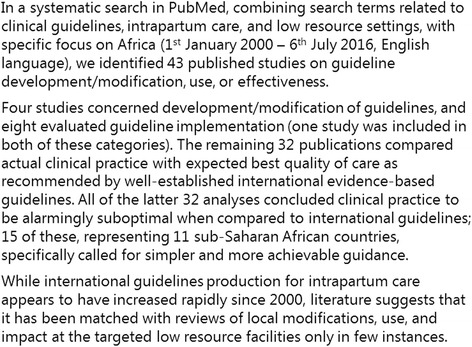
Background: While international guidelines for intrapartum care appear to have increased rapidly since 2000, literature suggests that it has only in few instances been matched with reviews of local modifications, use, and impact at the targeted low resource facilities. At a Tanzanian referral hospital, this paper describes the development process of locally achievable, partograph-associated, and peer-reviewed labour management guidelines, and it presents an assessment of professional birth attendants' perceptions.
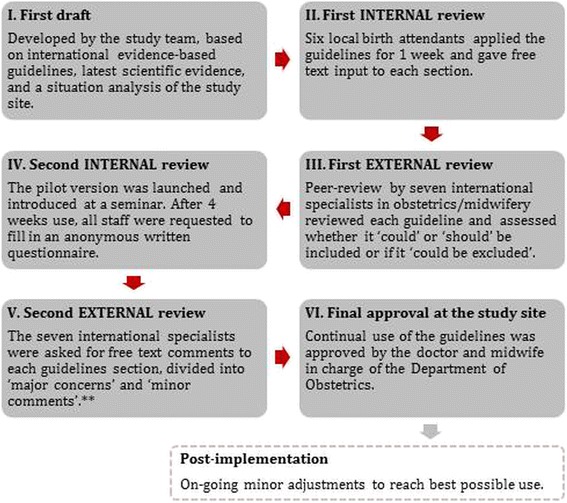
Methods: Part 1: Modification of evidence-based international guidelines through repeated evaluation cycles by local staff and seven external specialists in midwifery/obstetrics. Part 2: Questionnaire evaluation 12 months post-implementation of perceptions and use among professional birth attendants.
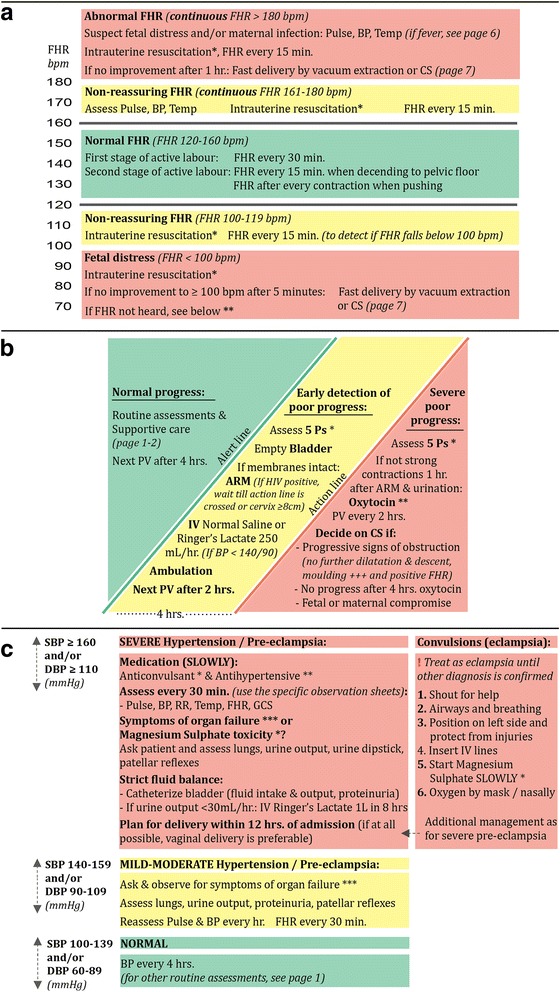
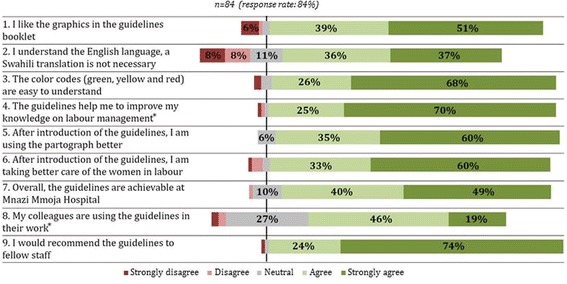
Results: Part 1: After the development process, including three rounds of evaluation by staff and two external peer-review cycles, there were no major concerns with the guidelines internally nor externally. Thereby, international recommendations were condensed to the eight-paged 'PartoMa guidelines ©'. This pocket booklet includes routine assessments, supportive care, and management of common abnormalities in foetal heart rate, labour progress, and maternal condition. It uses colour codes indicating urgency. Compared to international guidelines, reductions were made in frequency of assessments, information load, and ambiguity. Part 2: Response rate of 84% (n = 84). The majority of staff (93%) agreed that the guidelines helped to improve care. They found the guidelines achievable (89%), and the graphics worked well (90%). Doctors more often than nurse-midwives (89% versus 74%) responded to use the guidelines daily.
Conclusions: The PartoMa guidelines ensure readily available, locally achievable, and acceptable support for intrapartum surveillance, triage, and management. This is a crucial example of adapting evidence-based international recommendations to local reality.
Trial registration: This paper describes the intervention of the PartoMa trial, which is registered on ClinicalTrials.org ( NCT02318420 , 4th November 2014).
Keywords: Guidelines; Labour; PartoMa; Partograph; Quality of care; Tanzania.
Figures
References
-
- Alkema L, Chou D, Hogan D, Zhang S, Moller A-B, Gemmill A, et al. Global, regional, and national levels and trends in maternal mortality between 1990 and 2015, with scenario-based projections to 2030: a systematic analysis by the UN maternal mortality estimation inter-agency group. Lancet. 2015;387:462–474. doi: 10.1016/S0140-6736(15)00838-7. - DOI - PMC - PubMed
-
- UNICEF, WHO, The World Bank, United Nations. Levels & Trends in Child Mortality: Report 2015. New York: United Nations Children’s Fund; 2015.
-
- Wang W, Alva S, Wang S, Fort A. Levels and Trends in the Use of Maternal Health Services in Developing Countries - DHS Comparative Reports 26. Calverton: U.S. Agency for International Development; 2011.
-
- Puchalski Ritchie LM, Khan S, Moore JE, Timmings C, van Lettow M, Vogel JP, et al. Low- and middle-income countries face many common barriers to implementation of maternal health evidence products. J. Clin. Epidemiol. 2016;In Press. - PubMed
MeSH terms
Associated data
LinkOut - more resources
Full Text Sources
Other Literature Sources
Medical
