Association of Sex with Risk of Kidney Graft Failure Differs by Age
- PMID: 28592422
- PMCID: PMC5619967
- DOI: 10.1681/ASN.2016121380
Association of Sex with Risk of Kidney Graft Failure Differs by Age
Abstract
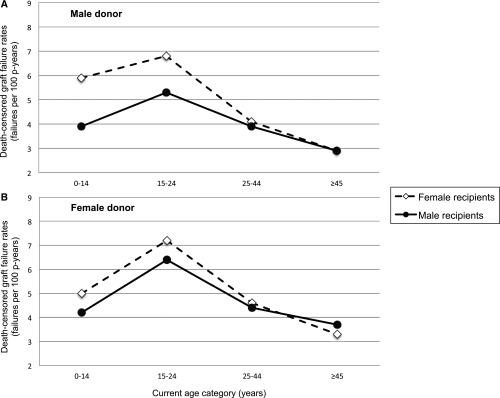
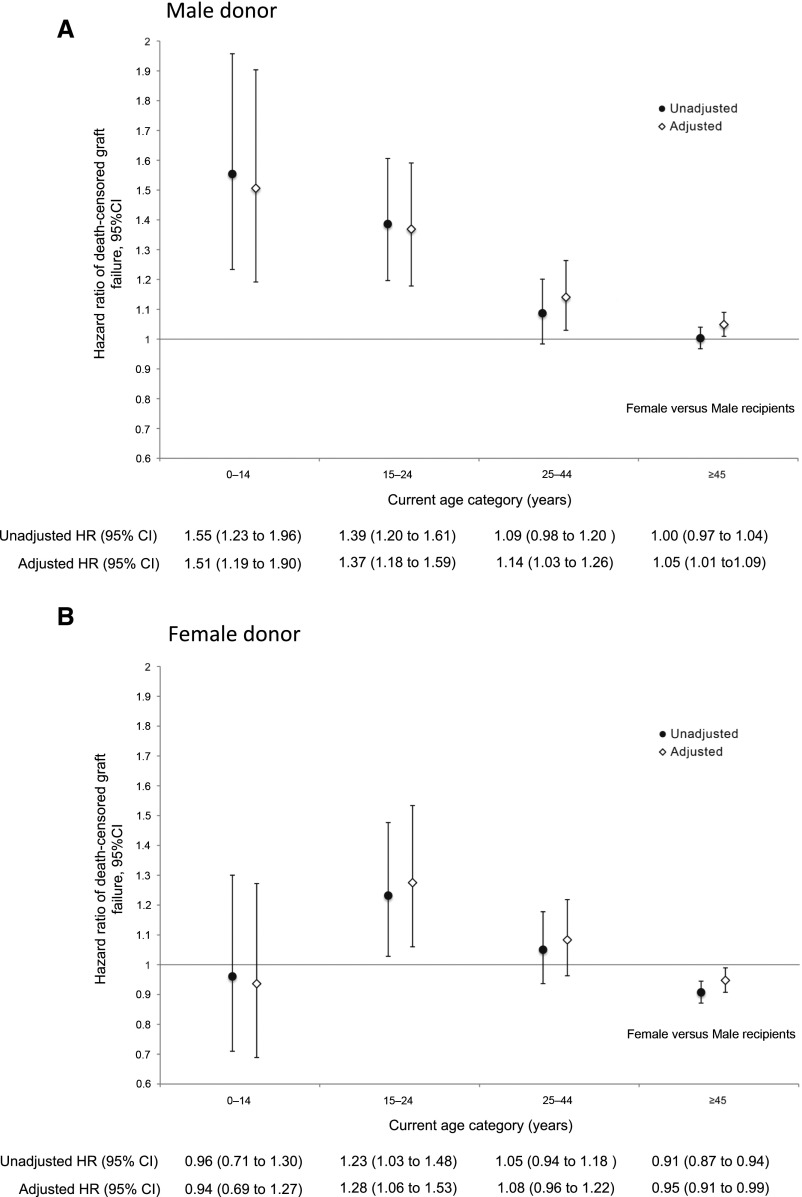
Prior studies of sex differences in kidney graft survival showed conflicting results. We hypothesized that the association between recipient sex and kidney graft failure risk differs by recipient age and donor sex. We evaluated 159,417 patients recorded in the Scientific Registry of Transplant Recipients database who received a first deceased-donor kidney transplant (1995-2013). We used time-varying Cox models to estimate the association between recipient sex and death-censored graft failure. Models, stratified on donor sex and adjusted for potential confounders, included a recipient sex by current age interaction term. Among recipients of male donors, females of all ages had significantly higher graft failure risks than males (adjusted hazard ratios 0-14 years: 1.51 [95% confidence intervals 1.19 to 1.90]; 15-24 years: 1.37 [1.18 to 1.59]; 25-44 years: 1.14 [1.03 to 1.26]; 45 years: 1.05 [1.01 to 1.09]). Among recipients of female-donor grafts, only female recipients aged 15-24 years had a significantly higher graft failure risk than their male counterparts had (1.28 [1.06 to 1.53]). Indeed, female recipients aged ≥45 years had a significantly lower graft failure risk than their male counterparts had (0.95 [0.91 to 0.99]). These observations might be explained by the combined influence of several factors, including recognition of sex-determined minor histocompatibility antigens, influence of sex hormones on immune activation, sex- and age-related differences in medication adherence, and sex-related differences in body size. Additional studies should determine whether sex- and age-specific immunosuppression strategies are warranted for kidney graft recipients.
Keywords: Epidemiology and outcomes; kidney transplantation; transplant outcomes.
Copyright © 2017 by the American Society of Nephrology.
Figures
Comment in
-
Sex and Kidney Transplantation: Why Can't a Woman Be More Like a Man?J Am Soc Nephrol. 2017 Oct;28(10):2829-2831. doi: 10.1681/ASN.2017060657. Epub 2017 Jul 28. J Am Soc Nephrol. 2017. PMID: 28754789 Free PMC article. No abstract available.
References
-
- Foster BJ, Dahhou M, Zhang X, Platt RW, Samuel SM, Hanley JA: Association between age and graft failure rates in young kidney transplant recipients. Transplantation 92: 1237–1243, 2011 - PubMed
-
- Keith DS, Cantarovich M, Paraskevas S, Tchervenkov J: Recipient age and risk of chronic allograft nephropathy in primary deceased donor kidney transplant. Transpl Int 19: 649–656, 2006 - PubMed
-
- Kaboré R, Couchoud C, Macher M-A, Salomon R, Ranchin B, Lahoche A, Roussey-Kesler G, Garaix F, Decramer S, Piètrement C, Lassalle M, Baudouin V, Cochat P, Niaudet P, Joly P, Leffondré K, Harambat J: Age dependent risk of graft failure in young kidney transplant recipients [published online ahead of print August 1, 2016]. Transplantation 10.1097/TP.0000000000001372 - DOI - PubMed
-
- Meier-Kriesche HU, Ojo AO, Leavey SF, Hanson JA, Leichtman AB, Magee JC, Cibrik DM, Kaplan B: Gender differences in the risk for chronic renal allograft failure. Transplantation 71: 429–432, 2001 - PubMed
MeSH terms
LinkOut - more resources
Full Text Sources
Other Literature Sources
Medical