Review
. 2017 Dec 27;57(3):87-97.
doi: 10.3960/jslrt.17008. Epub 2017 Jun 8.

Treatment advances and prognosis for patients with adult T-cell leukemia-lymphoma

Affiliations
Review

Treatment advances and prognosis for patients with adult T-cell leukemia-lymphoma

Hiroo Katsuya et al. J Clin Exp Hematop. .

Abstract

A classification for adult T-cell leukemia-lymphoma (ATL) based on clinical features was proposed in 1991: acute, lymphoma, chronic, and smoldering types, and their median survival times (MSTs) were reported to be 6.2, 10.2, 24.3 months, and not reached, respectively. Several new therapies for ATL have since been developed, i.e. dose-intensity multi-agent chemotherapies, allogeneic hematopoietic stem cell transplantation (allo-HSCT), monoclonal antibodies, and anti-viral therapy. The monoclonal antibody to CCR4, mogamulizumab, clearly improved response rates in patients with treatment-naïve and relapsed aggressive ATL, and has the potential to provide a survival advantage. The outcomes of allo-HSCT have been reported since the early 2000s. High treatment-related mortality was initially the crucial issue associated with this treatment approach; however, reduced intensity conditioning regimens have decreased the risk of treatment-related mortality. The introduction of allo- HSCT has had a positive impact on the prognosis of and potential curability with treatments for ATL. A meta-analysis of a treatment with interferon-α and zidovudine (IFN/AZT) revealed a survival benefit in patients with the leukemic subtype. A phase 3 study comparing IFN/AZT with watchful waiting in patients with indolent ATL is ongoing in Japan. Several clinical trials on novel agents are currently being conducted, such as the histone deacetylase inhibitors, alemtuzumab, brentuximab vedotin, nivolumab, and an EZH1/2 dual inhibitor.

Keywords: adult T-cell leukemia-lymphoma; allogeneic hematopoietic stem cell transplantation; dose-intensity multi-agent chemotherapy.


Conflict of interest statement

CONFLICT OF INTEREST: H.K. has no conflicts of interest to declare.

K.I. reports grants and personal fees from Kyowa Hakko Kirin, Chugai Pharmaceutical, Takeda Pharmaceutical, Novartis, Eisai, and Taiho Pharmaceutical; personal fees from Bristol-Myers Squibb, Celgene, Janssen Pharmaceutical, and Pfizer; and grants from Yakult Pharmaceutical, MSD, and Japan Blood Products Organization, outside the submitted work.

Figures
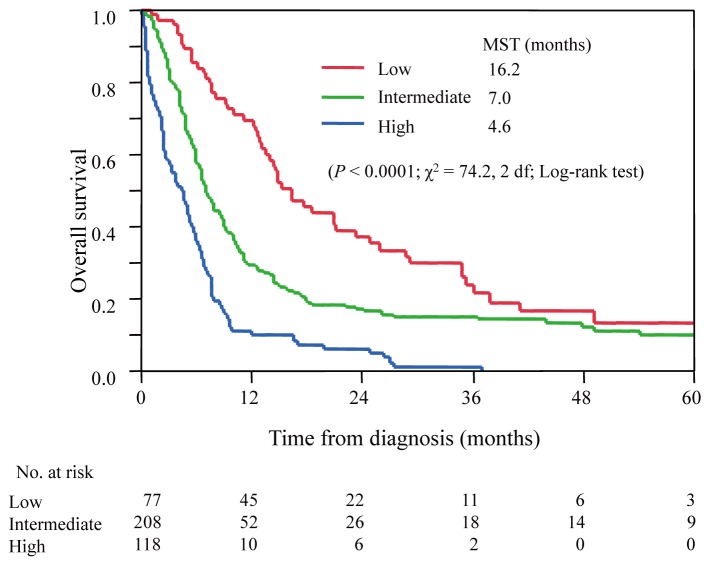
Fig. 1
Fig. 1
Survival curves for acute and lymphoma types according to ATL-PI. The prognostic score = 2 (if the stage = III or IV); + 1 (if the ECOG performance status > 1); + 1 (if age > 70); + 1 (if albumin < 3.5 g/dL; + 1 (if sIL2R > 20,000 U/mL). Scores from 0 to 2 were categorized as low risk, 3 to 4 as intermediate risk, and 5 to 6 as high risk.
Fig. 2
Fig. 2
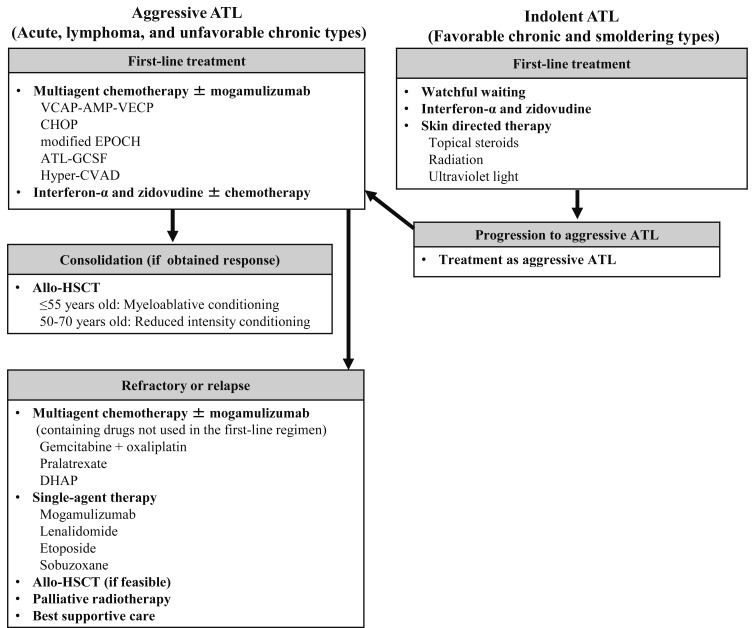
Treatment algorithm for ATL patients. The multi-agent chemotherapies are recommended for patients with aggressive ATL as first-line treatment, such as VCAP-AMP-VECP and CHOP. If these patients respond to first-line chemotherapy and have a HLA-matched donor, subsequent allo-HSCT is recommended. Mogamulizumab is used for patients whose ATL cells express CC chemokine receptor 4. Patients with refractory or relapsed aggressive ATL are treated with multi-agent chemotherapy containing drugs not used in the prior regimen or single-agent therapies. The combination of gemcitabine and oxaliplatin, pralatrexate, or DHAP were used as investigator’s choice regimens in a prospective study. The combination of interferon-α and zidovudine (IFN-AZT) have been used for the treatment of acute, chronic, and smoldering types outside Japan. The retrospective study showed that low-dose IFN-AZT with chemotherapy is also an option for lymphoma type. Regarding indolent ATL, watchful waiting including skin-directed therapy for skin lesions or IFN-AZT are recommended. Chemotherapy is applied if transformation to an aggressive type occurs. Abbreviations: allo-HSCT, allogeneic-hematopoietic stem cell transplantation; CHOP, consisting of cyclophosphamide, doxorubicin, vincristine, and prednisolone; VCAP-AMP-VECP, sequential combination chemotherapy consisting of VCAP (vincristine, cyclophosphamide, doxorubicin, and prednisolone), AMP (doxorubicin, ranimustine, and prednisolone), and VECP (vindesine, etoposide, carboplatin, and prednisolone); ATL-GCSG, consisting of vincristine, vindesine, doxorubicin, mitoxantrone, cyclophosphamide, etoposide, ranimustine, and prednisolone with prophylactic support by granulocyte colony-stimulating factor; Modified EPOCH consisting of etoposide, prednisolone, vincristine, carboplatin, and doxorubicin: cyclophosphamide used in original EPOCH was substituted for carboplatin.; DHAP, consisting of dexamethasone, high-dose cytarabine, and cisplatin; Hyper-CVAD, consisting of cyclophosphamide, doxorubicin, vincristine, and dexamethasone.

References

    1. de The G : Bomford R: An HTLV-I vaccine: why, how, for whom? AIDS Res Hum Retroviruses 9: 381-386, 1993. 10.1089/aid.1993.9.381 - DOI - PubMed
    1. Gessain A, Cassar O: Epidemiological Aspects and World Distribution of HTLV-1 Infection. Front Microbiol 3: 388, 2012. 10.3389/fmicb.2012.00388 - DOI - PMC - PubMed
    1. Proietti FA, Carneiro-Proietti AB, Catalan-Soares BC, Murphy EL: Global epidemiology of HTLV-I infection and associated diseases. Oncogene 24: 6058-6068, 2005. 10.1038/sj.onc.1208968 - DOI - PubMed
    1. Iwanaga M, Watanabe T, Yamaguchi K: Adult T-cell leukemia: a review of epidemiological evidence. Front Microbiol 3: 322, 2012. 10.3389/fmicb.2012.00322 - DOI - PMC - PubMed
    1. Shimoyama M: Diagnostic criteria and classification of clinical subtypes of adult T-cell leukaemia-lymphoma. A report from the Lymphoma Study Group (1984-87). Br J Haematol 79: 428-437, 1991. 10.1111/j.1365-2141.1991.tb08051.x - DOI - PubMed

MeSH terms