


Biogeography of Amazon birds: rivers limit species composition, but not areas of endemism
- PMID: 28592879
- PMCID: PMC5462822
- DOI: 10.1038/s41598-017-03098-w
Biogeography of Amazon birds: rivers limit species composition, but not areas of endemism
Abstract
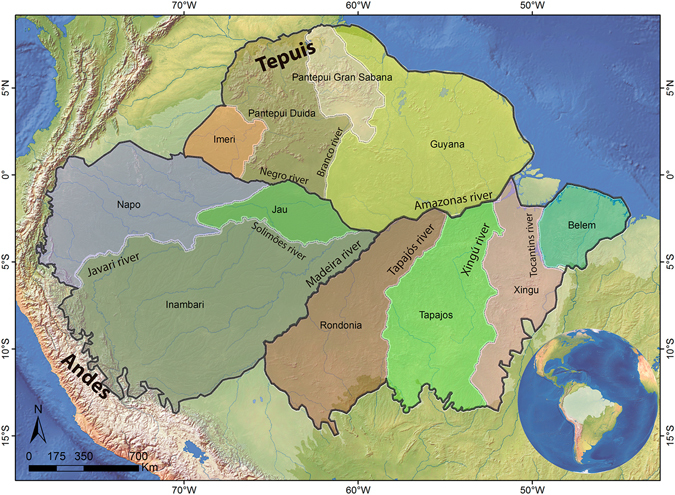
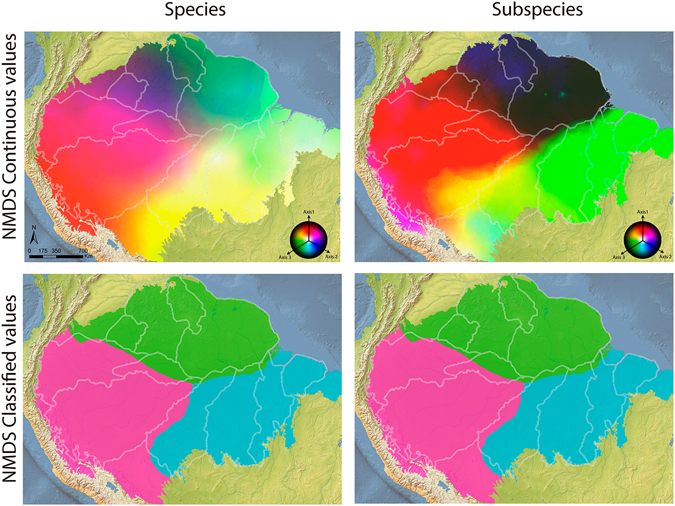
Amazonian rivers are usually suggested as dispersal barriers, limiting biogeographic units. This is evident in a widely accepted Areas of Endemism (AoEs) hypothesis proposed for Amazonian birds. We empirically test this hypothesis based on quantitative analyses of species distribution. We compiled a database of bird species and subspecies distribution records, and used this dataset to identify AoEs through three different methods. Our results show that the currently accepted Amazonian AoEs are not consistent with areas identified, which were generally congruent among datasets and methods. Some Amazonian rivers represent limits of AoEs, but these areas are not congruent with those previously proposed. However, spatial variation in species composition is correlated with largest Amazonian rivers. Overall, the previously proposed Amazonian AoEs are not consistent with the evidence from bird distribution. However, the fact that major rivers coincide with breaks in species composition suggest they can act as dispersal barriers, though not necessarily for all bird taxa. This scenario indicates a more complex picture of the Amazonian bird distribution than previously imagined.
Conflict of interest statement
The authors declare that they have no competing interests.
Figures



References
-
- Wallace A. On the monkeys of the Amazon. Proc. Zool. Soc. London. 1852;20:107–110.
-
- Cracraft, J. Historical biogeography and patterns of differentiation within the South American avifauna: areas of endemism. Ornithol. Monogr. 49–84 (1985).
-
- Silva, J. M. C., Novaes, F. C. & Oren, D. C. Differentiation of Xiphocolaptes (Dendrocolaptidae) across the river Xingu, Brazilian Amazonia: recognition of a new phylogenetic species and biogeographic implications. Br. Ornithol. Club 185–194 (2002).
-
- Borges SH, Silva JMC. Da. A New Area of Endemism for Amazonian Birds in the Rio Negro Basin. Wilson J. Ornithol. 2012;124:15–23. doi: 10.1676/07-103.1. - DOI
Publication types
MeSH terms
LinkOut - more resources
Full Text Sources
Other Literature Sources
