Review
. 2017 Apr 7;20(2):91-96.
doi: 10.1007/s40477-017-0244-7. eCollection 2017 Jun.

The use of lung ultrasound images for the differential diagnosis of pulmonary and cardiac interstitial pathology

Affiliations
Review

The use of lung ultrasound images for the differential diagnosis of pulmonary and cardiac interstitial pathology

Gino Soldati et al. J Ultrasound. .

Abstract

In recent years, great advances have been made in the use of lung ultrasound to detect pulmonary edema and interstitial changes in the lung. However, it is clear that B-lines oversimplify the description of the physical phenomena associated with their presence. The artifactual images that ultrasounds provide in interstitial pulmonary pathology are merely the ultimate outcome of the complex interaction of a specific acoustic wave with a specific three-dimensional biological structure. This interaction lacks a solid physical interpretation of the acoustic signs to support it. The aim of this paper was to describe the differences between the sonographic interstitial syndrome related to lung diseases and that related to cardiogenic edema in the light of current knowledge regarding the pleural plane's response to ultrasound waves.

Negli ultimi anni sono stati fatti grandi progressi in ecografia polmonare per rilevare l’edema polmonare e le alterazioni dell’interstizio polmonare. Tuttavia, è chiaro che le linee B semplificano eccessivamente la descrizione di fenomeni fisici associati alla loro presenza. Le immagini di artefatti date dagli ultrasuoni nella patologia polmonare interstiziale sono soltanto il risultato finale di una complessa interazione tra un’onda acustica specifica ed una altrettanto specifica struttura biologica tridimensionale. Questa interazione manca di una solida interpretazione fisica. Lo scopo di questo lavoro è quello di descrivere le differenze ecografiche tra la sindrome interstiziale dovuta a malattia polmonare e quelle relative ad edema cardiogeno, alla luce delle attuali conoscenze in merito alla risposta del piano pleurico agli ultrasuoni.

Keywords: Artifacts; Diagnosis; Lung; Physics; Ultrasound.


Conflict of interest statement

Conflict of interest

The Authors declare no conflict of interest.

Ethical approval

The authors declare that an approval of ethic committee is not applicable for this paper.

Informed consent

For this study, Informed consent is not required.

Figures

Fig. 1
Fig. 1
Sonographic interstitial syndrome. Multiple, separated B-lines. 6-MHz convex probe, fundamental imaging. Acute cardiogenic pulmonary edema
Fig. 2
Fig. 2
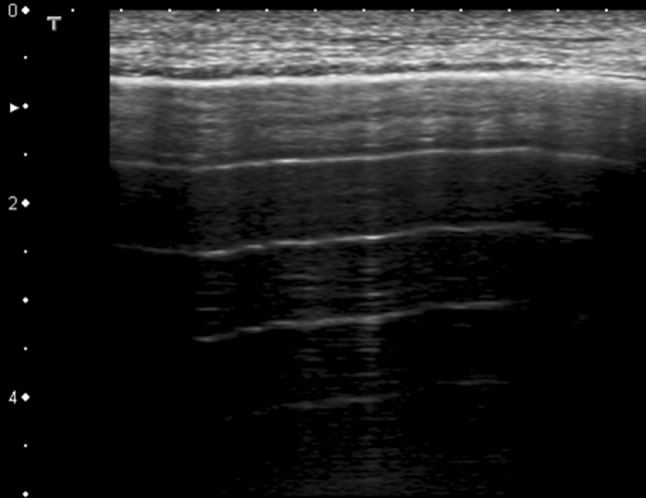
Normal sonographic lung appearance. Intercostal scan of the chest using a 7-MHz linear probe. Multiple horizontal reverberations of the pleural line are detected (A-lines) and the superficial subpleural space shows the artifactual representation of the fascial and muscular layers that the beam encounters before reaching the pleural line (mirror effect)
Fig. 3
Fig. 3
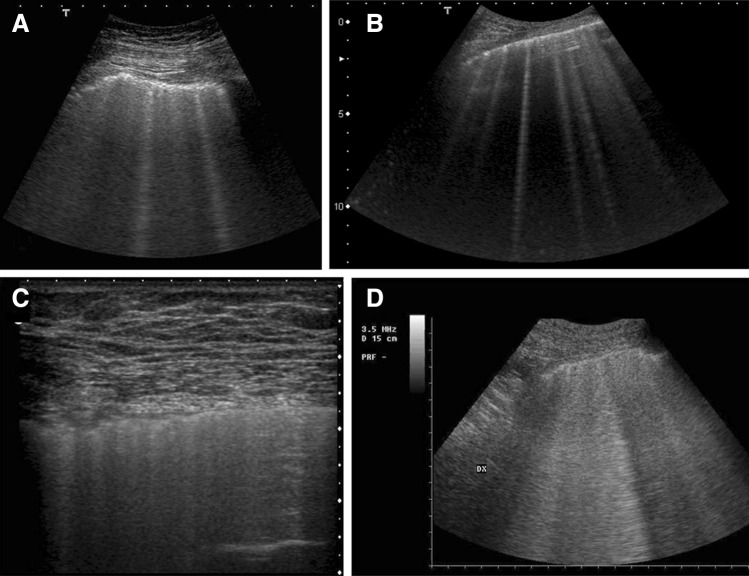
Morphological variations of the B-lines in sonographic interstitial syndrome. a Pneumogenic interstitial syndrome (pulmonary silicosis), 6 MHz convex probe. Irregular pleural line and multiple blurred, uneven B-lines. b Acute interstitial cardiogenic pulmonary edema. 6 MHz convex probe. The pleural line is regular. Some bright, laser-like B-lines with septal disposition are represented. c ARDS, non-gravitational area without consolidation. 7 MHz linear probe. On the right of the picture, an area of near-normal lung showing A-lines with a relatively regular pleura is visible. On the left of the image, the pleura is irregular, coalescent B-lines are hidden, and there is not a normal A-line pattern. d Non-consolidative ARDS: 6-MHz convex probe. Inhomogeneous white lung. The detection of single B-lines that appear laser-like is unusual. This pattern is consistent with non-consolidative alveolar flooding
Fig. 4
Fig. 4
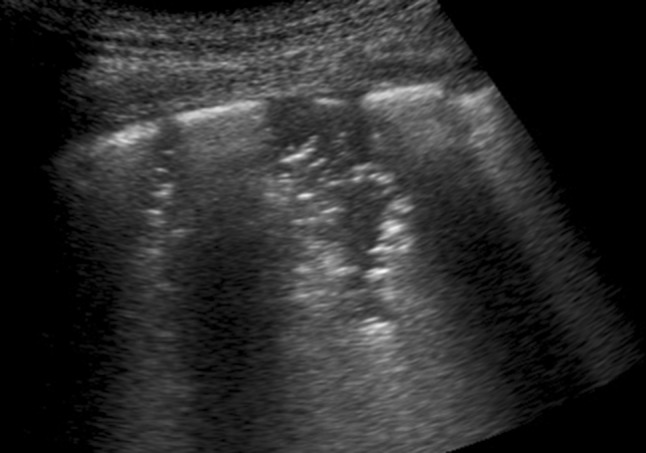
Bronchopneumonia, 6 MHz convex probe. White lung and B-lines are often observed in the areas adjacent to the pneumonic consolidations and are related to interstitial and alveolar inflammatory changes. In this picture, two small consolidations surrounded by white lung, and containing small air bronchograms and alveolograms, are evident. This focal pattern is pneumogenic and generally represents pneumonia

References

    1. Picano E, Pellikka PA. Ultrasound for extravascular lung water: a new standard for pulmonary congestion. Eur Heart J. 2016;36:2097–2104. doi: 10.1093/eurheartj/ehw164. - DOI - PMC - PubMed
    1. Blanco PA, Cianciulli TF. Pulmonary edema assessed by ultrasound: impact in cardiology and intensive care practice. Echocardiography. 2016;33:778–787. doi: 10.1111/echo.13182. - DOI - PubMed
    1. Lichtenstein D, Meziere G. A lung ultrasound sign allowing bedside distinction between pulmonary edema and COPD: the comet-tail artifact. Intensive Care Med. 1998;24:1331–1334. doi: 10.1007/s001340050771. - DOI - PubMed
    1. Lichtenstein D, Meziere GA. Relevance of lung ultrasound in the diagnosis of acute respiratory failure: the BLUE protocol. Chest. 2008;134:117–125. doi: 10.1378/chest.07-2800. - DOI - PMC - PubMed
    1. Soldati G, Demi M, Inchingolo R, Smargiassi A, Demi L (2016) On the physical basis of pulmonary sonographic interstitial syndrome. J Ultrasound Med. doi:10.7863/ultra.15.08023 - PubMed

MeSH terms