


Contrast-enhanced ultrasound of the carotid system: a review of the current literature
- PMID: 28592999
- PMCID: PMC5440332
- DOI: 10.1007/s40477-017-0239-4
Contrast-enhanced ultrasound of the carotid system: a review of the current literature
Abstract
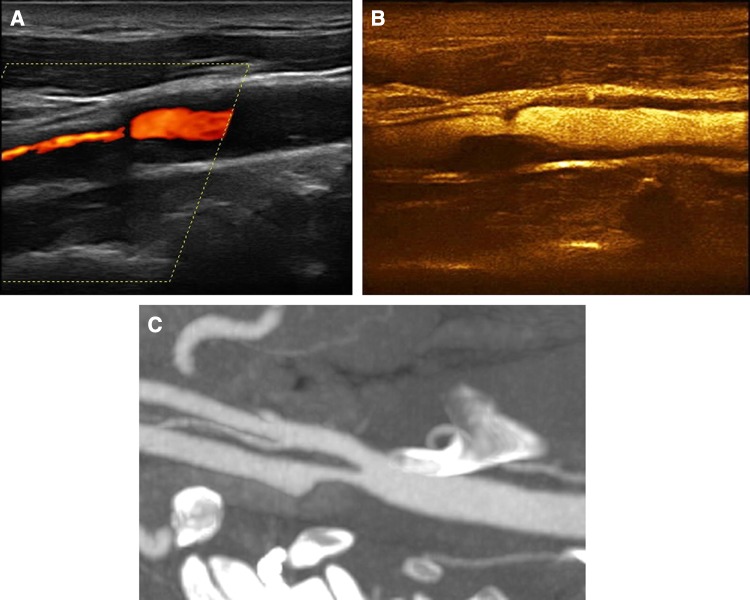
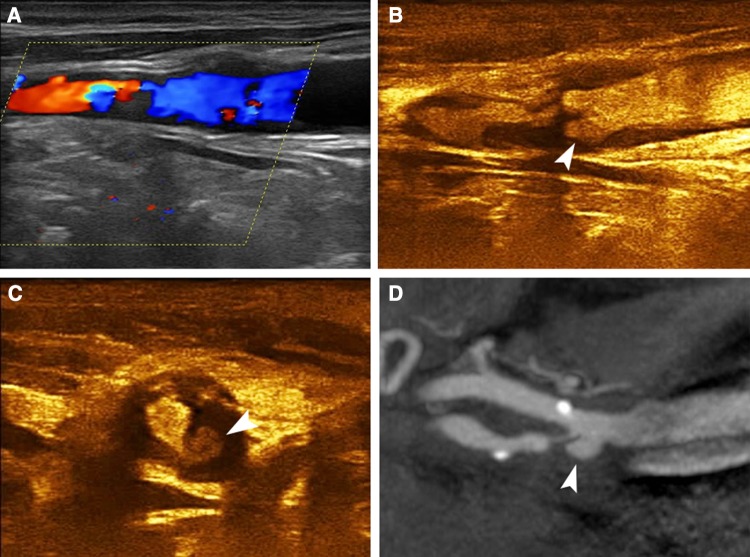
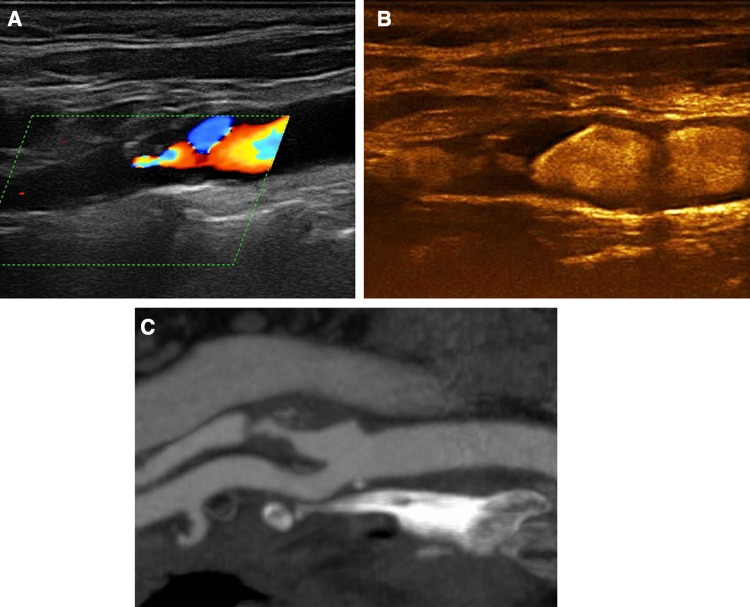
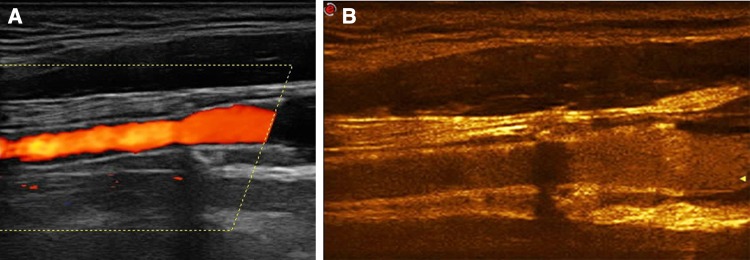
Carotid disease is a major current health problem accounting for a significant part of stroke patients. Ultrasound with colour Doppler and spectral analysis is the primary imaging technique used for screening and diagnostic evaluation of the extracranial part of carotid arteries offering identification and grading of carotid disease. However, inherent limitations of this technique include flow-related artefacts like Doppler angle dependence and aliasing artefact which may sometimes hinder complete assessment of a stenotic part of the vessel, potentially failing to address clinically significant differential diagnosis issues. The intravenous use of microbubbles as an US contrast agent has been introduced for the supplementation of conventional technique. The value of contrast-enhanced ultrasound (CEUS) has been investigated in the evaluation of carotid disease leading to promising results. CEUS provides improved flow visualization free of artefacts and detailed plaque surface delineation, thus being able to accurately grade stenosis, identify carotid plaque ulcerations, differentiate occlusion from highly stenotic plaques and identify carotid dissection. Furthermore, microbubbles can be used to identify and grade intraplaque neovascularization, carotid wall inflammation in patients with arteritis, follow-up patients after carotid intervention and assist interventional procedures reducing the need for nephrotoxic contrast agents. The purpose of this review is to present and discuss the current literature regarding the various uses of CEUS in carotid arteries.
La malattia carotidea rappresenta un grosso problema attuale di una parte significativa dei pazienti con ictus. L’ecografia con color Doppler e l’analisi spettrale è la metodica di imagine di prima istanza utilizzata per lo screening e la valutazione diagnostica della parte extracraniale delle arterie carotidee che offre l’identificazione e la classificazione della malattia carotidea. Tuttavia le limitazioni intrinseche di questa tecnica includono gli artefatti connessi al flusso, come dipendenza dall’angolo Doppler e l’artefatto aliasing che talvolta possono ostacolare la valutazione totale di una parte stenotica del vaso, avendo ad affrontare potenzialmente significativi problemi clinici di diagnosi differenziale. L’ uso endovenoso di microbolle come agente di contrasto nell’ecografia è stato introdotto per la supplementazione della tecnica convenzionale. Il valore del mezzo di contrasto nell’ ecografia (CEUS) è stato studiato per la valutazione della patologia carotidea e sta portando risultati promettenti. CEUS offre una migliore visualizzazione dettagliatta, libera da artefatti di flusso della placca e la delineazione della superficie essendo così in grado di precisare il grado di stenosi ed identificare ulzerazioni della placca carotidea, differenziare l’occlusione dalle placche altamente stenotiche e identificare la dissezione carotidea. Inoltre, le microbolle possono essere utilizzate per l’identificazione del grado di neovascolarizzazione intraplacca, l’infiammazione della parete carotidea in pazienti con l’arterite, di eseguire il follow-up dei pazienti dopo l’intervento carotideo e assistere le procedure interventistiche riducendo la necessità di mezzi di contrasto nefrotossici. Lo scopo di questa rassegna è quello di presentare e discutere la letteratura attuale per quando riguarda i vari usi di CEUS nelle arterie carotidee.
Keywords: Atherosclerosis; Carotid; Contrast-enhanced ultrasound; Occlusion; Plaque; Stenosis.
Conflict of interest statement
Conflict of interest
The authors declare that they have no conflict of interest.
Ethical approval
All procedures performed in studies involving human participants were in accordance with the ethical standards of the institutional and/or national research committee and with the 1964 Helsinki Declaration and its later amendments or comparable ethical standards.
Informed consent
Informed consent was obtained from all individual participants included in the study.
Figures

References
-
- Krogias C, Kerasnoudis A. Detection of microembolic signals and ultrasonic brain perfusion imaging in symptomatic carotid artery disease. Nevrologia-gr. 2012;21:36–46.
-
- Kernan WN, Ovbiagele B, Black HR, et al. Guidelines for the prevention of stroke in patients with stroke and transient ischemic attack: a guideline for healthcare professionals from the American Heart Association/American Stroke Association. Stroke. 2014;45:2160–2236. doi: 10.1161/STR.0000000000000024. - DOI - PubMed
Publication types
MeSH terms
Substances
LinkOut - more resources
Full Text Sources
Other Literature Sources
Medical
