Review
. 2017 Jun 5:21:9.
doi: 10.1186/s40824-017-0095-5. eCollection 2017.

Natural graft tissues and synthetic biomaterials for periodontal and alveolar bone reconstructive applications: a review

Affiliations
Review

Natural graft tissues and synthetic biomaterials for periodontal and alveolar bone reconstructive applications: a review

Zeeshan Sheikh et al. Biomater Res. .

Abstract

Periodontal disease is categorized by the destruction of periodontal tissues. Over the years, there have been several clinical techniques and material options that been investigated for periodontal defect repair/regeneration. The development of improved biomaterials for periodontal tissue engineering has significantly improved the available treatment options and their clinical results. Bone replacement graft materials, barrier membranes, various growth factors and combination of these have been used. The available bone tissue replacement materials commonly used include autografts, allografts, xenografts and alloplasts. These graft materials mostly function as osteogenic, osteoinductive and/or osteoconductive scaffolds. Polymers (natural and synthetic) are more widely used as a barrier material in guided tissue regeneration (GTR) and guided bone regeneration (GBR) applications. They work on the principle of epithelial cell exclusion to allow periodontal ligament and alveolar bone cells to repopulate the defect before the normally faster epithelial cells. However, in an attempt to overcome complications related to the epithelial down-growth and/or collapse of the non-rigid barrier membrane and to maintain space, clinicians commonly use a combination of membranes with hard tissue grafts. This article aims to review various available natural tissues and biomaterial based bone replacement graft and membrane options used in periodontal regeneration applications.


Figures

Fig. 1
Fig. 1
Clinical photographs showing autogenous block grafting. a Advanced vertical and horizontal bone loss. b Autogenous block graft fixed with screws. c FDBA particles added to fill any remaining gaps. d Porcine degrdable collagen membrane (Bio-Gide) used to contain and cover bone grafts. e. Six month results showing successful bone augmentation. f Dental implants successfully placed into augmented bone. (Courtesy of Dr. Aditya Patel, periodontist, Halifax, NS, Canada)
Fig. 2
Fig. 2
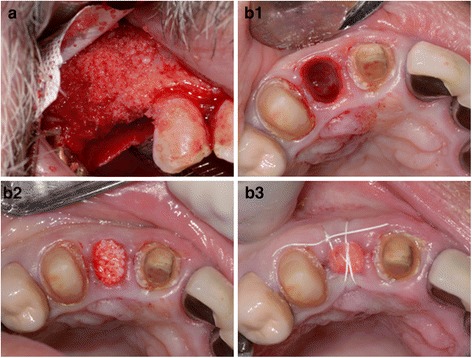
Clinical photographs showing two common applications of FDBA. a. Augmentation of resorbed alveolar ridge. b. Socket preservation after atraumatic extraction of teeth. b1. Tooth #1.2 was atraumatically extracted. b2. FDBA graft gently packed into extraction socket. b3. Absorbable collagen membrane used to cover bone graft
Fig. 3
Fig. 3
Examples of different applications of DBBM Xenograft (Bio-Oss®). a Subantral maxillary augmentation (direct sinus lift). b Augmenting thin bone around dental implants. c As a top layer covering FDBA particles to provide long-term support (sandwich GBR technique). Notice the use of Ti-reinforced d-PTFE membrane to provide space for the healing graft
Fig. 4
Fig. 4
Clinical photographs showing Ti-reinforced d-PTFE membrane application. a Full-thickness mucoperiosteal flap reflected and one defect prepared to receive bone graft. b Particulate bone allograft (FDBA) gently packed into the bony defect. c Ti-reinforced d-PTFE membrane being adapted to cover the bone graft material. d Ti-reinforced d-PTFE membrane could be left exposed during the healing period thanks to its occlusive properties
Fig. 5
Fig. 5
Degradable collagen membranes. a Collagen membranes are best cut into the desired shape utilizing a template before final insertion into oral cavity as their manipulation becomes more difficult after being mixed with blood. b Degradable porcine collagen membrane (Bio-Gide®) used to cover and contain FDBA particles during GBR. c Degradable porcine collagen membrane (Bio-Gide®) is often used to cover and contain FDBA particles used for socket preservation. d Degradable porcine collagen membrane (Bio-Gide®) can be stretched over bone graft and stabilized with fixation tacs. e For GBR, a degradable bovine collagen membrane (Biomend Extend®) could be chosen for its longer resorption time and stiffness f The stiff degradable bovine collagen membrane (Biomend Extend®) could be chosen for its relative rigidity and slow absorption time

References

    1. Listl S, Galloway J, Mossey P, Marcenes W. Global economic impact of dental diseases. J Dent Res. 2015;94:1355–61. doi: 10.1177/0022034515602879. - DOI - PubMed
    1. Albandar JM. Epidemiology and risk factors of periodontal diseases. Dent Clin N Am. 2005;49:517–32. doi: 10.1016/j.cden.2005.03.003. - DOI - PubMed
    1. Loesche WJ, Grossman NS. Periodontal disease as a specific, albeit chronic, infection: diagnosis and treatment. Clin Microbiol Rev. 2001;14:727–52. doi: 10.1128/CMR.14.4.727-752.2001. - DOI - PMC - PubMed
    1. Ramseier CA, Rasperini G, Batia S, Giannobile WV. Advanced reconstructive technologies for periodontal tissue repair. Periodontol 2000. 2012;59:185–202. doi: 10.1111/j.1600-0757.2011.00432.x. - DOI - PMC - PubMed
    1. Misch CM. Autogenous bone: is it still the gold standard? Implant Dent. 2010;19:361. doi: 10.1097/ID.0b013e3181f8115b. - DOI - PubMed