


Strategies for Worksite Health Interventions to Employees with Elevated Risk of Chronic Diseases
- PMID: 28593067
- PMCID: PMC5447415
- DOI: 10.1016/j.shaw.2016.11.004
Strategies for Worksite Health Interventions to Employees with Elevated Risk of Chronic Diseases
Abstract
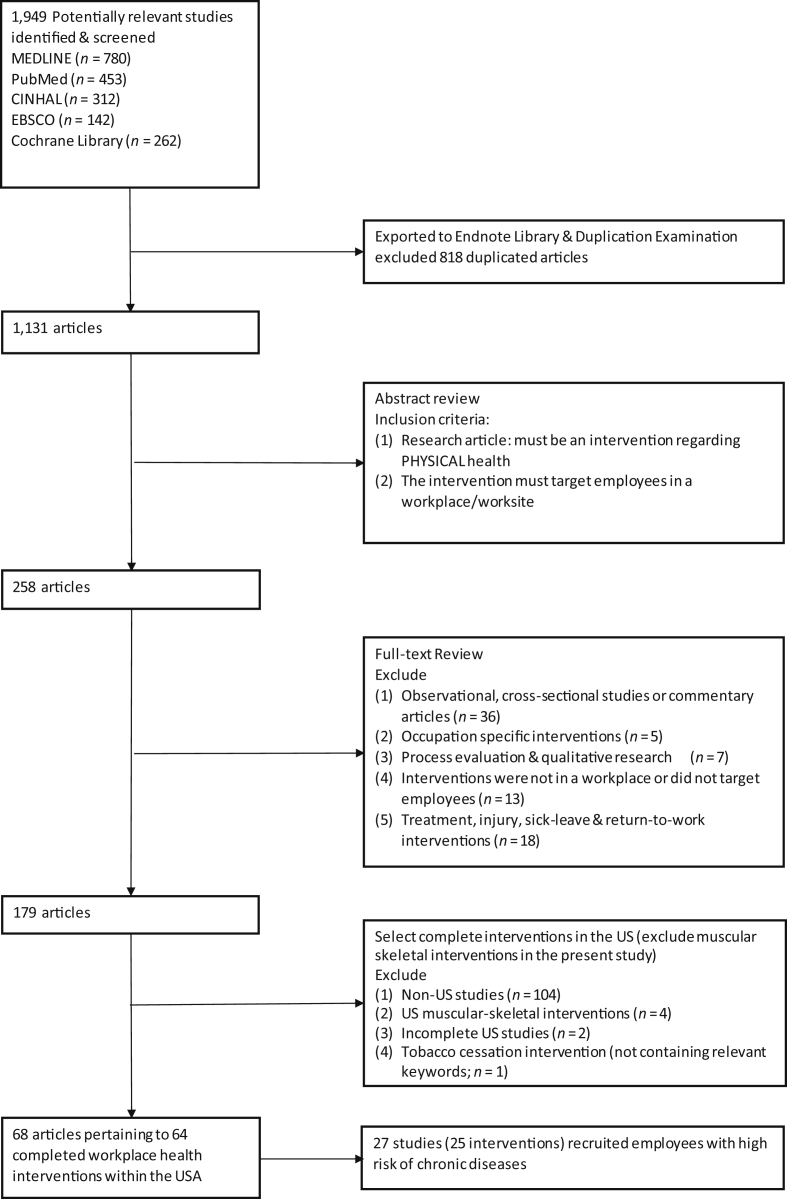
Chronic disease rates have become more prevalent in the modern American workforce, which has negative implications for workplace productivity and healthcare costs. Offering workplace health interventions is recognized as an effective strategy to reduce chronic disease progression, absenteeism, and healthcare costs as well as improve population health. This review documents intervention and evaluation strategies used for health promotion programs delivered in workplaces. Using predetermined search terms in five online databases, we identified 1,131 published items from 1995 to 2014. Of these items, 27 peer-reviewed articles met the inclusion criteria; reporting data from completed United States-based workplace interventions that recruited at-risk employees based on their disease or disease-related risk factors. A content rubric was developed and used to catalogue these 27 published field studies. Selected workplace interventions targeted obesity (n = 13), cardiovascular diseases (n = 8), and diabetes (n = 6). Intervention strategies included instructional education/counseling (n = 20), workplace environmental change (n = 6), physical activity (n = 10), use of technology (n = 10), and incentives (n = 13). Self-reported data (n = 21), anthropometric measurements (n = 17), and laboratory tests (n = 14) were used most often in studies with outcome evaluation. This is the first literature review to focus on interventions for employees with elevated risk for chronic diseases. The review has the potential to inform future workplace health interventions by presenting strategies related to implementation and evaluation strategies in workplace settings. These strategies can help determine optimal worksite health programs based on the unique characteristics of work settings and the health risk factors of their employee populations.
Keywords: chronic disease; employee health; health intervention; intervention strategies; worksite.
References
-
- The Employment Situation—October 2015 Bureau of Labor Statistics 2015 [Internet]. [cited 2015 Dec 11]. Available from: http://www.bls.gov/news.release/pdf/empsit.pdf.
-
- Thorp A.A., Healy G.N., Winkler E., Clark B.K., Gardiner P.A., Owen N., Dunstan D.W. Prolonged sedentary time and physical activity in workplace and non-work contexts: a cross-sectional study of office, customer service and call centre employees. Int J Behav Nutr Phys Act. 2012;9:128. - PMC - PubMed
-
- Duncan G.E. Exercise, fitness, and cardiovascular disease risk in type 2 diabetes and the metabolic syndrome. Curr Diab Rep. 2006;6:29–35. - PubMed
-
- Beunza J.J., Martínez-González M.A., Ebrahim S., Bes-Rastrollo M., Núñez J., Martínez J.A., Alonso A. Sedentary behaviors and the risk of incident hypertension: the SUN Cohort. Am J Hypertens. 2007;20:1156–1162. - PubMed
Publication types
LinkOut - more resources
Full Text Sources
Other Literature Sources
Medical
Miscellaneous
