


POSTURAL STABILITY AND KINETIC CHANGE IN SUBJECTS WITH PATELLOFEMORAL PAIN AFTER A NINE-WEEK HIP AND CORE STRENGTHENING INTERVENTION
- PMID: 28593085
- PMCID: PMC5455181
POSTURAL STABILITY AND KINETIC CHANGE IN SUBJECTS WITH PATELLOFEMORAL PAIN AFTER A NINE-WEEK HIP AND CORE STRENGTHENING INTERVENTION
Abstract
Background: Idiopathic patellofemoral pain (PFP) has been linked to hip weakness and abnormal lower extremity mechanics. The effect of a strengthening intervention on balance has not been well studied among individuals with PFP.
Hypothesis/purpose: The primary aim of this study was to evaluate changes in center of pressure displacement during the single limb squat following a nine-week physical therapy intervention among adolescent females with PFP.
Study design: Interventional and cross-sectional.
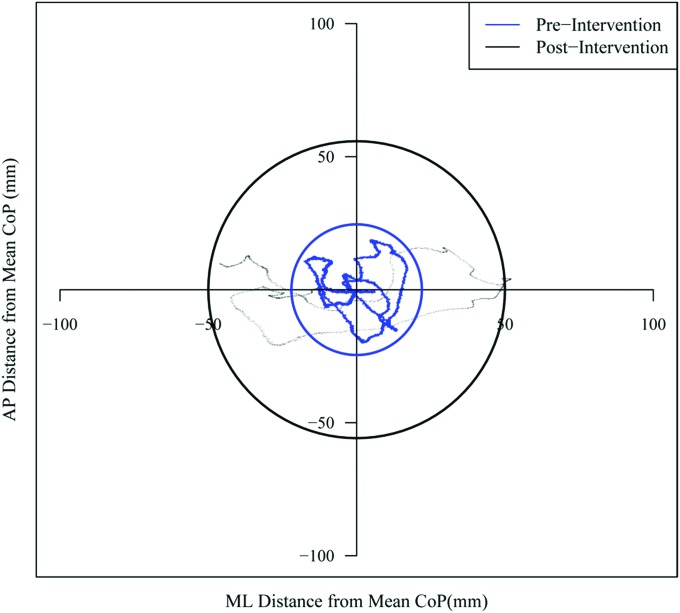
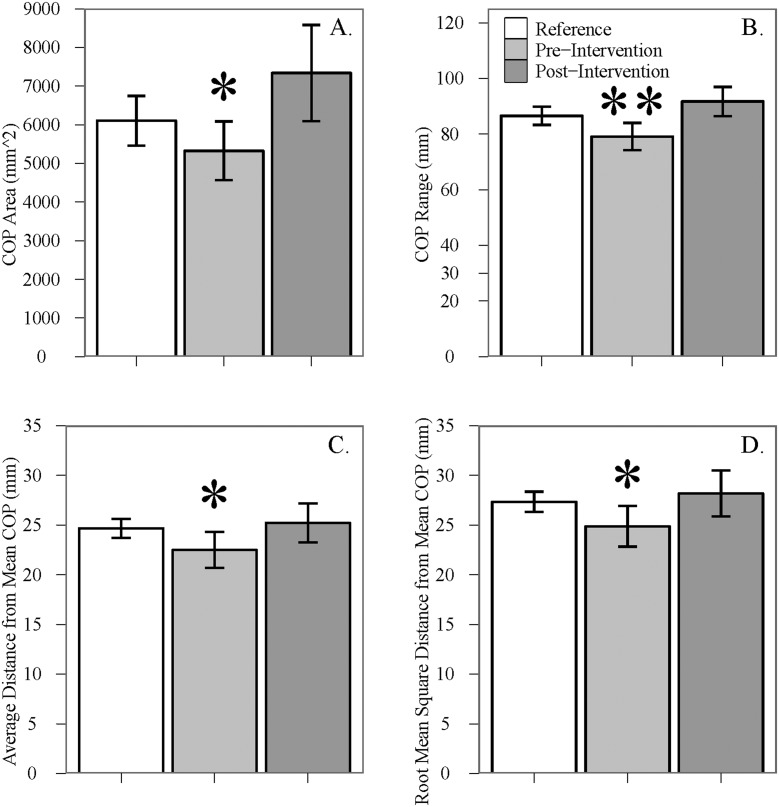
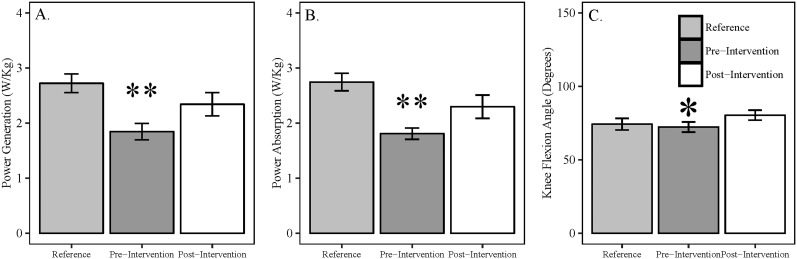
Methods: Seven adolescent females with PFP (10 extremities) were included in the study. Center of Pressure (CoP) excursions during a single limb squat task were measured before and after a nine week of physical therapy intervention focused on strengthening of the hip and core. Seven asymptomatic females were matched to the PFP group on the basis of age and activity level, and were tested as a reference group. CoP trajectories were reduced into four variables: mean distance (MDIST), root-mean-square distance (RDIST), range (RANGE), and 95% confidence interval circle area (AREA-CC). Maximum knee flexion angle, peak knee power generation and absorption were also recorded. Linear mixed models were used to test for within and between group differences in CoP metrics.
Results: Pre-intervention, CoP range, knee power absorption and generation were significantly decreased in the PFP group relative to the reference group. Post-intervention, the PFP group reported a significant decrease in symptom severity. There was also a significant (p<0.05) increase in MDIST, RDIST, RANGE, AREA-CC, peak knee flexion angle, peak power absorption and power generation. There was no difference (p>0.05) in knee flexion, knee power or CoP displacement between the two groups after the physical therapy intervention.
Conclusion: Hip and core-strengthening resulted in a significant decrease in symptom severity as well as significant reductions in CoP displacement.
Level of evidence: 3.
Keywords: Balance; hip strength; patellofemoral pain syndrome; postural stability.
Figures
References
-
- Cichanowski HR Schmitt JS Johnson RJ Niemuth PE. Hip strength in collegiate female athletes with patellofemoral pain. Med Sci Sports Exerc. 2007;39(8):1227-1232. - PubMed
-
- Magalhaes E Fukuda TY Sacramento SN, et al. A comparison of hip strength between sedentary females with and without patellofemoral pain syndrome. J Orthop Sports Phys Ther. 2010;40(10):641-647. - PubMed
-
- Carry PM Kanai S Miller NH Polousky JD. Adolescent patellofemoral pain: a review of evidence for the role of lower extremity biomechanics and core instability. Orthopedics. 2010;33(7):498-507. - PubMed
-
- Powers CM Ward SR Fredericson M, et al. Patellofemoral kinematics during weight-bearing and non-weight-bearing knee extension in persons with lateral subluxation of the patella: a preliminary study. J Orthop Sports Phys Ther. 2003;33(11):677-685. - PubMed
-
- Souza RB Powers CM. Differences in hip kinematics muscle strength, and muscle activation between subjects with and without patellofemoral pain. J Orthop Sports Phys Ther. 2009;39(1):12-19. - PubMed
LinkOut - more resources
Full Text Sources
Research Materials