Simultaneous Antidepressant and Benzodiazepine New Use and Subsequent Long-term Benzodiazepine Use in Adults With Depression, United States, 2001-2014
- PMID: 28593281
- PMCID: PMC5710248
- DOI: 10.1001/jamapsychiatry.2017.1273
Simultaneous Antidepressant and Benzodiazepine New Use and Subsequent Long-term Benzodiazepine Use in Adults With Depression, United States, 2001-2014
Abstract
Importance: Benzodiazepines have been prescribed for short periods to patients with depression who are beginning antidepressant therapy to improve depressive symptoms more quickly, mitigate concomitant anxiety, and improve antidepressant treatment continuation. However, benzodiazepine therapy is associated with risks, including dependency, which may take only a few weeks to develop.
Objectives: To examine trends in simultaneous benzodiazepine and antidepressant new use among adults with depression initiating an antidepressant, assess antidepressant treatment length by simultaneous new use status, estimate subsequent long-term benzodiazepine use in those with simultaneous antidepressant and benzodiazepine new use, and identify determinants of simultaneous new use and long-term benzodiazepine use.
Design, setting, and participants: This cohort study using a US commercial claims database included commercially insured adults (aged 18-64 years) from January 1, 2001, through December 31, 2014, with a recent depression diagnosis who began antidepressant therapy but had not used antidepressants or benzodiazepines in the prior year.
Exposures: Simultaneous new use, defined as a new benzodiazepine prescription dispensed on the same day as a new antidepressant prescription.
Main outcomes and measures: The proportion of antidepressant initiators with simultaneous new use and continuing antidepressant treatment for 6 months and the proportion of simultaneous new users receiving long-term (6-months) benzodiazepine therapy.
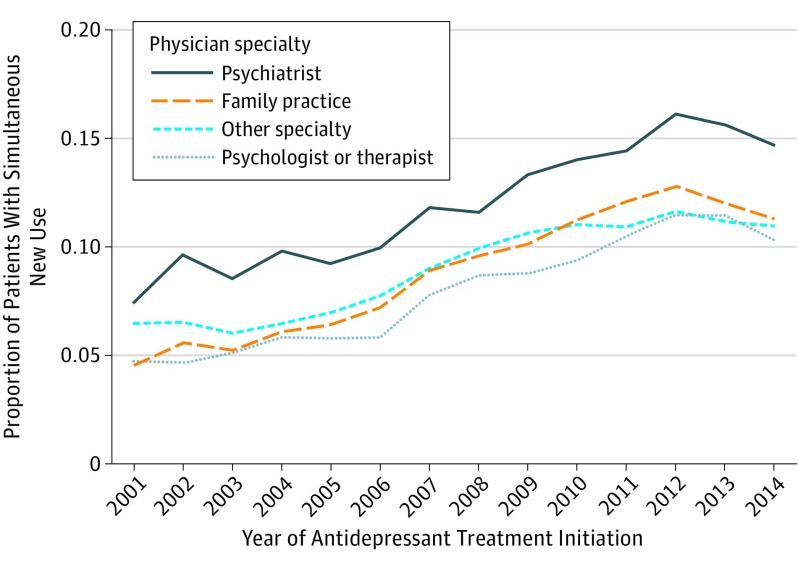
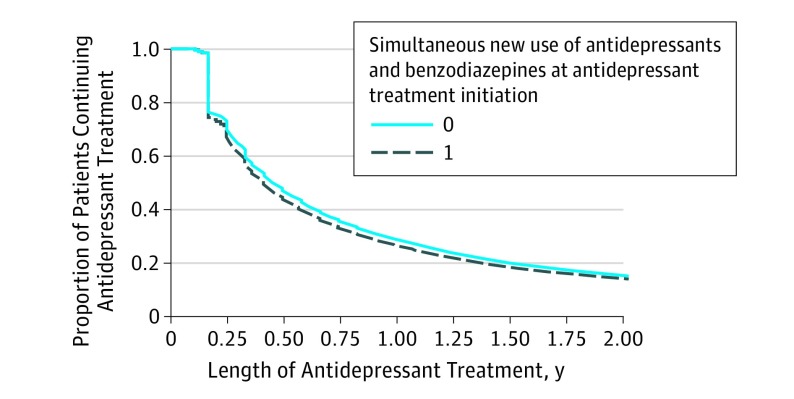
Results: Of the 765 130 adults (median age, 39 years; interquartile range, 29-49 years; 507 451 women [66.3%]) who initiated antidepressant treatment, 81 020 (10.6%) also initiated benzodiazepine treatment. The mean annual increase in the proportion simultaneously starting use of both agents from 2001 to 2014 was 0.49% (95% CI, 0.47%-0.51%), increasing from 6.1% (95% CI, 5.5%-6.6%) in 2001 to 12.5% (95% CI, 12.3%-12.7%) in 2012 and stabilizing through 2014 (11.3%; 95% CI, 11.1%-11.5%). Similar findings were apparent by age group and physician type. Antidepressant treatment length was similar in simultaneous new users and non-simultaneous new users. Among simultaneous new users, 12.3% (95% CI, 12.0%-12.5%) exhibited long-term benzodiazepine use (64.0% discontinued taking benzodiazepines after the initial fill). Determinants of long-term benzodiazepine use after simultaneous new use were longer initial benzodiazepine days' supply, first prescription for a long-acting benzodiazepine, and recent prescription opioid fills.
Conclusions and relevance: One-tenth of antidepressant initiators with depression simultaneously initiated benzodiazepine therapy. No meaningful difference in antidepressant treatment at 6 months was observed by simultaneous new use status. Because of the risks associated with benzodiazepines, simultaneous new use at antidepressant initiation and the benzodiazepine regimen itself require careful consideration.
Conflict of interest statement
Figures
References
-
- American Psychiatric Association Practice Guideline for the Treatment of Patients With Major Depressive Disorder. 3rd ed Arlington, VA: American Psychiatric Association; 2010.
-
- Furukawa TA, Streiner DL, Young LT, Kinoshita Y. Antidepressant plus benzodiazepine for major depression. Cochrane Database Syst Rev. 2001;2(2):CD001026. - PubMed
-
- Smith WT, Londborg PD, Glaudin V, Painter JR; Summit Research Network . Is extended clonazepam cotherapy of fluoxetine effective for outpatients with major depression? J Affect Disord. 2002;70(3):251-259. - PubMed
-
- Youssef NA, Rich CL. Does acute treatment with sedatives/hypnotics for anxiety in depressed patients affect suicide risk? a literature review. Ann Clin Psychiatry. 2008;20(3):157-169. - PubMed
-
- Baldwin DS, Aitchison K, Bateson A, et al. . Benzodiazepines: risks and benefits: a reconsideration. J Psychopharmacol. 2013;27(11):967-971. - PubMed
Publication types
MeSH terms
Substances
Grants and funding
LinkOut - more resources
Full Text Sources
Other Literature Sources
Medical