


Balancing the intermolecular forces in peptide amphiphiles for controlling self-assembly transitions
- PMID: 28594046
- PMCID: PMC6432923
- DOI: 10.1039/c7ob00875a
Balancing the intermolecular forces in peptide amphiphiles for controlling self-assembly transitions
Abstract
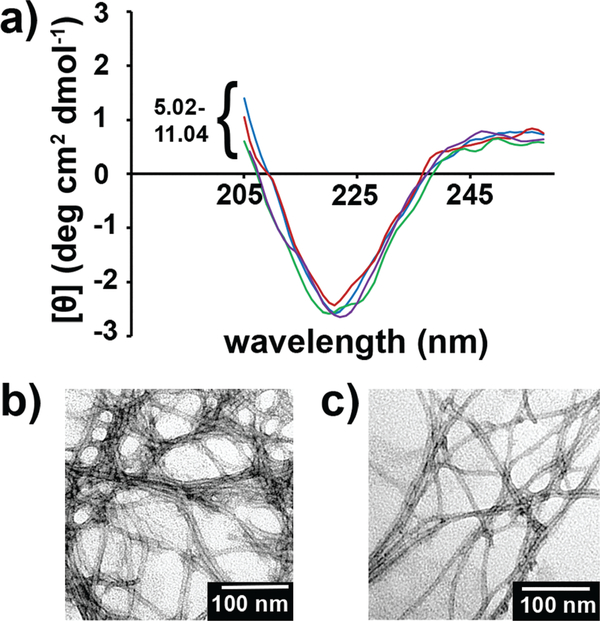
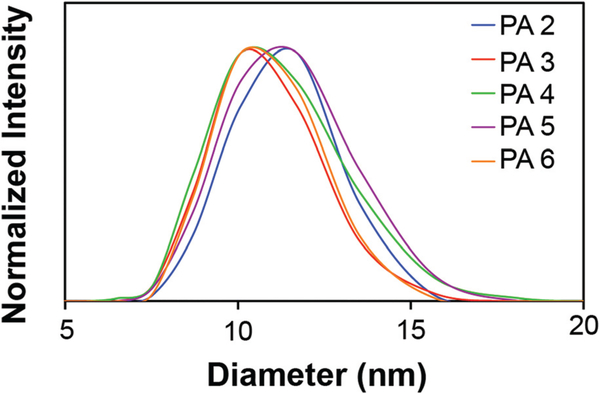
While the influence of alkyl chain length and headgroup size on self-assembly behaviour has been well-established for simple surfactants, the rational control over the pH- and concentration-dependent self-assembly behaviour in stimuli responsive peptides remains an elusive goal. Here, we show that different amphiphilic peptides can have similar self-assembly phase diagrams, providing the relative strengths of the attractive and repulsive forces are balanced. Using palmitoyl-YYAAEEEEK(DO3A:Gd)-NH2 and palmitoyl-YAAEEEEK(DO3A:Gd)-NH2 as controls, we show that reducing hydrophobic attractive forces through fewer methylene groups in the alkyl chain will lead to a similar self-assembly phase diagram as increasing the electrostatic repulsive forces via the addition of a glutamic acid residue. These changes allow creation of self-assembled MRI vehicles with slightly different micelle and nanofiber diameters but with minimal changes in the spin-lattice T1 relaxivity. These findings reveal a powerful strategy to design self-assembled vehicles with different sizes but with similar self-assembly profiles.
Figures




References
-
- Schaefer C, Voets I, Palmans A, Meijer E, van der Schoot P and Besenius P, Controlling the cooperativity in the supramolecular polymerization of ionic discotic amphiphiles via electrostatic screening, ACS Macro Lett, 2012, 1, 830–833. - PubMed
-
- Besenius P, Heynens JL, Straathof R, Nieuwenhuizen MM, Bomans PH, Terreno E, Aime S, Strijkers GJ, Nicolay K and Meijer E, Paramagnetic self-assembled nanoparticles as supramolecular MRI contrast agents, Contrast Media Mol. Imaging, 2012, 7, 356–361. - PubMed
MeSH terms
Substances
Grants and funding
LinkOut - more resources
Full Text Sources
Other Literature Sources
