


doi: 10.1097/AOG.0000000000002106.
Cervical Evaluation: From Ancient Medicine to Precision Medicine
Affiliations
- PMID: 28594774
- PMCID: PMC5503468
- DOI: 10.1097/AOG.0000000000002106
Item in Clipboard
Cervical Evaluation: From Ancient Medicine to Precision Medicine
Obstet Gynecol.
2017 Jul.
Abstract
Since ancient times, cervical assessment for predicting timing of delivery has relied primarily on digital (subjective) assessment of dilatation, softening, and length. To date, transvaginal ultrasound cervical length is the only one of these parameters that meets criteria for a biomarker; no objective, quantitative measure of cervical dilatation or softening has gained clinical acceptance. This review discusses how the cervix has been assessed from ancient times to the present day and how a precision medicine approach could improve understanding of not only the cervix, but also parturition in general.
Figures
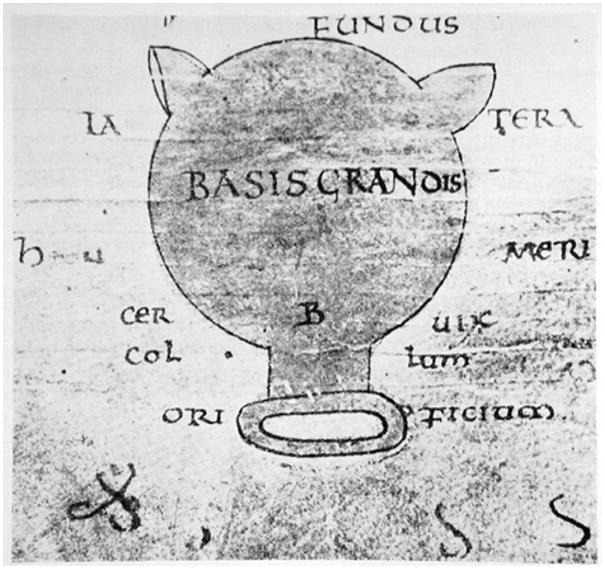
Earliest known diagram of the uterus (9th century C.E.). Based on drawings of Soranus of Ephesus (1st/2nd century C.E.), the original gynecologist. Reprinted from Okulicz WC. Cellular and molecular regulation of the primate endometrium: a perspective. Reprod Biol Endocrinol. 2006;4 Suppl 1:S3. Copyright © Okulicz; licensee BioMed Central Ltd. 2006. Okulicz WC et al is published under license to BioMed Central Ltd. This is an open access article distributed under the terms of the Creative Commons Attribution License (http://creativecommons.org/licenses/by/2.0 ), which permits unrestricted use, distribution, and reproduction in any medium, provided the original work is properly cited.
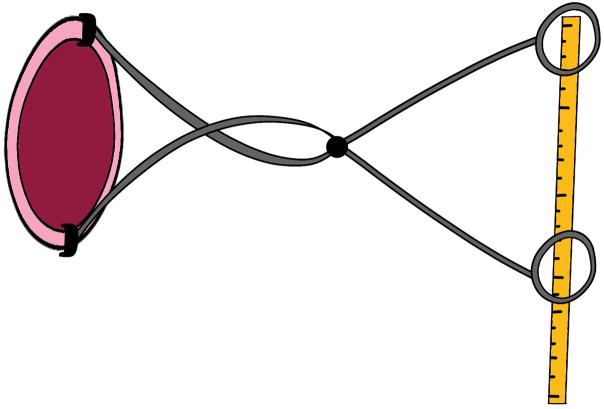
Friedman’s 1956 cervimeter. Proximally, bulldog clips affixed the calipers to the cervix while the handles on the distal end were connected to a centimeter rule that depicted cervical diameter. Modified from van Dessel T, Frijns JH, Kok FT, Wallenburg HC. Assessment of cervical dilatation during labor: a review. Eur J Obstet Gynecol Reprod Biol 1991;41(3):165–71, © 1991, with permission from Elsevier.
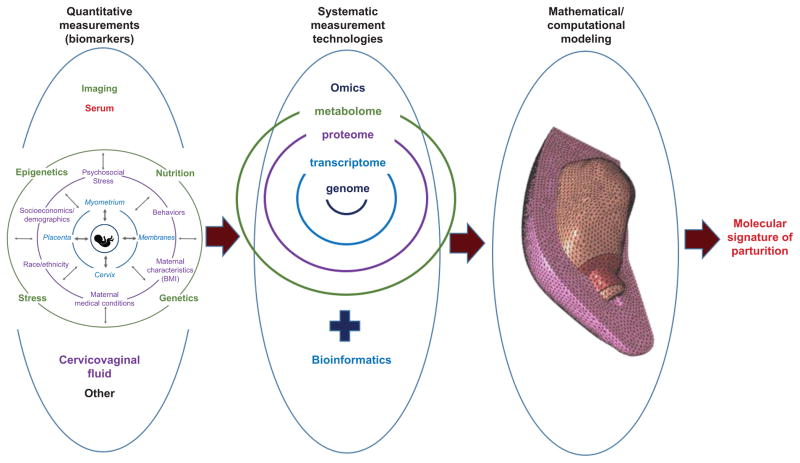
A simplified schematic of a systems biology approach to precision medicine for parturition. The left portion of the figure shows a theoretical framework of parturition. Continual interaction of multiple maternal and fetal factors (intrinsic and extrinsic) contribute to activation or quiescence of co-dependent pregnancy tissues to determine the ultimate parturition phenotype. The middle and right portions of the figure show identification of quantitative biomarkers (using imaging and minimally-invasive acquisition of biospecimens) which leads to identification of molecular processes through bioinformatics, which in turn leads to mathematical/computational modeling of molecular processes and their biomechanical and microstructural effects, through which the molecular signature of parturition is revealed. This could allow precise targeting of specific therapies for abnormal parturition. The mathematical/computational modeling portion of the figure is reprinted with permission from House M, Feltovich H, Hall TJ, Stack T, Patel A, Socrate S. Three-dimensional, extended field-of-view ultrasound method for estimating large strain mechanical properties of the cervix during pregnancy. Ultrason Imaging 2012;34(1):1–14.
References
-
- Iams JD, Goldenberg RL, Meis PJ, Mercer BM, Moawad D, Das A, Thom E, McNellis D, Copper R, Johnson F, Roberts J. The length of the cervix and the risk of spontaneous premature delivery. National Institute of Child Health and Human Development Maternal Fetal Medicine Unit Network. N Engl J Med. 1996;334(9):567–572. - PubMed
-
- ACOG Practice Bulletin no. 142, Cerclage for the management of cervical insufficiency. Obstet Gynecol. 2014 Feb;123(2 pt 1):372–379. - PubMed
-
- McIntosh J, Feltovich H, Berghella V, Manuck T the Society for Maternal Fetal Medicine Publications Committee. The role of routine cervical length screening in selected high- and low-risk women for preterm birth prevention. Am J Obstet Gynecol. 2016;215(3):B2–7. - PubMed
-
- Friedman E. Primigravid labor; a graphicostatistical analysis. Obstet Gynecol. 1955;6(6):567–589. - PubMed
-
- Friedman E. Labor in multiparas; a graphicostatistical analysis. Obstet Gynecol. 1956;8(6):691–703. - PubMed
Publication types
MeSH terms
Grants and funding
LinkOut - more resources
Full Text Sources
Other Literature Sources
