


Clinical Validation of a Test for the Diagnosis of Vaginitis
- PMID: 28594779
- PMCID: PMC5635603
- DOI: 10.1097/AOG.0000000000002090
Clinical Validation of a Test for the Diagnosis of Vaginitis
Abstract
Objective: Vaginitis may be diagnosed as bacterial vaginosis, vulvovaginal candidiasis, trichomoniasis, or coinfection. A new molecular test assays the vaginal microbiome and organisms that cause three common infections. The objective of the trial was to evaluate the clinical accuracy of the investigational test for vaginal swabs collected by patients (self) or clinicians. The primary and secondary outcomes were to compare the investigational test with reference methods for the three most common causes of vaginitis and compare clinician-collected with self-collected swabs.
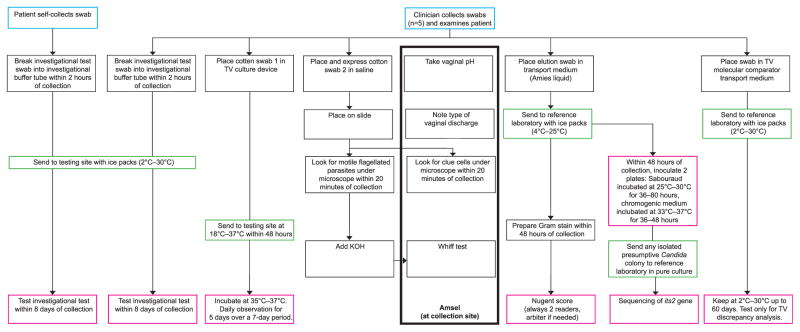
Methods: We conducted a cross-sectional study in which women with symptoms of vaginitis were recruited at ten clinical centers and consented to the investigation between May and September 2015. The woman collected a vaginal swab, sheathed, and then handed it to the clinician. These swabs were to evaluate how self-collected swabs compared with clinician-collected swabs. The clinician collected an investigational test swab and reference test swabs. From 1,740 symptomatic patients, clinician-collected and self-collected vaginal swabs were evaluated by the molecular test and six tests. The reference methods for bacterial vaginosis were Nugent's score and Amsel's criteria for intermediate Nugent results. The reference methods for Candida infection were isolation of any potential Candida microorganisms from inoculation of two culture media: chromogenic and Sabouraud agar and sequencing. The reference methods for trichomoniasis were wet mount and culture.
Results: For clinician-collected swabs, by reference methods, bacterial vaginosis was diagnosed in 56.5%, vaginal candidiasis in 32.8%, trichomoniasis in 8%, and none of the three infections in 24% with a coinfection rate of 20%. The investigational test sensitivity was 90.5% (95% confidence interval [CI] 88.3-92.2%) and specificity was 85.8% (95% CI 83.0-88.3%) for bacterial vaginosis. The investigational test sensitivity was 90.9% (95% CI 88.1-93.1%) and specificity was 94.1% (95% CI 92.6-95.4%) for the Candida group. Sensitivity for Candida glabrata was 75.9% (95% CI 57.9-87.8%) and specificity was 99.7% (95% CI 99.3-99.9%). Investigational test sensitivity was 93.1% (95% CI 87.4-96.3%) and specificity was 99.3% (95% CI 98.7-99.6%) for trichomoniasis. Results from self-collected swabs were similar to clinician-collected swabs.
Conclusion: A molecular-based test using vaginal swabs collected by clinicians or patients can accurately diagnose most common bacterial, fungal, and protozoan causes of vaginitis. Women and their clinicians seeking accurate diagnosis and appropriate selection of efficacious treatment for symptoms of vaginitis might benefit from this molecular test.
Figures
Comment in
-
Clinical Validation of a Test for the Diagnosis of Vaginitis.Obstet Gynecol. 2017 Oct;130(4):912. doi: 10.1097/AOG.0000000000002280. Obstet Gynecol. 2017. PMID: 28937557 No abstract available.
-
In Reply.Obstet Gynecol. 2017 Oct;130(4):912-913. doi: 10.1097/AOG.0000000000002281. Obstet Gynecol. 2017. PMID: 28937558 No abstract available.
References
-
- Centers for Disease Control and Prevention. Sexually transmitted disease surveillance 2014. Atlanta (GA): U.S. Department of Health and Human Services; 2015.
-
- Koumans EH, Sternberg M, Bruce C, McQuillan G, Kendrick J, Sutton M, et al. The prevalence of bacterial vaginosis in the United States, 2001–2004; associations with symptoms, sexual behaviors, and reproductive health. Sex Transm Dis. 2007;34:864–9. - PubMed
-
- Anderson MR, Klink K, Cohrssen A. Evaluation of vaginal complaints. JAMA. 2004;291:1368–79. - PubMed
-
- Taylor BD, Darville T, Haggerty CL. Does bacterial vaginosis cause pelvic inflammatory disease? Sex Transm Dis. 2013;40:117–22. - PubMed
Publication types
MeSH terms
Grants and funding
LinkOut - more resources
Full Text Sources
Other Literature Sources
Medical
