Case Reports
. 2017 Jun 8;12(6):e0178125.
doi: 10.1371/journal.pone.0178125. eCollection 2017.

Compound heterozygous mutations in glycyl-tRNA synthetase (GARS) cause mitochondrial respiratory chain dysfunction

Affiliations
Case Reports

Compound heterozygous mutations in glycyl-tRNA synthetase (GARS) cause mitochondrial respiratory chain dysfunction

Michael Nafisinia et al. PLoS One. .

Abstract

Glycyl-tRNA synthetase (GARS; OMIM 600287) is one of thirty-seven tRNA-synthetase genes that catalyses the synthesis of glycyl-tRNA, which is required to insert glycine into proteins within the cytosol and mitochondria. To date, eighteen mutations in GARS have been reported in patients with autosomal-dominant Charcot-Marie-Tooth disease type 2D (CMT2D; OMIM 601472), and/or distal spinal muscular atrophy type V (dSMA-V; OMIM 600794). In this study, we report a patient with clinical and biochemical features suggestive of a mitochondrial respiratory chain (MRC) disorder including mild left ventricular posterior wall hypertrophy, exercise intolerance, and lactic acidosis. Using whole exome sequencing we identified compound heterozygous novel variants, c.803C>T; p.(Thr268Ile) and c.1234C>T; p.(Arg412Cys), in GARS in the proband. Spectrophotometric evaluation of the MRC complexes showed reduced activity of Complex I, III and IV in patient skeletal muscle and reduced Complex I and IV activity in the patient liver, with Complex IV being the most severely affected in both tissues. Immunoblot analysis of GARS protein and subunits of the MRC enzyme complexes in patient fibroblast extracts showed significant reduction in GARS protein levels and Complex IV. Together these studies provide evidence that the identified compound heterozygous GARS variants may be the cause of the mitochondrial dysfunction in our patient.


Conflict of interest statement

Competing Interests: The authors have declared that no competing interests exist.

Figures

Fig 1
Fig 1
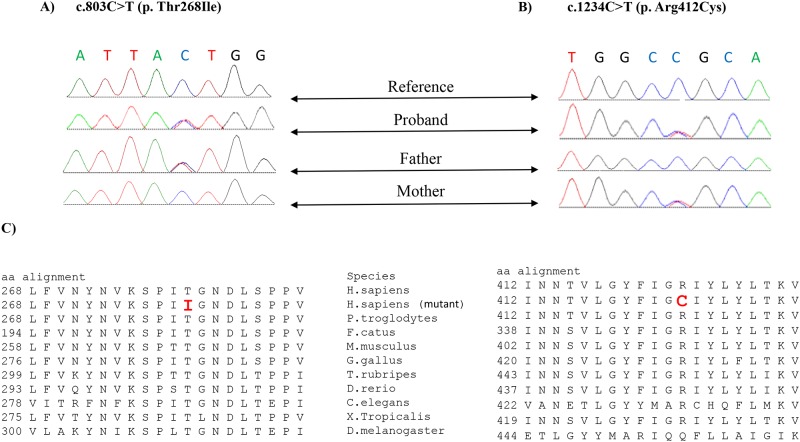
A) Sanger sequencing profile of GARS from the proband and parents showing c.803C>T; p.(Thr268Ile) variant is heterozygous in the proband and the father. B) Sanger sequencing profile of GARS from the proband and parents showing c.1234C>T; p.(Arg412Cys) variant is heterozygous in the proband and the mother. C) Evolutionary sequence conservations of the altered amino acid residues p.Thr268 and p. Arg412 are denoted in bold red in boxes.
Fig 2
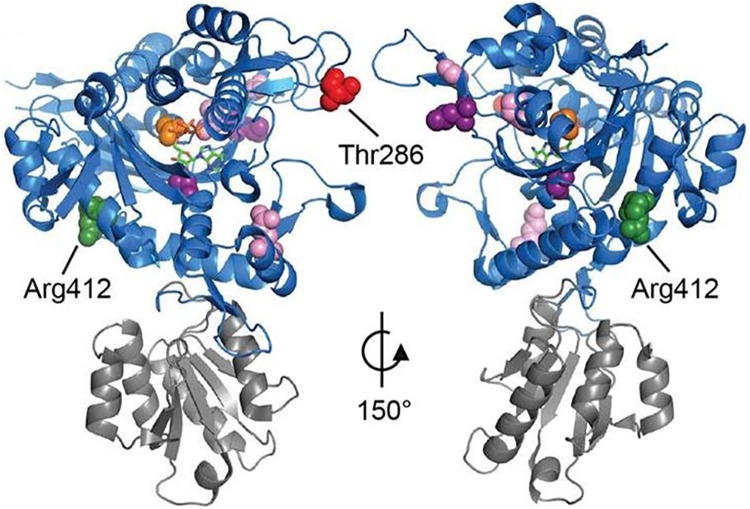
Fig 2. Relative position and conservation of GARS mutations.
Model of GARS protein structure showing catalytic domain (blue) and anticodon binding domain (grey). Residues mutated in the proband are displayed as red (Thr268) and green (Arg412) spheres. ATP (sticks) and glycine (orange spheres) are seen in the active site pocket. Pink and purple residues indicate previously reported pathogenic mutations in CMT2D and dSMA-V respectively [6,27,28]. Model based on PDB structure 2ZT7.
Fig 3
Fig 3
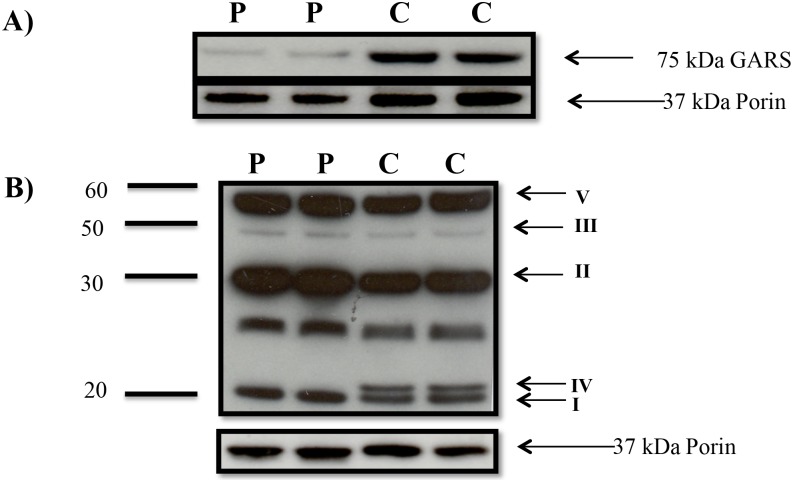
A) Immunoblot analysis of cultured fibroblasts lysates indicated reduction in expression of GARS protein in patient (P) compared to control (C). Samples containing 20 μg of total protein per lane were loaded in duplicate. Porin was used as a loading control. B) Each data point is immunoblot showing OXPHOS expression in cultured fibroblasts from the proband (P) compared to controls (C) in duplicate with a total of 30 μg of protein in each lane. Porin was used as a loading control.

References

    1. Kawakami N, Komatsu K, Yamashita H, Uemura K, Oka N, Takashima H, et al. (2014) [A novel mutation in glycyl-tRNA synthetase caused Charcot-Marie-Tooth disease type 2D with facial and respiratory muscle involvement]. Rinsho Shinkeigaku 54: 911–915. - PubMed
    1. Diodato D, Ghezzi D, Tiranti V (2014) The Mitochondrial Aminoacyl tRNA Synthetases: Genes and Syndromes. Int J Cell Biol 2014: 787956 10.1155/2014/787956 - DOI - PMC - PubMed
    1. Grice SJ, Sleigh JN, Motley WW, Liu JL, Burgess RW, Talbot K, et al. (2015) Dominant, toxic gain-of-function mutations in gars lead to non-cell autonomous neuropathology. Hum Mol Genet 24: 4397–4406. 10.1093/hmg/ddv176 - DOI - PMC - PubMed
    1. Motley WW, Talbot K, Fischbeck KH (2010) GARS axonopathy: not every neuron's cup of tRNA. Trends Neurosci 33: 59–66. 10.1016/j.tins.2009.11.001 - DOI - PMC - PubMed
    1. Liao YC, Liu YT, Tsai PC, Chang CC, Huang YH, Soong BW, et al. (2015) Two Novel De Novo GARS Mutations Cause Early-Onset Axonal Charcot-Marie-Tooth Disease. PLoS One 10: e0133423 10.1371/journal.pone.0133423 - DOI - PMC - PubMed

Publication types

Substances

LinkOut - more resources