


Association among presence of cancer pain, inadequate pain control, and psychotropic drug use
- PMID: 28594871
- PMCID: PMC5464574
- DOI: 10.1371/journal.pone.0178742
Association among presence of cancer pain, inadequate pain control, and psychotropic drug use
Abstract
Introduction: Pain is a common symptom in cancer patients, and its control and management are complex. Despite the high concomitant use of psychotropic drugs among such patients, the association among pain, inadequate pain control, and psychotropic drug use has not been fully determined. This study examined the prevalence of cancer pain and inadequate pain control and the association with psychotropic drug use.
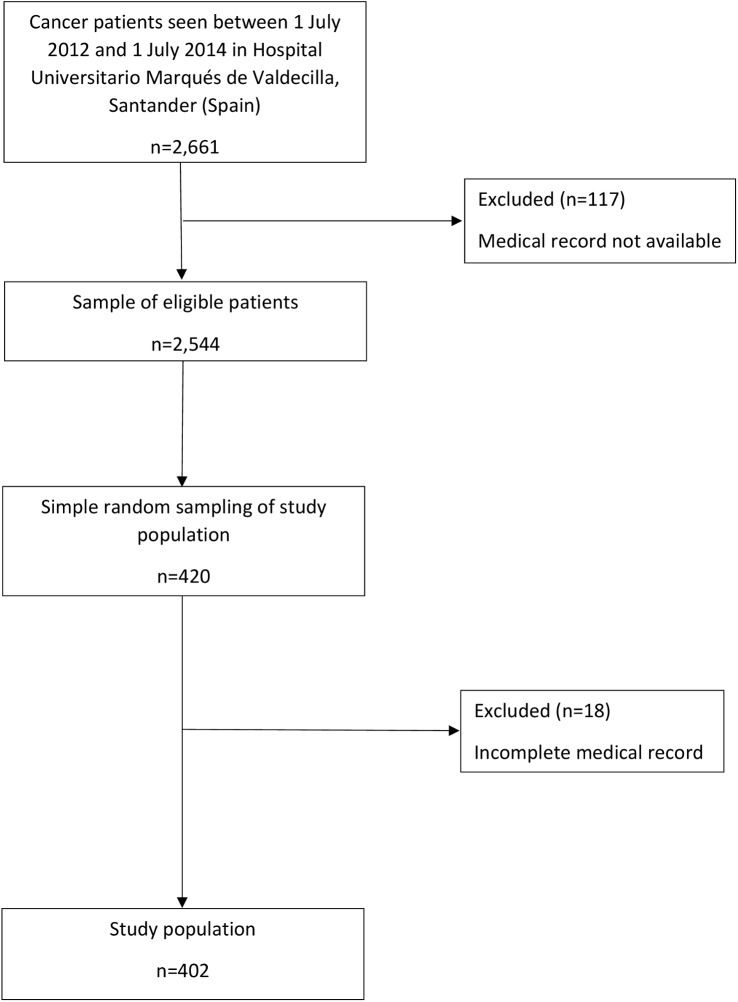
Materials and methods: In this cross-sectional study, we investigated 402 medical records obtained by simple random sampling of oncology patients at a hospital in northern Spain from July 2012 to July 2014. Adjusted odds ratios (ORs) were estimated together with their 95% confidence intervals (95% CIs) by unconditional logistic regression for each type of psychotropic drug (anxiolytics, hypnotics, and antidepressants).
Results: The mean patient age was 61.17 (standard deviation ± 13.14) years; 57.5% were women, 42.5% men. Pain was present in 18.4% of patients and inadequate pain control in 54.2%. We found a statistically significant association between the presence of cancer pain and anxiolytic use (adjusted OR, 3.15; 95% CI, 1.49-6.68) and hypnotic use (adjusted OR, 5.19; 95% CI, 1.77-15.25). Inadequate pain control was associated to a greater extent with the use of those drugs: adjusted OR for anxiolytic use, 4.74 (95% CI, 1.91-11.80); adjusted OR for hypnotic use, 6.09 (95% CI, 1.74-21.32). By contrast, no association was found between pain and antidepressant use (adjusted OR, 0.99).
Conclusion: The presence of pain and (to a greater extent) poor pain control were associated with increased use of certain psychotropic drugs, such as anxiolytics and hypnotics. There appeared to be no association between pain and antidepressant use.
Conflict of interest statement
References
-
- International Association for the Study of Pain The IASP Taxonomy. Classification of Chronic Pain;2012.
-
- Portenoy RK. Treatment of cancer pain. Lancet. 2011; 25:377(9784):2236–47. doi: 10.1016/S0140-6736(11)60236-5 - DOI - PubMed
-
- Greco MT, Roberto A, Corli O, Deandrea S, Bandieri E, Cavuto S et al. Quality of cancer pain management: an update of a systematic review of undertreatment of patients with cancer. J Clin Oncol 2014;32(36):54 doi: 10.1200/JCO.2014.56.0383 - DOI - PubMed
-
- Deandrea S, Montanari M, Moja L, Apolone G. Prevalence of undertreatment in cancer pain. A review of published literature. Ann Oncol. 2008;19(12):1985–91. doi: 10.1093/annonc/mdn419 - DOI - PMC - PubMed
-
- Fischer DJ, Villines D, Kim YO, Epstein JB, Wilkie DJ. Anxiety, depression, and pain: differences by primary cancer. Support Care Cancer. 2010; 18 (7): 801–10. doi: 10.1007/s00520-009-0712-5 - DOI - PMC - PubMed
MeSH terms
Substances
LinkOut - more resources
Full Text Sources
Other Literature Sources
