


Dexamethasone facilitates fear extinction and safety discrimination in PTSD: A placebo-controlled, double-blind study
- PMID: 28595089
- PMCID: PMC5524593
- DOI: 10.1016/j.psyneuen.2017.05.023
Dexamethasone facilitates fear extinction and safety discrimination in PTSD: A placebo-controlled, double-blind study
Abstract
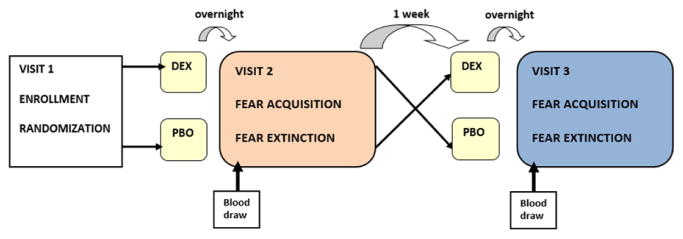
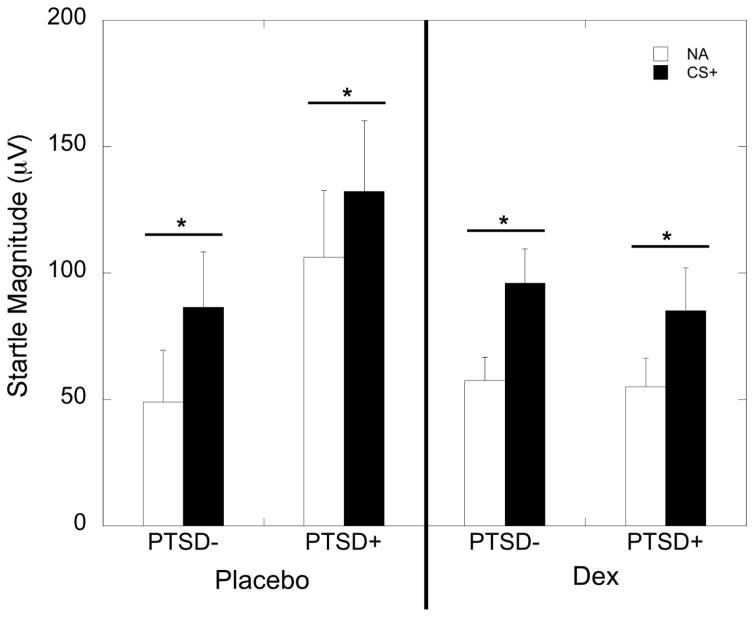
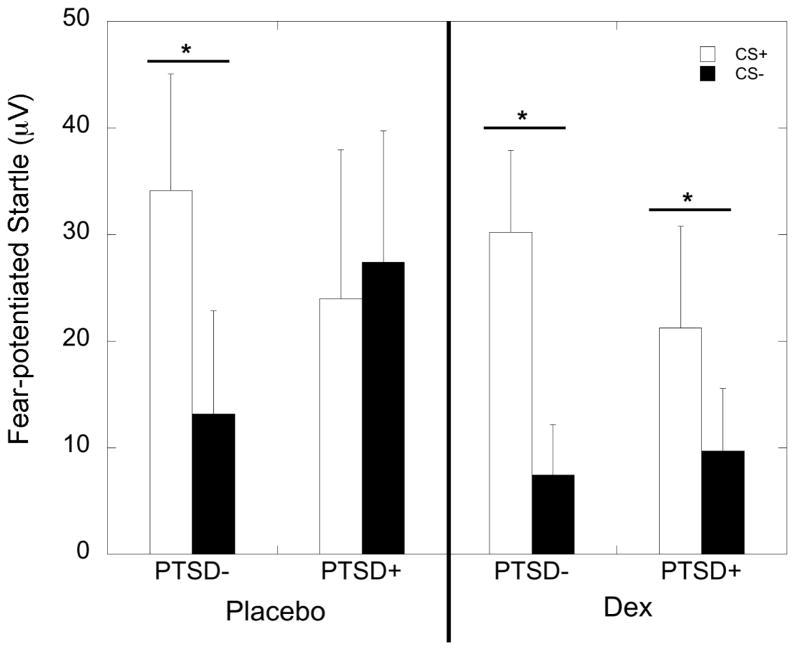
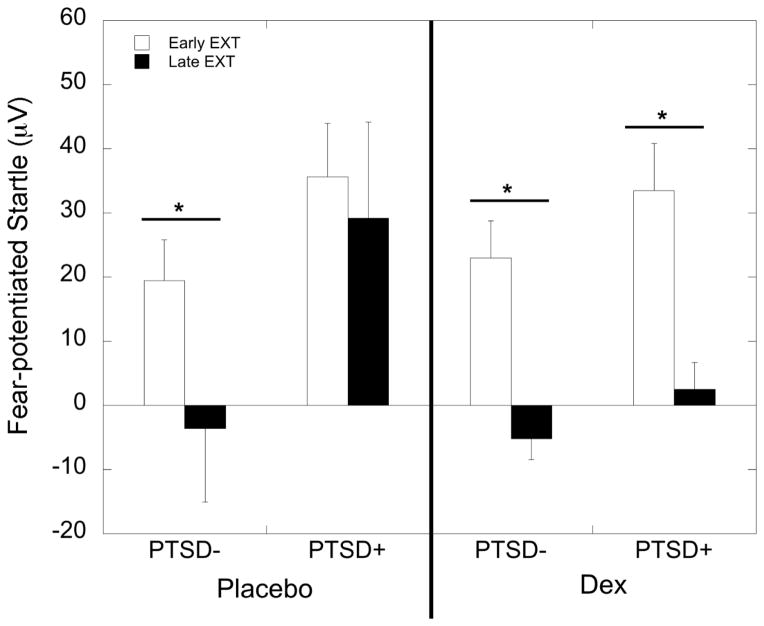
Psychophysiological hallmarks of posttraumatic stress disorder (PTSD) include exaggerated fear responses, impaired inhibition and extinction of conditioned fear, and decreased discrimination between safety and fear cues. This increased fear load associated with PTSD can be a barrier to effective therapy thus indicating the need for new treatments to reduce fear expression in people with PTSD. One potential biological target for reducing fear expression in PTSD is the hypothalamic-pituitary-adrenal (HPA) axis, which is dysregulated in PTSD. Recent translational rodent studies and cross-sectional clinical studies have shown that dexamethasone administration and the resulting suppression of cortisol in individuals with PTSD leads to a decrease in the fear responses characteristic of PTSD. These data, taken together, suggest that dexamethasone may serve as a novel pharmacologic intervention for heightened fear responses in PTSD. We conducted a double-blind, placebo-controlled trial to test our hypothesis that dexamethasone administration and the concomitant suppression of HPA axis hyperactivity would attenuate fear expression and enhance fear extinction in individuals with PTSD. Study participants (n=62) were recruited from Grady Memorial Hospital in Atlanta, GA. Participants were randomized to receive dexamethasone or placebo prior to fear conditioning and extinction, in a counterbalanced design (treatments separated by a week). Both PTSD- (n=37) and PTSD+ (n=25) participants showed significant startle increases in the presence of the danger signal during placebo and dexamethasone treatments (all p<0.05). However, only PTSD- control participants showed decreases in fear-potentiated startle across extinction blocks during both conditions (p's≤0.001), with PTSD+ participants showing deficits in fear extinction and safety discrimination in the placebo condition. Notably, extinction and discrimination deficits in PTSD+ subjects were markedly reversed with dexamethasone (p<0.001). These data suggest that dexamethasone may serve as a pharmacological agent with which to facilitate fear extinction and discrimination in individuals with PTSD.
Keywords: Dexamethasone; Fear extinction; Fear-potentiated startle; PTSD; Safety discrimination.
Copyright © 2017 Elsevier Ltd. All rights reserved.
Figures
References
-
- APA, A.P.A. Diagnostic and Statistical Manual of Mental Disorders. 2000.
-
- Baker DG, Ekhator NN, Kasckow JW, Dashevsky B, Horn PS, Bednarik L, Geracioti TD., Jr Higher levels of basal serial CSF cortisol in combat veterans with posttraumatic stress disorder. The American journal of psychiatry. 2005;162:992–994. - PubMed
-
- Beck AT, Steer RA, Ball R, Ranieri W. Comparison of Beck Depression Inventories -IA and -II in psychiatric outpatients. J Pers Assess. 1996;67:588–597. - PubMed
-
- Bernstein DP, Ahluvalia T, Pogge D, Handelsman L. Validity of the Childhood Trauma Questionnaire in an adolescent psychiatric population. J Am Acad Child Adolesc Psychiatry. 1997;36:340–348. - PubMed
-
- Binder EB, Bradley RG, Liu W, Epstein MP, Deveau TC, Mercer KB, Tang Y, Gillespie CF, Heim CM, Nemeroff CB, Schwartz AC, Cubells JF, Ressler KJ. Association of FKBP5 polymorphisms and childhood abuse with risk of posttraumatic stress disorder symptoms in adults. Jama. 2008;299:1291–1305. - PMC - PubMed
Publication types
MeSH terms
Substances
Grants and funding
LinkOut - more resources
Full Text Sources
Other Literature Sources
Medical
