


Executive Function and Dysregulated Eating Behaviors in Pediatric Obesity
- PMID: 28595362
- PMCID: PMC6093324
- DOI: 10.1093/jpepsy/jsx091
Executive Function and Dysregulated Eating Behaviors in Pediatric Obesity
Abstract
Objective: To examine the association between caregiver proxy report of executive function (EF) and dysregulated eating behavior in children with obesity.
Methods: Participants were 195 youth with obesity aged 8-17 years, and their legal guardians. Youth height, weight, demographics, depressive symptoms, eating behaviors, and EF were assessed cross-sectionally during a medical visit. Analyses of covariance, adjusted for child age, gender, race/ethnicity, standardized BMI, depressive symptoms, and family income were used to examine differences in youth EF across caregiver and youth self-report of eating behaviors.
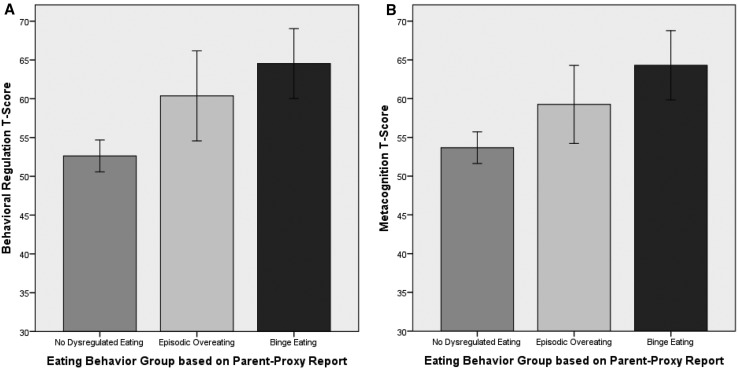
Results: Youth EF differed significantly by caregiver report of eating behavior but not youth self-report. Post hoc analyses showed that youth with overeating or binge eating had poorer EF than youth without these eating behaviors.
Conclusions: Executive dysfunction, as reported by caregivers, in youth with obesity may be associated with dysregulated eating behaviors predictive of poor long-term psychosocial and weight outcomes. Further consideration of EF-specific targets for assessment and intervention in youth with obesity may be warranted.
Figures
References
-
- Allgaier A. K., Frühe B., Pietsch K., Saravo B., Baethmann M., Schulte-Körne G. (2012). Is the Children's Depression Inventory short version a valid screening tool in pediatric care? A comparison to its full-length version. Journal of Psychosomatic Research, 73, 369–374. doi:10.1016/j.jpsychores.2012.08.016 - DOI - PubMed
-
- Anderson P. (2002). Assessment and development of Executive Function (EF) during childhood. Child Neuropsychology, 8, 71–82. doi:10.1076/chin.8.2.71.8724 - PubMed
-
- Braet C. (2006). Patient characteristics as predictors of weight loss after an obesity treatment for children. Obesity, 14, 148–155. doi:10.1038/oby.2006.18 - PubMed
-
- Briggs-Gowan M. J., Carter A. S., Schwab-Stone M. (1996). Discrepancies among mother, child, and teacher reports: Examining the contributions of maternal depression and anxiety. Journal of Abnormal Child Psychology, 24, 749–765. - PubMed
-
- Cella D., Yount S., Rothrock N., Gershon R., Cook K., Reeve B., Ader D., Fries J. F., Bruce B., Rose M.; PROMIS Cooperative Group. (2007). The Patient-Reported Outcomes Measurement Information System (PROMIS): Progress of an NIH Roadmap Cooperative Group during its first two years. Medical Care, 45, S3–S11. doi:10.1097/01.mlr.0000258615.42478.55 - PMC - PubMed
Publication types
MeSH terms
Grants and funding
LinkOut - more resources
Full Text Sources
Other Literature Sources
Medical
