The Protective Effect of Pregnancy on Risk for Drug Abuse: A Population, Co-Relative, Co-Spouse, and Within-Individual Analysis
- PMID: 28595490
- PMCID: PMC5624829
- DOI: 10.1176/appi.ajp.2017.16091006
The Protective Effect of Pregnancy on Risk for Drug Abuse: A Population, Co-Relative, Co-Spouse, and Within-Individual Analysis
Abstract
Objective: The authors sought to determine whether pregnancy is an intrinsic motivator for cessation of drug abuse.
Method: The authors conducted prospective cohort, co-relative, co-spouse, and within-person analyses of registration for drug abuse during pregnancy among Swedish women born between 1980 and 1990 who gave birth between ages 20 and 35 (N=149,512). Drug abuse was assessed from medical, criminal, and pharmacy registries.
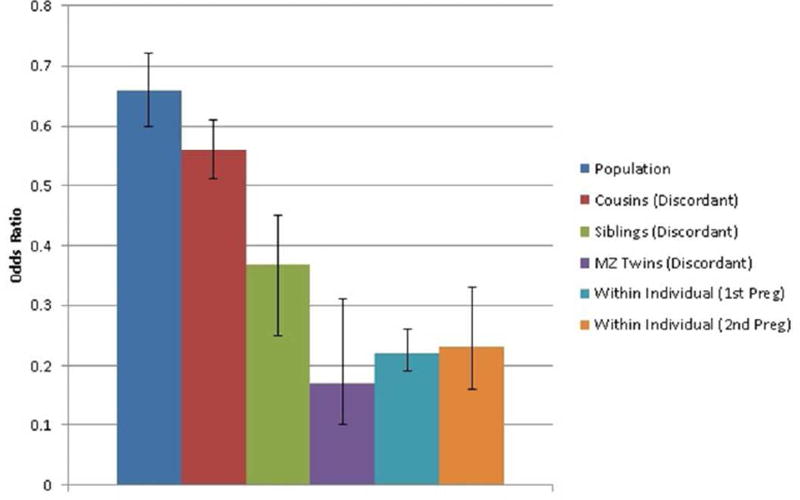
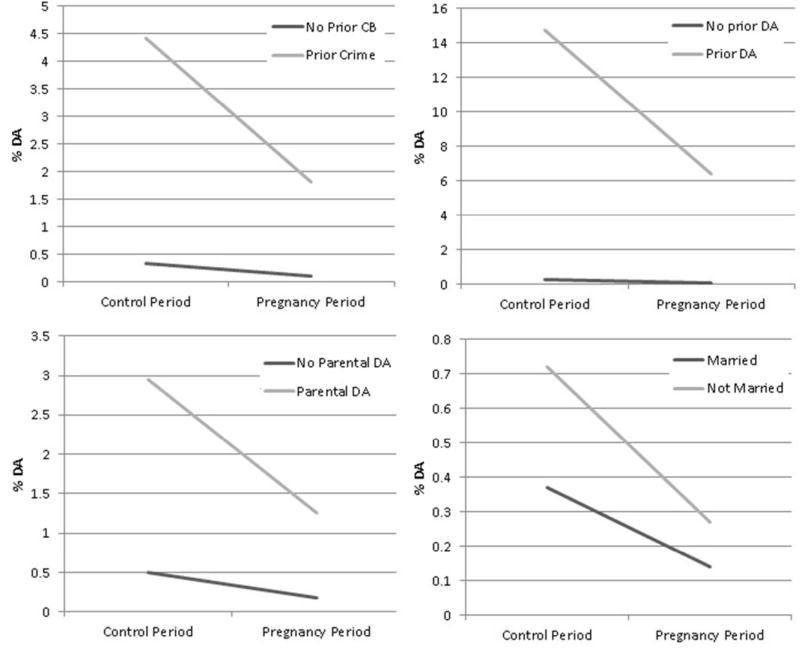
Results: In the population, rates of drug abuse were lower during pregnancy (unadjusted odds ratio=0.67, 95% CI=0.60, 0.74). Compared with population results, the negative association between pregnancy and drug abuse was moderately stronger in cousins (odds ratio=0.49, 95% CI=0.39, 0.62) and substantially stronger in siblings (odds ratio=0.35, 95% CI=0.24, 0.51) discordant for pregnancy. The estimated odds ratio for drug abuse in pregnancy-discordant monozygotic twins was even stronger, at 0.17 (95% CI=0.10, 0.31). Within individuals, the odds ratio for drug abuse while pregnant compared with an equivalent prepregnancy interval was similar to that seen in pregnancy-discordant monozygotic twins, at 0.22 (95% CI=0.19, 0.26). Compared with cohabiting fathers, mothers had a greater reduction in risk for drug abuse during pregnancy (odds ratio=0.40, 95% CI=0.34, 0.47). Pregnancy was more protective in women with low parental education and without a cohabiting, actively drug-abusing father. Compared with prepregnancy baseline, within-individual analyses indicate that risk for drug abuse is also substantially reduced in the postpartum period, for example, the odds ratio for postpartum days 0-242 was 0.13 (95% CI=0.11, 0.16).
Conclusions: Risk for drug abuse in women is substantially reduced during pregnancy. Multiple analyses suggest that this association is largely causal, suggesting that pregnancy is indeed a strong intrinsic motivator for drug abuse cessation. Similar strong protective effects may be present in the immediate postpartum period. Our results have implications for our etiologic models of drug abuse and especially for contingency management programs seeking to reduce drug abuse risk.
Keywords: Epidemiology; Psychoactive Substance Use Disorder.
Conflict of interest statement
Figures
Comment in
-
From Epidemiology to Interventions and Back.Am J Psychiatry. 2017 Oct 1;174(10):915-916. doi: 10.1176/appi.ajp.2017.17070796. Am J Psychiatry. 2017. PMID: 28965470 No abstract available.
-
Understanding Pregnancy's Protective Effect on Drug Use Within a Developmental Framework.Am J Psychiatry. 2018 Mar 1;175(3):286-287. doi: 10.1176/appi.ajp.2017.17101099. Am J Psychiatry. 2018. PMID: 29490492 Free PMC article. No abstract available.
References
-
- Leshner AI. Addiction is a brain disease, and it matters. Science. 1997 Oct 3;278(5335):45–7. - PubMed
-
- Koob GF, Le Moal M. Neurobiology of Addiction. London, UK: Elsevier, Inc - Academic Press; 2006.
-
- Prendergast M, Podus D, Finney J, Greenwell L, Roll J. Contingency management for treatment of substance use disorders: a meta-analysis. Addiction. 2006 Nov;101(11):1546–60. - PubMed
-
- Lussier JP, Heil SH, Mongeon JA, Badger GJ, Higgins ST. A meta-analysis of voucher-based reinforcement therapy for substance use disorders. Addiction. 2006 Feb;101(2):192–203. - PubMed
Publication types
MeSH terms
Grants and funding
LinkOut - more resources
Full Text Sources
Other Literature Sources
Medical