


Effect of stratum corneum heterogeneity, anisotropy, asymmetry and follicular pathway on transdermal penetration
- PMID: 28596104
- PMCID: PMC6429552
- DOI: 10.1016/j.jconrel.2017.05.034
Effect of stratum corneum heterogeneity, anisotropy, asymmetry and follicular pathway on transdermal penetration
Erratum in
-
Corrigendum to "Effect of stratum corneum heterogeneity, anisotropy, asymmetry and follicular pathway on transdermal penetration" [J. Control. Release 260 (2017) 234-246].J Control Release. 2017 Oct 28;264:341. doi: 10.1016/j.jconrel.2017.07.033. Epub 2017 Aug 4. J Control Release. 2017. PMID: 28784274 No abstract available.
Abstract
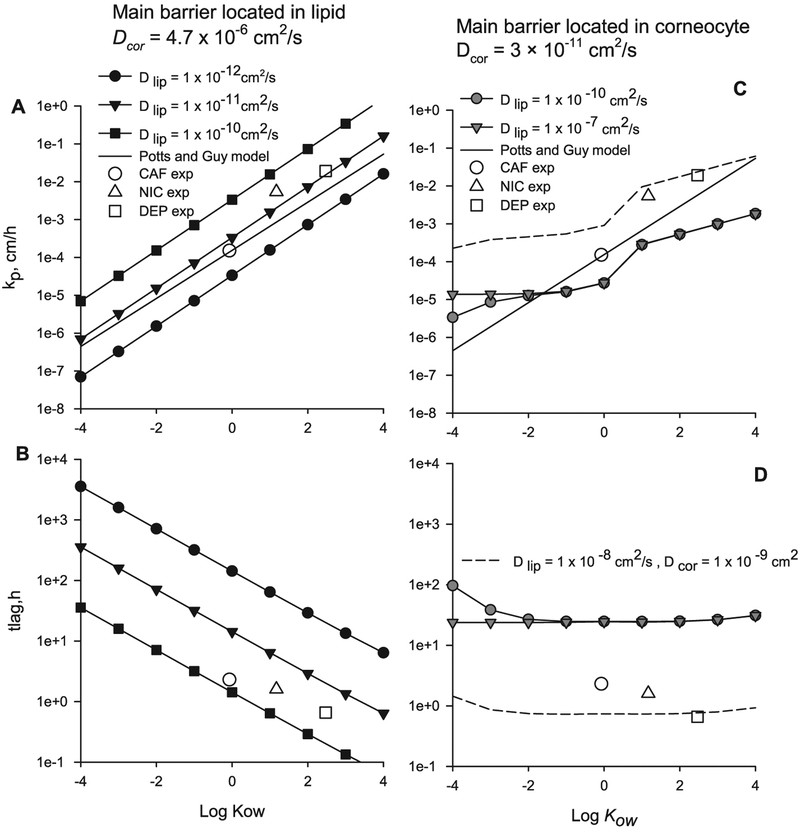
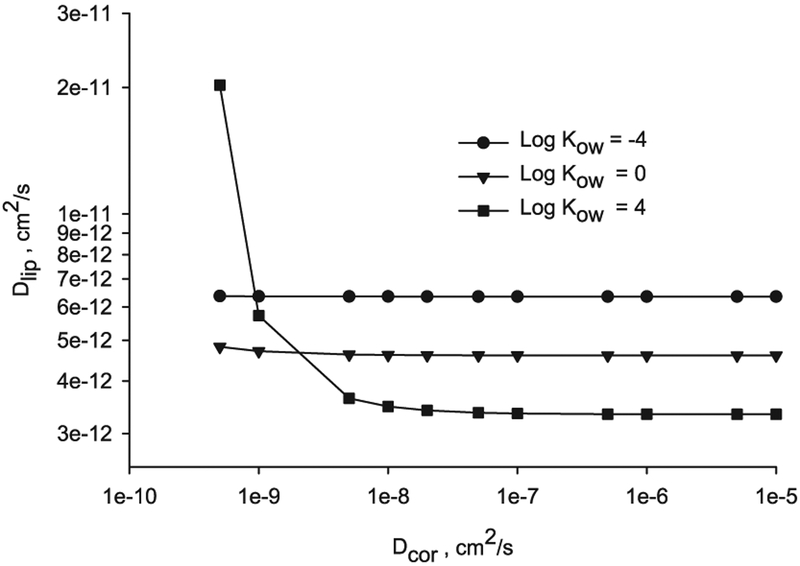
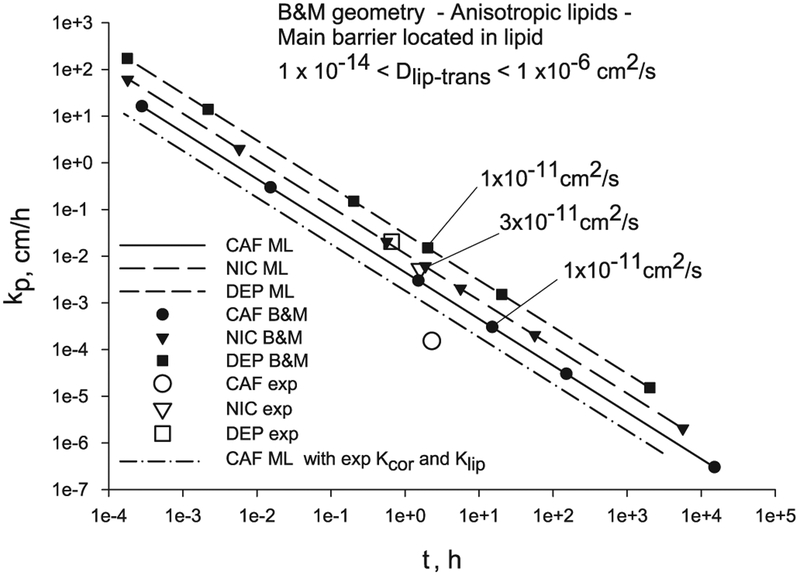
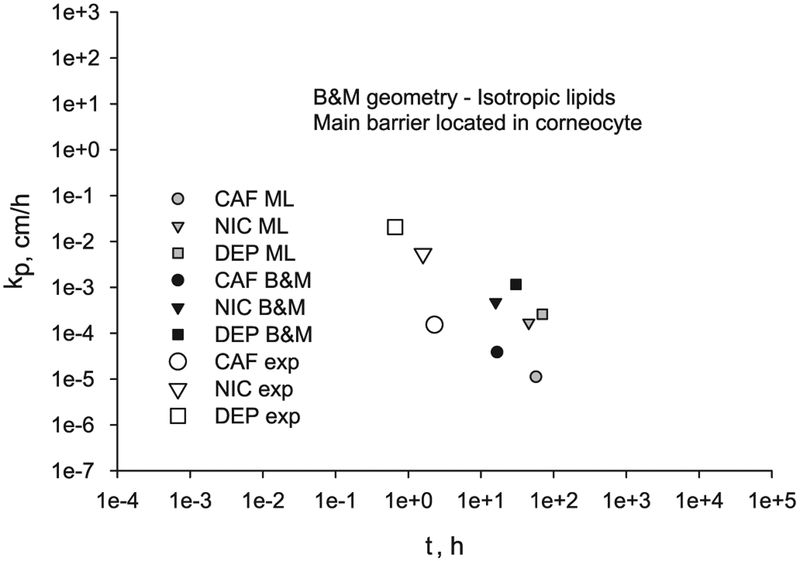
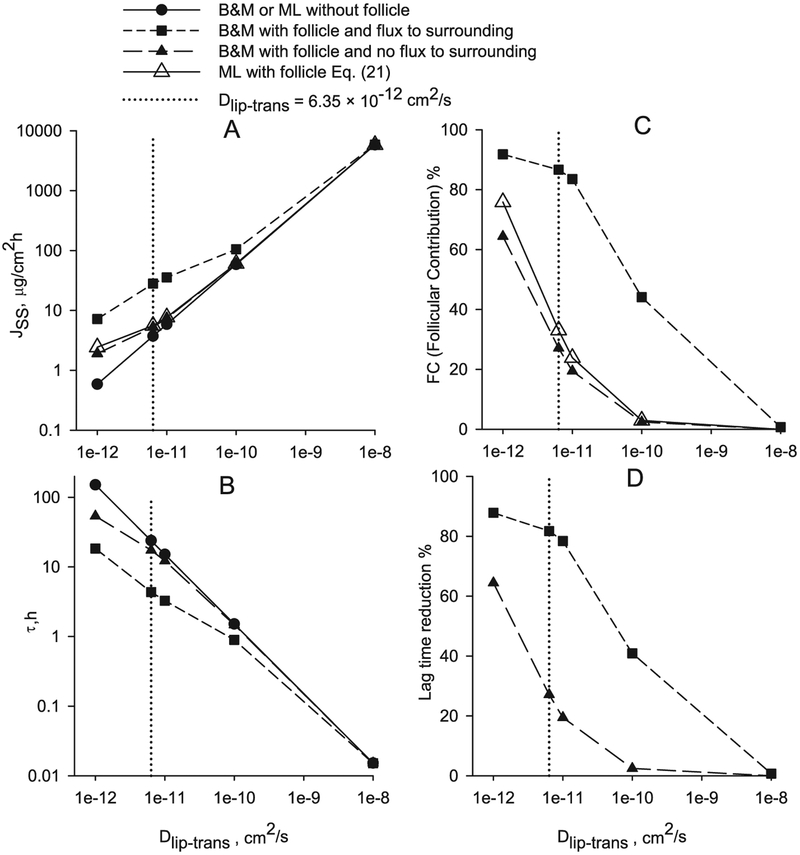
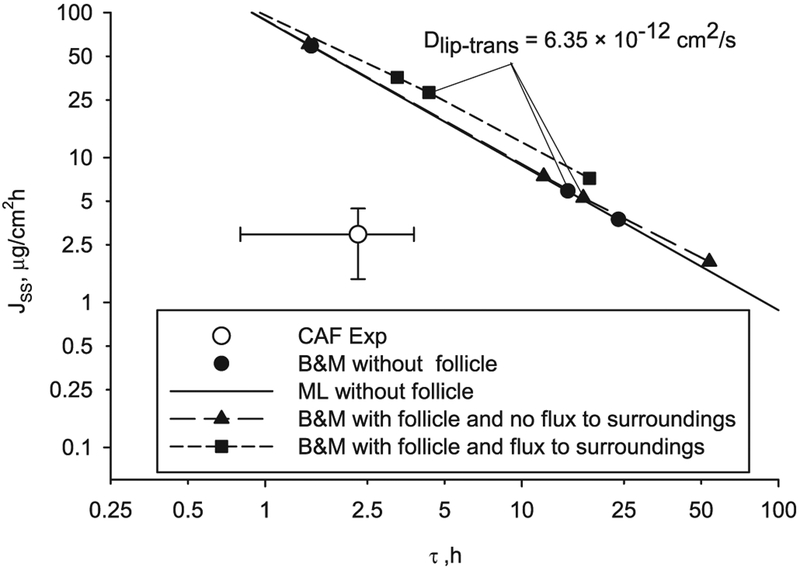
The impact of the complex structure of the stratum corneum on transdermal penetration is not yet fully described by existing models. A quantitative and thorough study of skin permeation is essential for chemical exposure assessment and transdermal delivery of drugs. The objective of this study is to analyze the effects of heterogeneity, anisotropy, asymmetry, follicular diffusion, and location of the main barrier of diffusion on percutaneous permeation. In the current study, the solution of the transient diffusion through a two-dimensional-anisotropic brick-and-mortar geometry of the stratum corneum is obtained using the commercial finite element program COMSOL Multiphysics. First, analytical solutions of an equivalent multilayer geometry are used to determine whether the lipids or corneocytes constitute the main permeation barrier. Also these analytical solutions are applied for validations of the finite element solutions. Three illustrative compounds are analyzed in these sections: diethyl phthalate, caffeine and nicotine. Then, asymmetry with depth and follicular diffusion are studied using caffeine as an illustrative compound. The following findings are drawn from this study: the main permeation barrier is located in the lipid layers; the flux and lag time of diffusion through a brick-and-mortar geometry are almost identical to the values corresponding to a multilayer geometry; the flux and lag time are affected when the lipid transbilayer diffusivity or the partition coefficients vary with depth, but are not affected by depth-dependent corneocyte diffusivity; and the follicular contribution has significance for low transbilayer lipid diffusivity, especially when flux between the follicle and the surrounding stratum corneum is involved. This study demonstrates that the diffusion is primarily transcellular and the main barrier is located in the lipid layers.
Keywords: Corneocyte; Diffusion; Lag time; Lipid bilayers; Partition coefficient; Skin appendages.
Published by Elsevier B.V.
Figures
References
-
- Scheuplein RJ, Blank IH, Permeability of the skin, Physiol. Rev 51 (1971) 702–747. - PubMed
-
- Kasting GB, Miller MA, Talreja PS, Evaluation of stratum corneum heterogeneity, in: Bronaugh RL, Maibach HI (Eds.), Percutaneoaus Absorption Drugs-Cosmetics-Mechanisms-Methods, CRC Press, Boca Raton, 2005, pp. 193–212.
-
- Kasting GB, Nitsche JM, Mathematical models of skin permeability: microscopic transport models and their predictions, in: Querleux B (Ed.), Computational Biophysics of the Skin, Pan Stanford Publishing Pte.Ltd., Singapure, 2014, pp. 187–216.
-
- Wang TF, Kasting GB, Nitsche JM, A multiphase microscopic diffusion model for stratum corneum permeability. I. Formulation, solution, and illustrative results for representative compounds, J. Pharm. Sci 95 (2006) 620–648. - PubMed
-
- Kushner JT, Kim D, So PT, Blankschtein D, Langer RS, Dual-channel two-photon microscopy study of transdermal transport in skin treated with low-frequency ultrasound and a chemical enhancer, J. Invest. Dermatol 127 (2007) 2832–2846. - PubMed
Publication types
MeSH terms
Substances
Grants and funding
LinkOut - more resources
Full Text Sources
Other Literature Sources
