. 2016 Dec;57(1):30.
doi: 10.1186/s40529-016-0146-6. Epub 2016 Oct 20.

Efficient and heritable transformation of Phalaenopsis orchids

Affiliations

Efficient and heritable transformation of Phalaenopsis orchids

Hong-Xian Hsing et al. Bot Stud. 2016 Dec.

Abstract

Background: Phalaenopsis orchid (Phal. orchid) is visually attractive and it is important economic floriculture species. Phal. orchids have many unique biological features. However, investigation of these features and validation on their biological functions are limited due to the lack of an efficient transformation method.

Results: We developed a heritable and efficient Agrobacterium- mediated transformation using protocorms derived from tetraploid or diploid Phal. orchids. A T-DNA vector construct containing eGFP driven by ubiquitin promoter was subjected to transformation. An approximate 1.2-5.2 % transformation rate was achieved. Genomic PCR confirmed that hygromycin selection marker, HptII gene and target gene eGFP were integrated into the orchid genome. Southern blotting indicated a low T-DNA insertion number in the orchid genome of the transformants. Western blot confirmed the expression of eGFP protein in the transgenic orchids. Furthermore, the GFP signal was detected in the transgenic orchids under microscopy. After backcrossing the pollinia of the transgenic plants to four different Phal. orchid varieties, the BC1 progenies showed hygromycin resistance and all surviving BC1 seedlings were HptII positive in PCR and expressed GFP protein as shown by western blot.

Conclusions: This study demonstrated a stable transformation system was generated for Phal. orchids. This useful transformation protocol enables functional genomics studies and molecular breeding.

Keywords: Agrobacterium tumefaciens; Hygromycin selection; Phalaenopsis aphrodite; Protocorm; Transformation; eGFP.


Figures
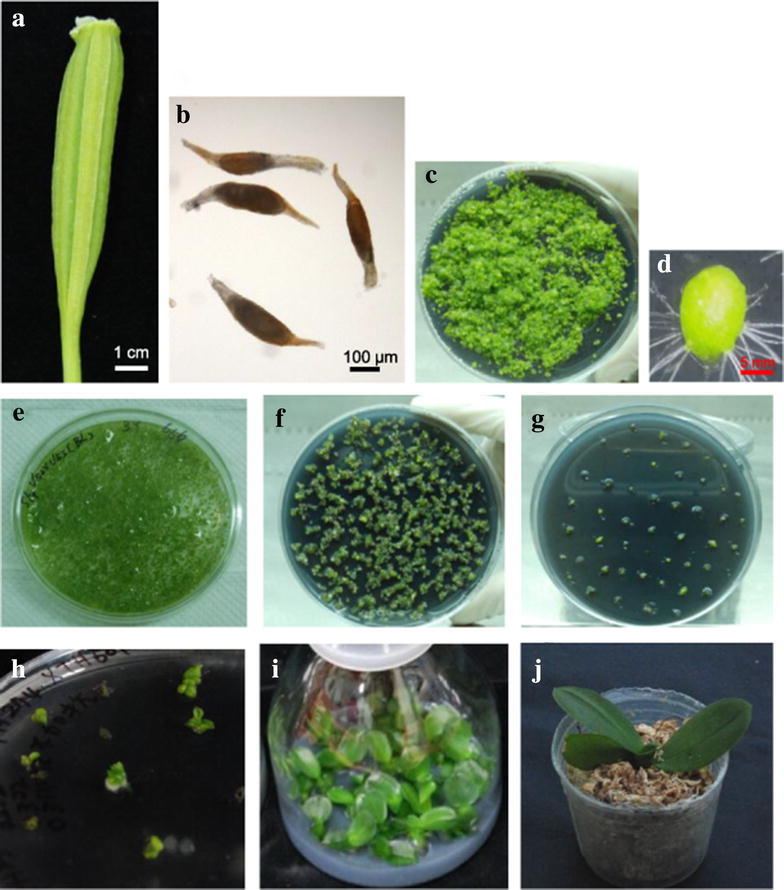
Fig. 1
Fig. 1
Procedures for Agrobaterium-mediated transformation of protocorms in Phalaenopsis orchid. a Mature orchid capsule at 4 months after pollination. b Stage of mature seeds ready for sowing. c Growth of protocorms sown on 1/2 MS agar plates for 1 month. d Healthy protocorm ready for infection. e Agrobacteria infection. f The 1st round selection for hygromycin resistance on T2 media containing 25 ppm hygromycin and 40 ppm meropenem (T2 + MH). g The 2nd round selection for hygromycin resistance on T2 + MH. h Growth of explants on 1/2 MS plate. i Growth of transgenic lines in jar. j Transplanted transgenic orchid to 1.7″ pot containing sphagnum moss
Fig. 2
Fig. 2
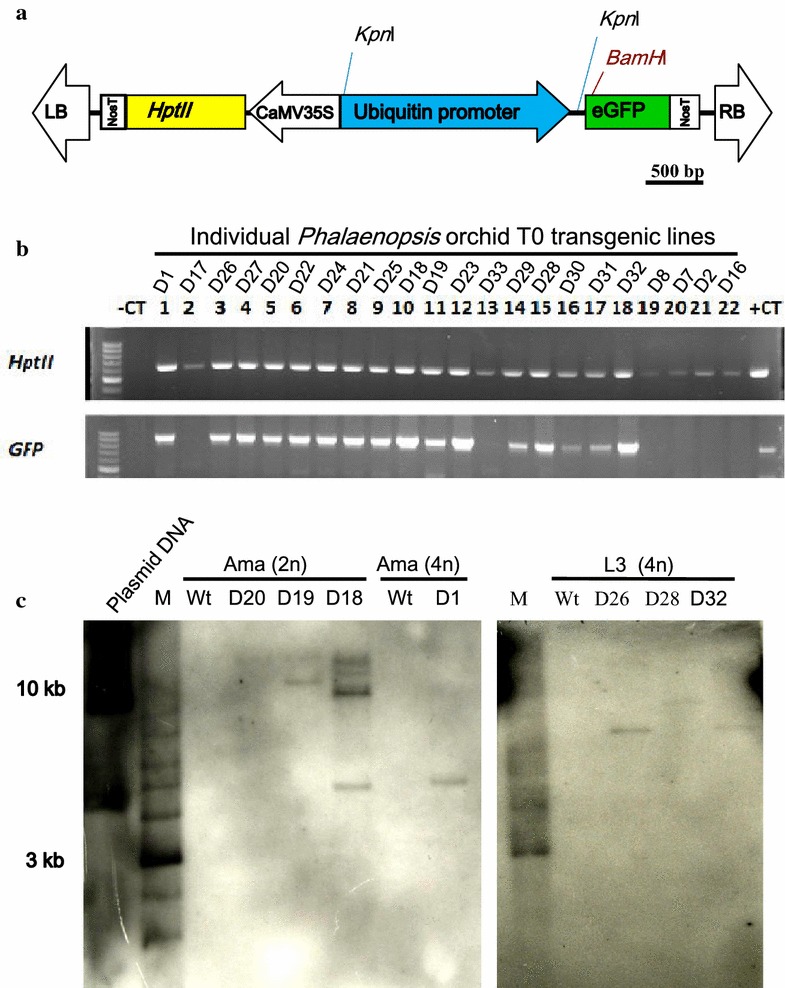
Confirmation of Phalaenopsis transgenic lines. a Construction map of Ubi:eGFP used in this study. Schematic structure of the T-DNA region in the vector of pZp200. CaMV 35S, promoter of CaMV 35S; HptII, coding region of hygromycin phosphotransferase gene; eGFP, coding region of eGFP; NosT, terminator of nopaline synthase gene; LB left border; RB right border. b Genomic PCR analysis of eGFP and HptII genes. −CT, negative control without addition of the genomic DNA template; +CT, with added plasmid DNA. c Southern blot analysis of HptII showing integration of T-DNA in Phalaenopsis orchid genome. Transgenic lines and their respective Wt plants were analyzed side by side
Fig. 3
Fig. 3
Western blot and detection of the GFP fluorescence signal in transgenic orchids. a Western blot analysis of the expression of GFP protein in transgenic orchids. Total protein was isolated from the leaf of orchid and 30 μg total protein was loaded into 10 % acrylamide gel, electrophoresed, and transferred onto polyvinylidene fluoride (PVDF) membrane for antibody probing. The membrane was probed using an anti-GFP antibody and anti-actin antibody served as the loading control. Wt wild-type; 4n tetraploid; 2n diploid. b GFP fluorescence signal was detected in D20 transgenic Phalaenopsis aphrodite. c A magnified view of the GFP signal in partial tissue of b. Root tissues of the D20 transgenic line and Wt were vertical and transversely sectioned, and leaves were transverse-sectioned using a vibratome and an image was obtained using a confocal microscope
Fig. 4
Fig. 4
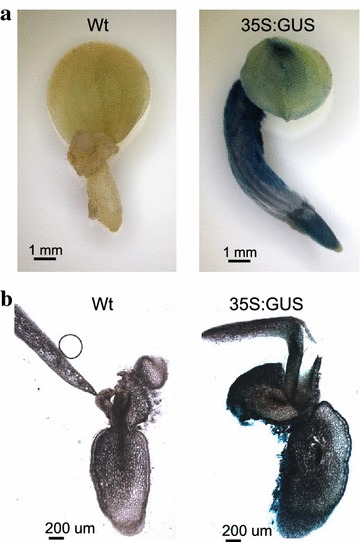
Histochemical Gus staining in transgenic Phalaenopsis orchid lines. Transgenic orchid explant harboring 35S:GUS and a Wt non-transgenic control were stained with X-Gluc and incubated at 37 °C overnight. a Image obtained using a Nikon SMZ1500 dissecting microscope (×7.5 magnification). b Explant tissue sections of approximately 120 µm in thickness were photographed on a Zeiss Axio Scope A1 microscope equipped with an Axio-Cam HRc camera (Zeiss, Germany) (×25 magnification)
Fig. 5
Fig. 5
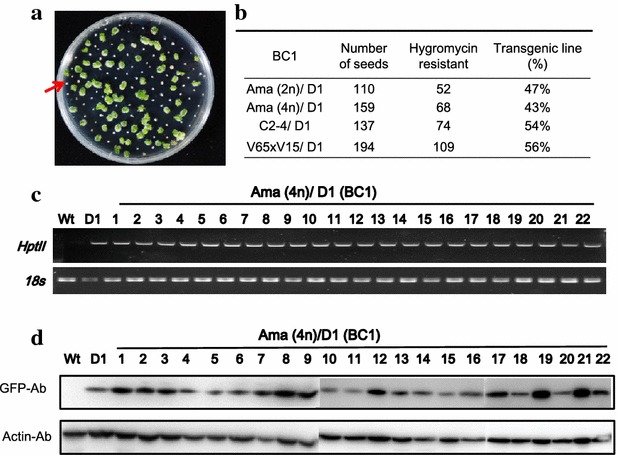
Stable inheritance of transgene in BC1 orchid progeny. a Pollinia of D1 transgenic line was crossed-pollinated to four distinct genetic backgrounds of Wt orchids and generated BC1 progenies. Ama (4n)/D1 BC1 seeds were sown on 1/2 MS agar plates containing 25 ppm hygromycin. Some BC1 progenies were resistant to hygromycin and some were susceptible showing white and wilt symptoms. Red arrows indicate hygromycin susceptible explants. b Record of survival rate in BC1 transgenic lines. c Genomic PCR showed HptII gene integration in the hygromycin-resistant BC1 progenies. d Western blot showed GFP protein expression in the hygromycin-resistant BC1 progenies. Ama (4n) was used as the non-transgenic wild-type negative control. D1, the original T0 transgenic parent was used as a positive control

References

    1. Anzai H, Tanaka T. Transgenic Phalaenopsis (a moth orchid) In: Bajaj YPS, editor. Biotechnology in agriculture and forestry transgenic crops III 48. Berlin: Springer; 2001. pp. 249–264.
    1. Anzai H, Ishii Y, Shichinohe M, Katsumata K, Nojiri C, Morikawa H, Tanaka M. Transformation of Phalaenopsis by particle bombardment. Plant Tissue Cult Lett. 1996;13:265–272. doi: 10.5511/plantbiotechnology1984.13.265. - DOI
    1. Belarmino MM, Mii M. Agrobacterium-mediated genetic transformation of a Phalaenopsis orchid. Plant Cell Rep. 2000;19:435–442. doi: 10.1007/s002990050752. - DOI - PubMed
    1. Chai ML, Xu CJ, Senthil KK, Kim JY, Kim DH. Stable transformation of protocorm-like bodies in Phalaenopsis orchid mediated by Agrobacterium tumefaciens. Sci Hort. 2002;96:213–224. doi: 10.1016/S0304-4238(02)00084-5. - DOI
    1. Chan YL, Lin KH, Liao LJ, Chen WH, Chan MT. Gene stacking in Phalaenopsis orchid enhances dual tolerance to pathogen attack. Transgenic Res. 2005;14:279–288. doi: 10.1007/s11248-005-0106-5. - DOI - PubMed