


Development an instrument assessing residents' attitude towards professionalism lapses in training
- PMID: 28597871
- PMCID: PMC5465436
- DOI: 10.3946/kjme.2017.55
Development an instrument assessing residents' attitude towards professionalism lapses in training
Abstract
Purpose: Medical professionalism is a fundamental competency for all physicians and continuous development of professionalism during residency training is crucial. The purpose of this study was to develop an instrument assessing residents' attitudes toward unprofessional behaviors.
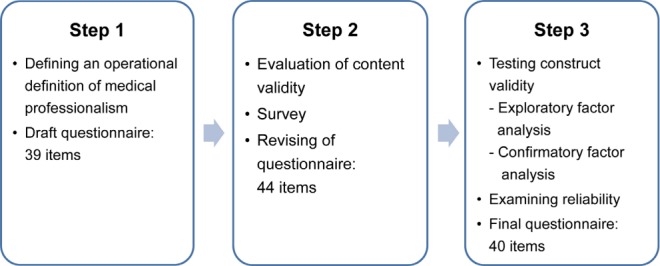
Methods: A questionnaire survey was conducted in cooperation with the Korea Resident Association from May to July 2013. A total of 317 residents from seven university-affiliated hospitals in South Korea participated in the survey.
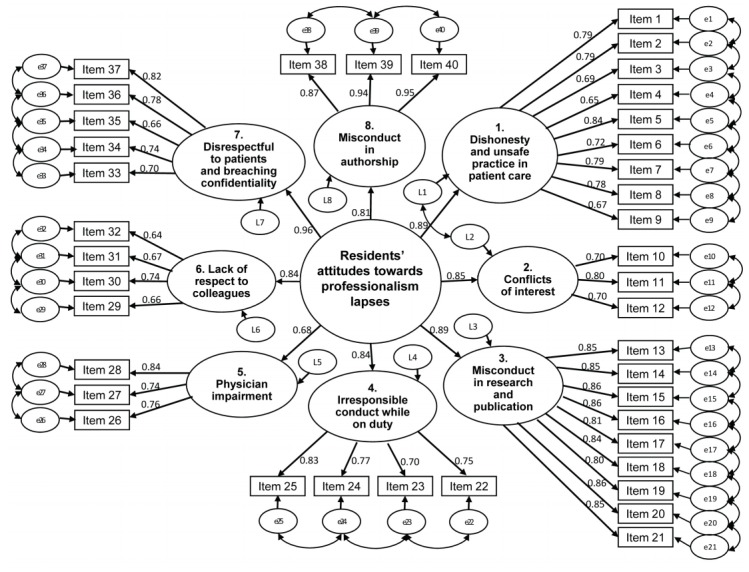
Results: In the exploratory factor analysis, seven factors were extracted from the data; factor loadings of the 44 items ranged between 0.40 and 0.89. Through iterative discussion, three items below 0.45 were deleted and one additional item was removed due to its irrelevance. Twelve items included in Factor 1 were divided into two different categories. A final version of the questionnaire containing 40 items in eight categories was assessed using confirmatory factor analysis. It was deemed to have a good fit; the root mean square error of approximation and comparative fit index were 0.07 and 0.9, respectively. The reliability (Cronbach's α) of the inventory was 0.97.
Conclusion: The items of this instrument encompass a broad range of residents' behaviors in clinical practice, research, and publication. In addition, it includes some types of misconduct that can be considered unique features of the authors' cultural backgrounds. We recommend this instrument as an assessment tool to diagnose residents' perceptions and attitudes towards professionalism lapses and to provide insight regarding potential improvement in professionalism education.
Keywords: Attitude; Instrumentation; Professional misconduct; Professionalism.
Figures
References
-
- Papadakis MA, Paauw DS, Hafferty FW, Shapiro J, Byyny RL, Alpha Omega Alpha Honor Medical Society Think Tank Perspective: the education community must develop best practices informed by evidence-based research to remediate lapses of professionalism. Acad Med. 2012;87:1694–1698. - PubMed
-
- Wynia MK, Papadakis MA, Sullivan WM, Hafferty FW. More than a list of values and desired behaviors: a foundational understanding of medical professionalism. Acad Med. 2014;89:712–714. - PubMed
-
- Hodges BD, Ginsburg S, Cruess R, Cruess S, Delport R, Hafferty F, Ho MJ, Holmboe E, Holtman M, Ohbu S, Rees C, Ten Cate O, Tsugawa Y, Van Mook W, Wass V, Wilkinson T, Wade W. Assessment of professionalism: recommendations from the Ottawa 2010 Conference. Med Teach. 2011;33:354–363. - PubMed
-
- Wilkinson TJ, Wade WB, Knock LD. A blueprint to assess professionalism: results of a systematic review. Acad Med. 2009;84:551–558. - PubMed
-
- Cohen JJ. Professionalism in medical education, an American perspective: from evidence to accountability. Med Educ. 2006;40:607–617. - PubMed
Publication types
MeSH terms
LinkOut - more resources
Full Text Sources
Other Literature Sources
