Glycolytic reliance promotes anabolism in photoreceptors
- PMID: 28598329
- PMCID: PMC5499945
- DOI: 10.7554/eLife.25946
Glycolytic reliance promotes anabolism in photoreceptors
Abstract
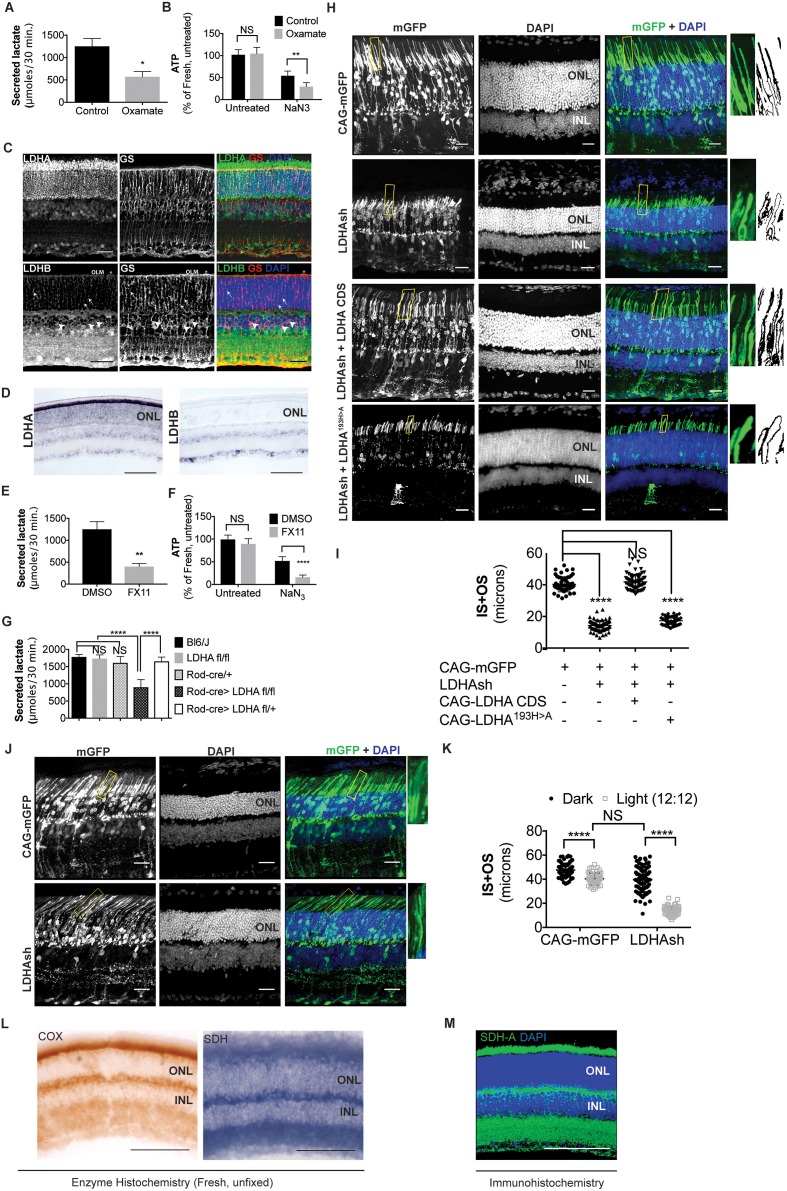
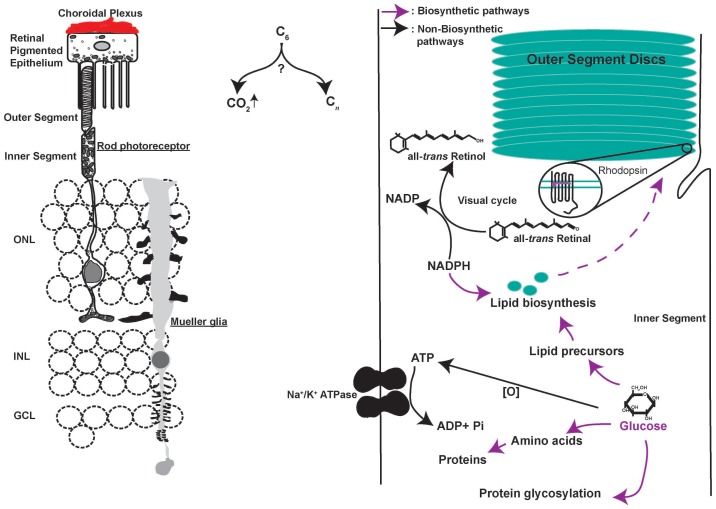
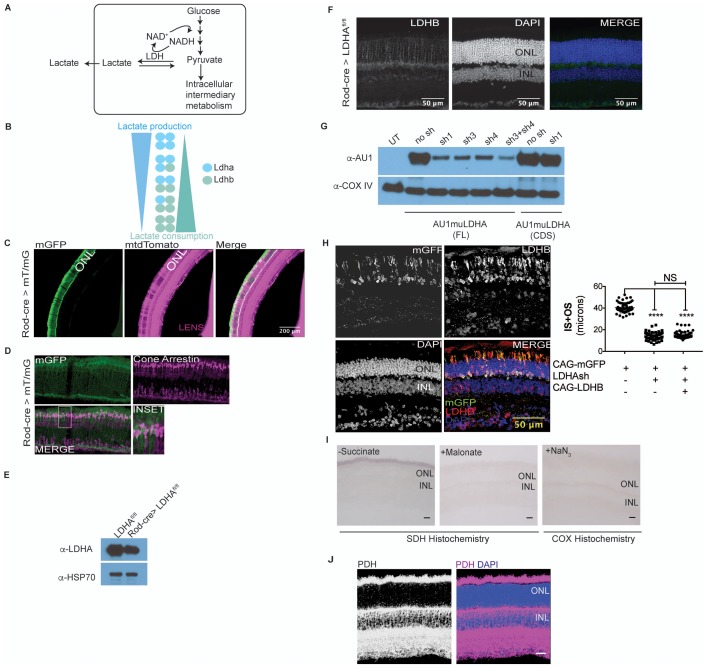
Vertebrate photoreceptors are among the most metabolically active cells, exhibiting a high rate of ATP consumption. This is coupled with a high anabolic demand, necessitated by the diurnal turnover of a specialized membrane-rich organelle, the outer segment, which is the primary site of phototransduction. How photoreceptors balance their catabolic and anabolic demands is poorly understood. Here, we show that rod photoreceptors in mice rely on glycolysis for their outer segment biogenesis. Genetic perturbations targeting allostery or key regulatory nodes in the glycolytic pathway impacted the size of the outer segments. Fibroblast growth factor signaling was found to regulate glycolysis, with antagonism of this pathway resulting in anabolic deficits. These data demonstrate the cell autonomous role of the glycolytic pathway in outer segment maintenance and provide evidence that aerobic glycolysis is part of a metabolic program that supports the biosynthetic needs of a normal neuronal cell type.
Keywords: Warburg effect; allostery; cell biology; mouse; neuroscience; outer segments; retinal metabolism.
Conflict of interest statement
The authors declare that no competing interests exist.
Figures
Comment in
-
Warburg's vision.Elife. 2017 Jul 6;6:e29217. doi: 10.7554/eLife.29217. Elife. 2017. PMID: 28681722 Free PMC article.
Similar articles
-
Retinal metabolism displays evidence for uncoupling of glycolysis and oxidative phosphorylation via Cori-, Cahill-, and mini-Krebs-cycle.Elife. 2024 May 13;12:RP91141. doi: 10.7554/eLife.91141. Elife. 2024. PMID: 38739438 Free PMC article.
-
Glucose metabolism in photoreceptor outer segments. Its role in phototransduction and in NADPH-requiring reactions.J Biol Chem. 1994 Jul 8;269(27):17954-9. J Biol Chem. 1994. PMID: 8027053
-
Reprogramming metabolism by targeting sirtuin 6 attenuates retinal degeneration.J Clin Invest. 2016 Dec 1;126(12):4659-4673. doi: 10.1172/JCI86905. Epub 2016 Nov 14. J Clin Invest. 2016. PMID: 27841758 Free PMC article.
-
Metabolic and redox signaling in the retina.Cell Mol Life Sci. 2017 Oct;74(20):3649-3665. doi: 10.1007/s00018-016-2318-7. Epub 2016 Aug 20. Cell Mol Life Sci. 2017. PMID: 27543457 Free PMC article. Review.
-
Photoreceptors at a glance.J Cell Sci. 2015 Nov 15;128(22):4039-45. doi: 10.1242/jcs.175687. J Cell Sci. 2015. PMID: 26574505 Free PMC article. Review.
Cited by
-
Metabolic Analysis of Vitreous/Lens and Retina in Wild Type and Retinal Degeneration Mice.Int J Mol Sci. 2021 Feb 26;22(5):2345. doi: 10.3390/ijms22052345. Int J Mol Sci. 2021. PMID: 33652907 Free PMC article.
-
Energy Metabolism in the Inner Retina in Health and Glaucoma.Int J Mol Sci. 2021 Apr 1;22(7):3689. doi: 10.3390/ijms22073689. Int J Mol Sci. 2021. PMID: 33916246 Free PMC article. Review.
-
Metabolism and Vascular Retinopathies: Current Perspectives and Future Directions.Diagnostics (Basel). 2022 Apr 5;12(4):903. doi: 10.3390/diagnostics12040903. Diagnostics (Basel). 2022. PMID: 35453951 Free PMC article. Review.
-
Differential Susceptibility of Retinal Neurons to the Loss of Mitochondrial Biogenesis Factor Nrf1.Cells. 2022 Jul 14;11(14):2203. doi: 10.3390/cells11142203. Cells. 2022. PMID: 35883647 Free PMC article.
-
A Mathematical Analysis of Aerobic Glycolysis Triggered by Glucose Uptake in Cones.Sci Rep. 2019 Mar 11;9(1):4162. doi: 10.1038/s41598-019-39901-z. Sci Rep. 2019. PMID: 30858444 Free PMC article.
References
-
- Anastasiou D, Poulogiannis G, Asara JM, Boxer MB, Jiang JK, Shen M, Bellinger G, Sasaki AT, Locasale JW, Auld DS, Thomas CJ, Vander Heiden MG, Cantley LC. Inhibition of pyruvate kinase M2 by reactive oxygen species contributes to cellular antioxidant responses. Science. 2011;334:1278–1283. doi: 10.1126/science.1211485. - DOI - PMC - PubMed
-
- Anastasiou D, Yu Y, Israelsen WJ, Jiang JK, Boxer MB, Hong BS, Tempel W, Dimov S, Shen M, Jha A, Yang H, Mattaini KR, Metallo CM, Fiske BP, Courtney KD, Malstrom S, Khan TM, Kung C, Skoumbourdis AP, Veith H, Southall N, Walsh MJ, Brimacombe KR, Leister W, Lunt SY, Johnson ZR, Yen KE, Kunii K, Davidson SM, Christofk HR, Austin CP, Inglese J, Harris MH, Asara JM, Stephanopoulos G, Salituro FG, Jin S, Dang L, Auld DS, Park HW, Cantley LC, Thomas CJ, Vander Heiden MG. Pyruvate kinase M2 activators promote tetramer formation and suppress tumorigenesis. Nature Chemical Biology. 2012;8:839–847. doi: 10.1038/nchembio.1060. - DOI - PMC - PubMed
-
- Aït-Ali N, Fridlich R, Millet-Puel G, Clérin E, Delalande F, Jaillard C, Blond F, Perrocheau L, Reichman S, Byrne LC, Olivier-Bandini A, Bellalou J, Moyse E, Bouillaud F, Nicol X, Dalkara D, van Dorsselaer A, Sahel JA, Léveillard T. Rod-derived cone viability factor promotes cone survival by stimulating aerobic glycolysis. Cell. 2015;161:817–832. doi: 10.1016/j.cell.2015.03.023. - DOI - PubMed
-
- Balinsky D, Platz CE, Lewis JW. Isozyme patterns of normal, benign, and malignant human breast tissues. Cancer Research. 1983;43:5895–5901. - PubMed
Publication types
MeSH terms
Substances
Grants and funding
LinkOut - more resources
Full Text Sources
Other Literature Sources
Molecular Biology Databases
Research Materials