


Role of Gut Microbiota in Rheumatoid Arthritis
- PMID: 28598360
- PMCID: PMC5483870
- DOI: 10.3390/jcm6060060
Role of Gut Microbiota in Rheumatoid Arthritis
Abstract
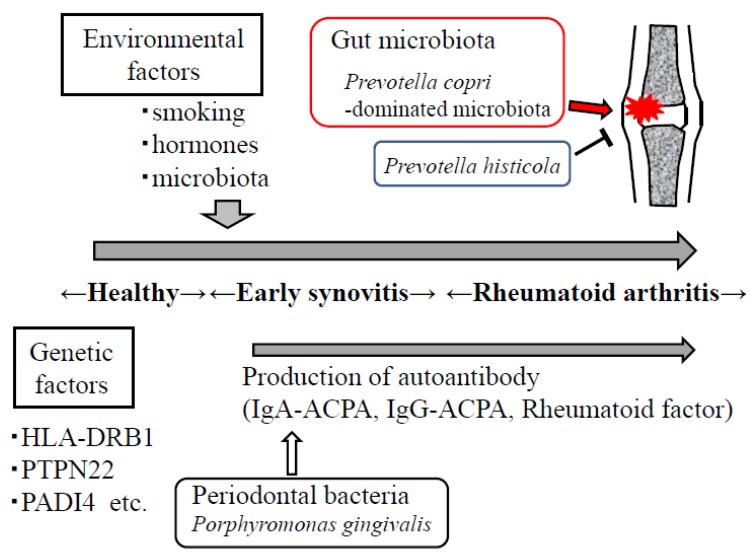
Rheumatoid arthritis (RA) is a systemic autoimmune disease, caused by both genetic and environmental factors. Recently, investigators have focused on the gut microbiota, which is thought to be an environmental agent affecting the development of RA. Here we review the evidence from animal and human studies that supports the role of the gut microbiota in RA. We and others have demonstrated that the abundance of Prevotella copri is increased in some early RA. We have also used gnotobiotic experiments to show that dysbiosis in RA patients contributed to the development of Th17 cell-dependent arthritis in intestinal microbiota-humanized SKG mice. On the other hand, Prevotella histicola from human gut microbiota suppressed the development of arthritis. In summary, Prevotella species are involved in the pathogenesis of arthritis.
Keywords: Prevotella copri; Th17 cell; gut; microbiota; rheumatoid arthritis.
Conflict of interest statement
The authors declare no conflict of interest.
Figures
References
-
- Alhagamhmad M.H., Day A.S., Lemberg D.A., Leach S.T. An overview of the bacterial contribution to Crohn disease pathogenesis. J. Med. Microbiol. 2016;65:1049–1059. - PubMed
Publication types
LinkOut - more resources
Full Text Sources
Other Literature Sources
