. 2017 Jun 9:8:15671.
doi: 10.1038/ncomms15671.

Age-related delay in visual and auditory evoked responses is mediated by white- and grey-matter differences

Collaborators, Affiliations

Age-related delay in visual and auditory evoked responses is mediated by white- and grey-matter differences

D Price et al. Nat Commun. .

Abstract

Slowing is a common feature of ageing, yet a direct relationship between neural slowing and brain atrophy is yet to be established in healthy humans. We combine magnetoencephalographic (MEG) measures of neural processing speed with magnetic resonance imaging (MRI) measures of white and grey matter in a large population-derived cohort to investigate the relationship between age-related structural differences and visual evoked field (VEF) and auditory evoked field (AEF) delay across two different tasks. Here we use a novel technique to show that VEFs exhibit a constant delay, whereas AEFs exhibit delay that accumulates over time. White-matter (WM) microstructure in the optic radiation partially mediates visual delay, suggesting increased transmission time, whereas grey matter (GM) in auditory cortex partially mediates auditory delay, suggesting less efficient local processing. Our results demonstrate that age has dissociable effects on neural processing speed, and that these effects relate to different types of brain atrophy.


Conflict of interest statement

The authors declare no competing financial interests.

Figures
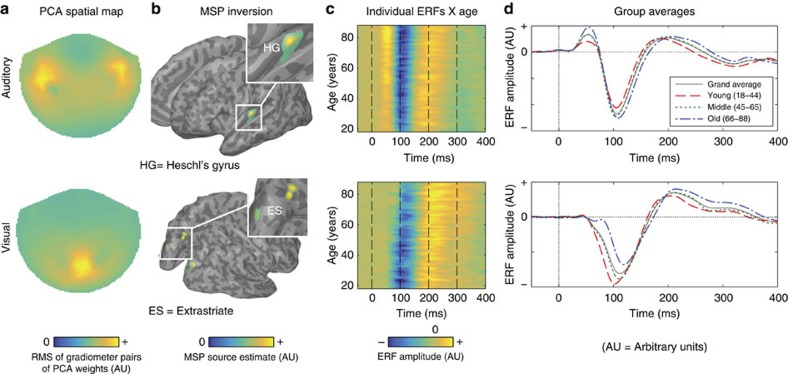
Figure 1
Figure 1. Principal component analysis (PCA) and delay estimation of auditory and visual evoked responses.
(a) Two-dimensional topographical MEG sensor plot of the first spatial component derived using PCA in the Passive task. Values represent the root mean square (RMS) of each pair of gradiometers. (b) Group Multiple Sparse Prior (MSP) source reconstruction based on the spatial component shown in a (cluser peak MNI coordinates: right HG=[+38, −22, +8], left=[−38, −26, +8]; right V2=[+14, −96, +20], left=[−14, −96, +20]; ES right=[+16, −74, +24], left=[−16, −74, +20]). (c) Heat-maps illustrating the mean time course for each participant from the first temporal component of the PCA. Data are smoothed in the y direction for visualization only (Gaussian width=5 subjects). (d) Group average time courses for each of three age groups (18–44, 45-65, 66–88 years). Because all of our analyses are based on principal components, the y axis of plots have arbitrary units.
Figure 2
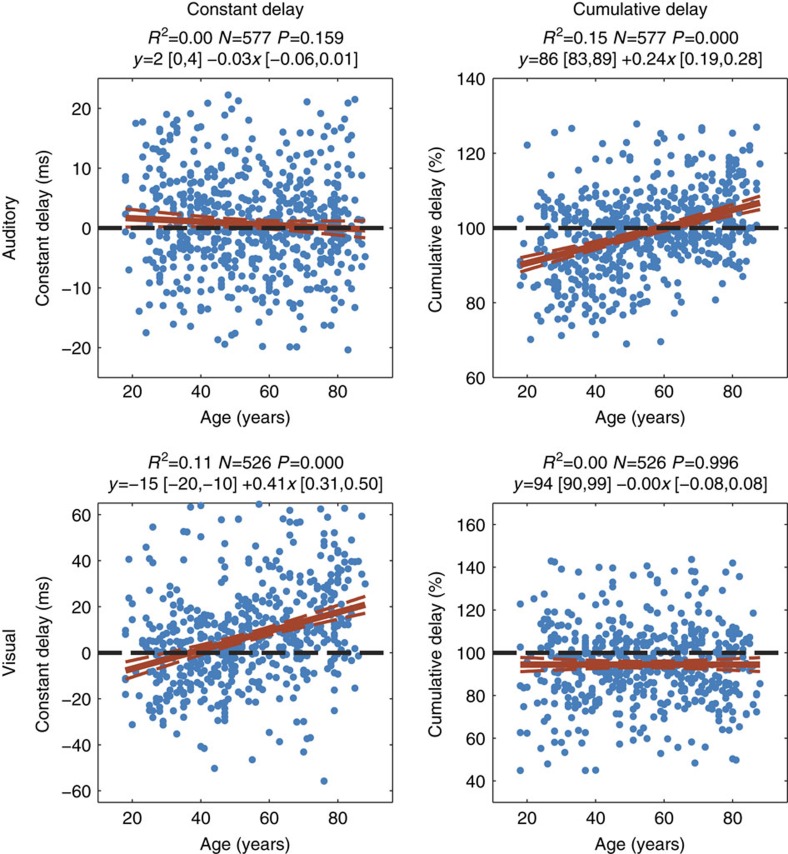
Figure 2. Robust regressions with age of the two delay parameters for each stimulus modality in the Passive task.
There is a significant effect of age on constant but not cumulative delay in the VEF, and a significant effect of age on cumulative but not constant delay in the AEF.
Figure 3
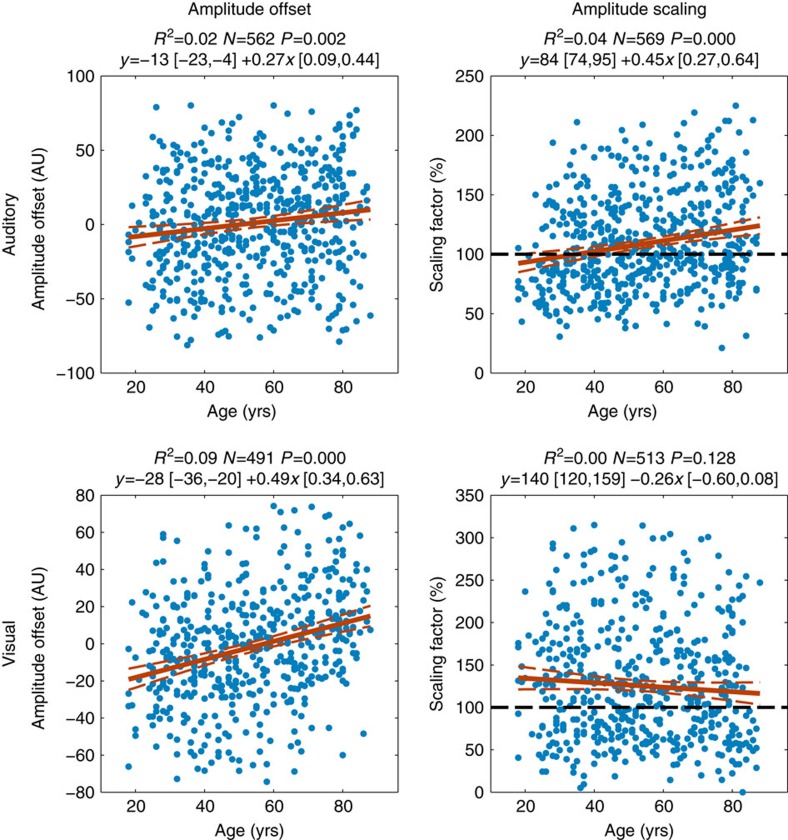
Figure 3. Amplitude offset and amplitude scaling parameters extracted during template fitting.
Amplitude offset was calculated by taking the mean difference between template and individual ERFs, while amplitude scaling indicates the amount the template needs to be scaled to minimize residual error between template and individual ERF.
Figure 4
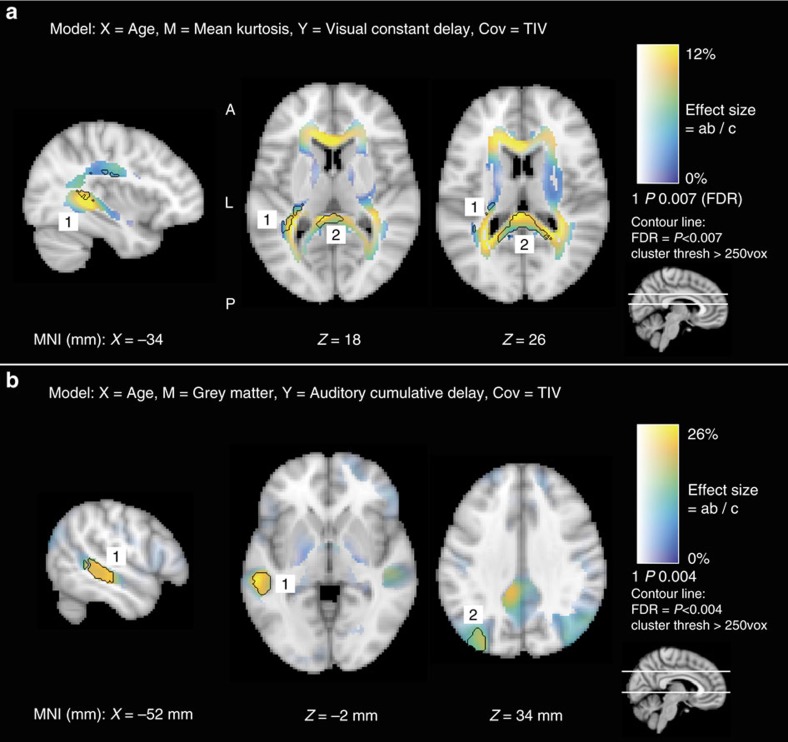
Figure 4. Whole-brain voxel-wise mediation analysis results.
Voxel hue corresponds to the effect size (% mediation effect), while opacity corresponds to the univariate P value. Clusters of at least 250 voxels that survive FDR correction are marked with a black border. (a) WM structure (MK) in the optic radiation (connecting LGN to V1) [label 1], and in splenium of corpus callosum [label 2], mediates the age versus visual constant delay relationship. (b) GM volume in the left posterior STG mediates the age versus auditory cumulative delay relationship [label 1]. Another cluster was observed in the left superior lateral occipital cortex, a region not involved in auditory processing [label 2]. All effects indicate positive mediation (that is, the age versus delay relationship is attenuated when including the mediator).
Figure 5
Figure 5
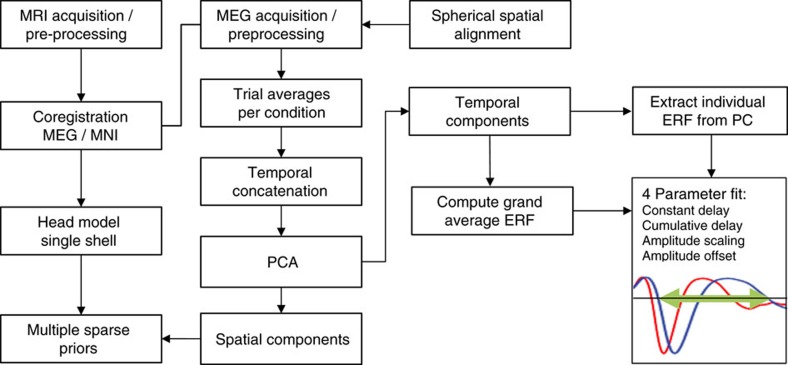
Flow chart diagram illustrating the processing steps involved in the analysis of MEG data.

References

    1. Kievit R. A. et al.. Distinct aspects of frontal lobe structure mediate age-related differences in fluid intelligence and multitasking. Nat. Commun. 5, 5658 (2014). - PMC - PubMed
    1. Salthouse T. A. The processing-speed theory of adult age differences in cognition. Psychol. Rev. 103, 403 (1996). - PubMed
    1. Lu P. H. et al.. Age-related slowing in cognitive processing speed is associated with myelin integrity in a very healthy elderly sample. J. Clin. Exp. Neuropsychol. 33, 1059–1068 (2011). - PMC - PubMed
    1. Lu P. H. et al.. Myelin breakdown mediates age-related slowing in cognitive processing speed in healthy elderly men. Brain Cogn. 81, 131–138 (2013). - PubMed
    1. Thomas C. et al.. Reduction in white matter connectivity, revealed by diffusion tensor imaging, may account for age-related changes in face perception. J. Cogn. Neurosci. 20, 268–284 (2008). - PMC - PubMed

Publication types

MeSH terms