


Ultrasonography for endoleak detection after endoluminal abdominal aortic aneurysm repair
- PMID: 28598495
- PMCID: PMC6481872
- DOI: 10.1002/14651858.CD010296.pub2
Ultrasonography for endoleak detection after endoluminal abdominal aortic aneurysm repair
Abstract
Background: People with abdominal aortic aneurysm who receive endovascular aneurysm repair (EVAR) need lifetime surveillance to detect potential endoleaks. Endoleak is defined as persistent blood flow within the aneurysm sac following EVAR. Computed tomography (CT) angiography is considered the reference standard for endoleak surveillance. Colour duplex ultrasound (CDUS) and contrast-enhanced CDUS (CE-CDUS) are less invasive but considered less accurate than CT.
Objectives: To determine the diagnostic accuracy of colour duplex ultrasound (CDUS) and contrast-enhanced-colour duplex ultrasound (CE-CDUS) in terms of sensitivity and specificity for endoleak detection after endoluminal abdominal aortic aneurysm repair (EVAR).
Search methods: We searched MEDLINE, Embase, LILACS, ISI Conference Proceedings, Zetoc, and trial registries in June 2016 without language restrictions and without use of filters to maximize sensitivity.
Selection criteria: Any cross-sectional diagnostic study evaluating participants who received EVAR by both ultrasound (with or without contrast) and CT scan assessed at regular intervals.
Data collection and analysis: Two pairs of review authors independently extracted data and assessed quality of included studies using the QUADAS 1 tool. A third review author resolved discrepancies. The unit of analysis was number of participants for the primary analysis and number of scans performed for the secondary analysis. We carried out a meta-analysis to estimate sensitivity and specificity of CDUS or CE-CDUS using a bivariate model. We analysed each index test separately. As potential sources of heterogeneity, we explored year of publication, characteristics of included participants (age and gender), direction of the study (retrospective, prospective), country of origin, number of CDUS operators, and ultrasound manufacturer.
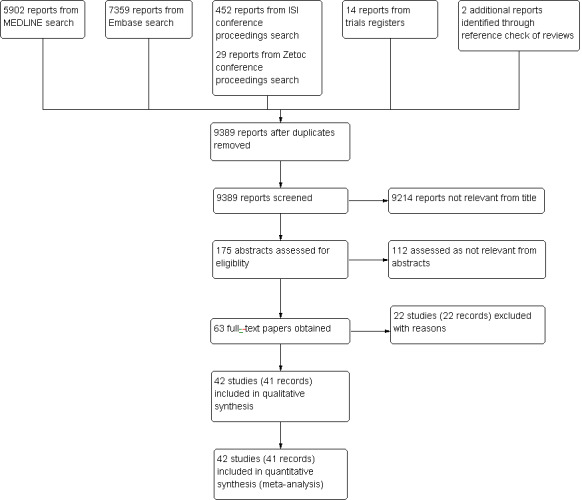
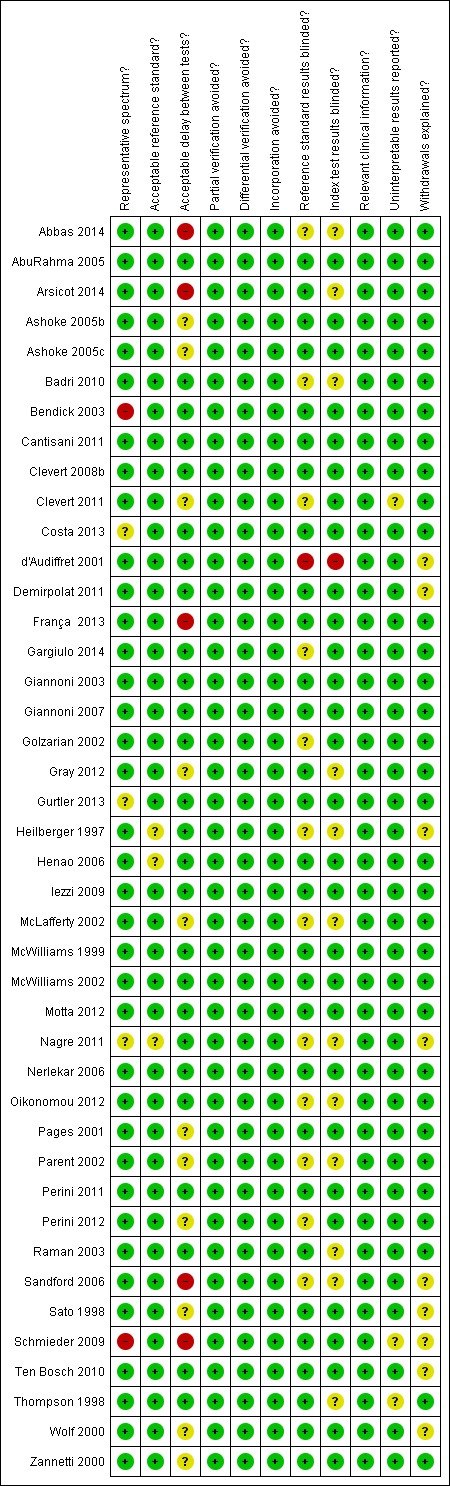
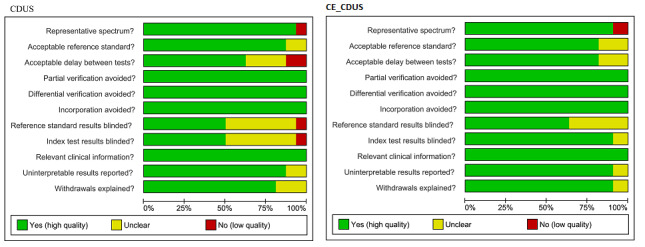
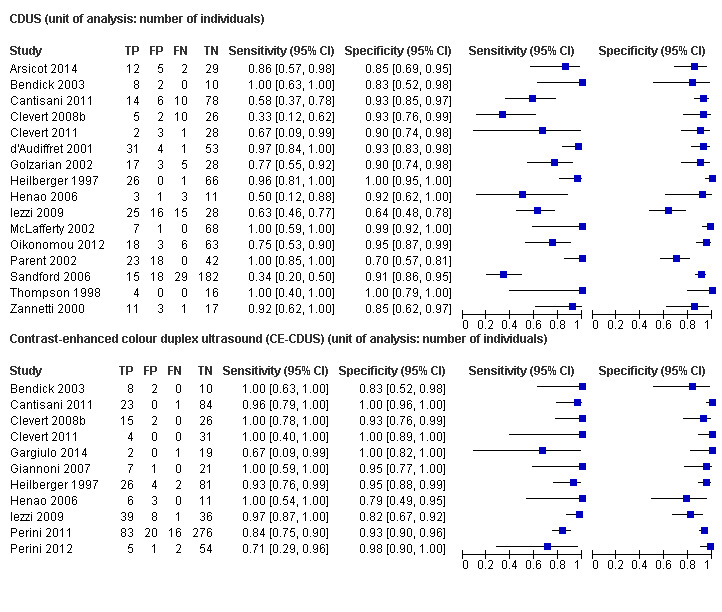
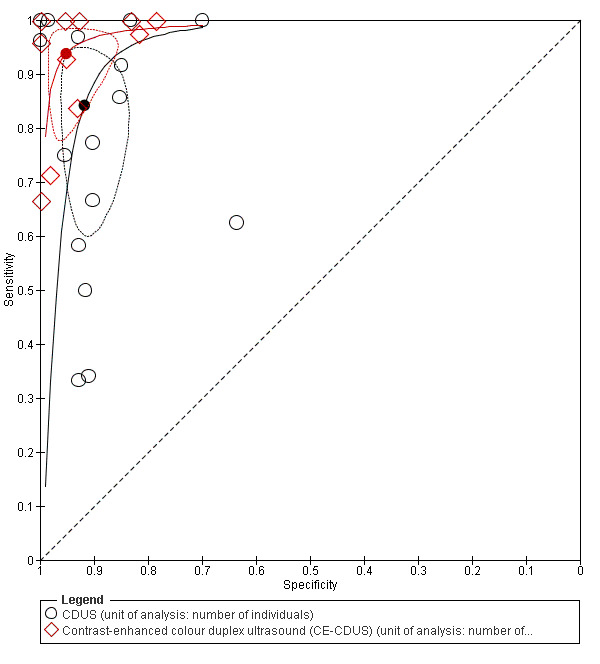
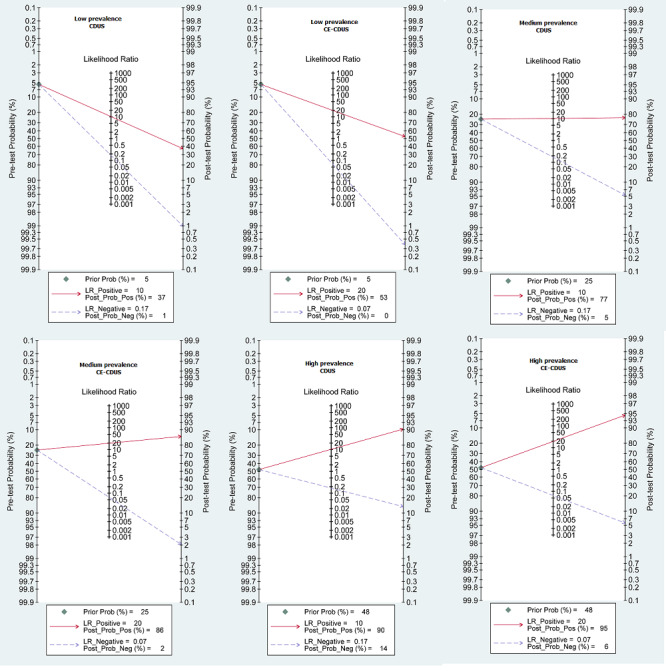
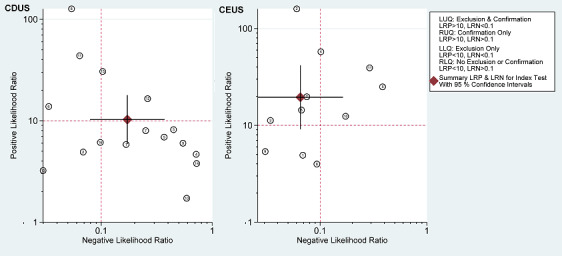
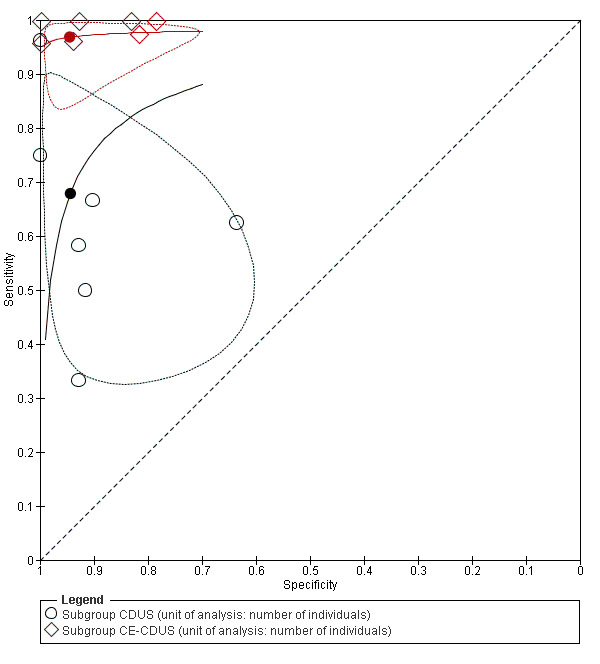
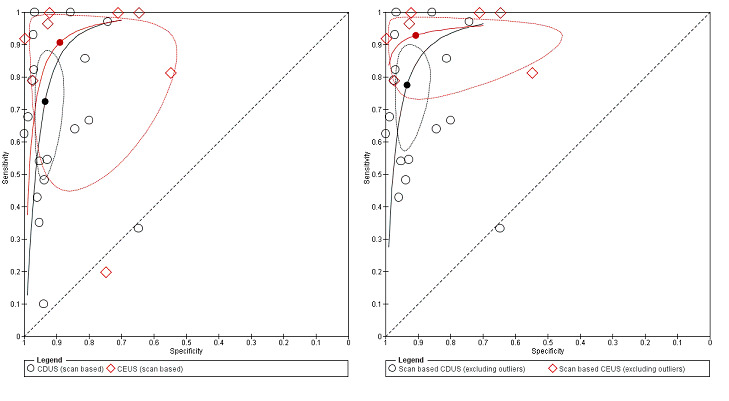
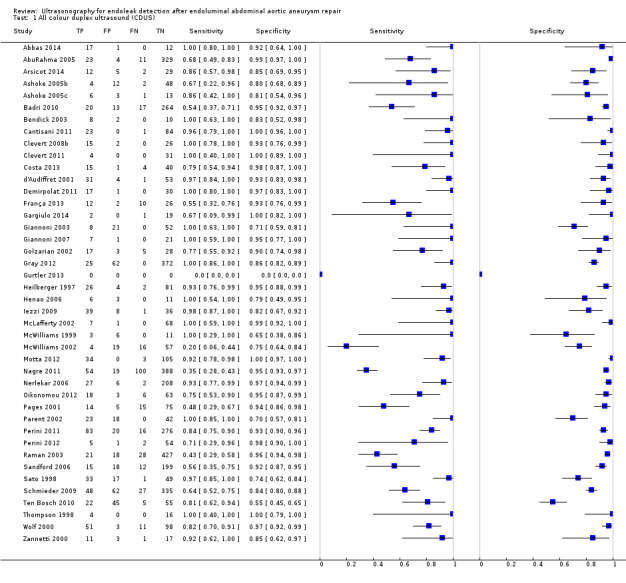
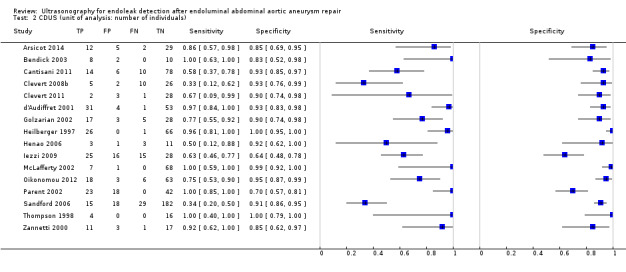
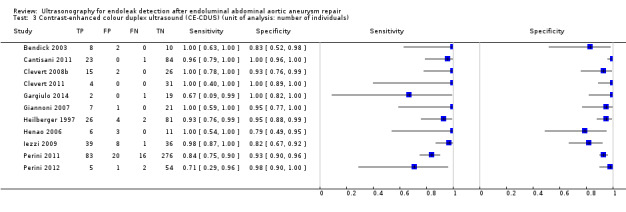
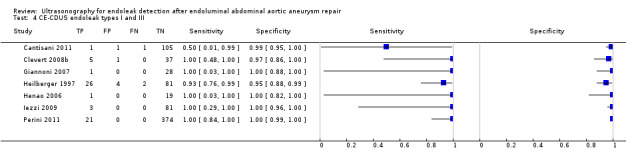
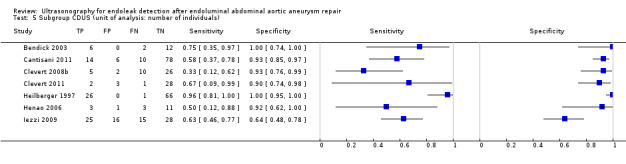
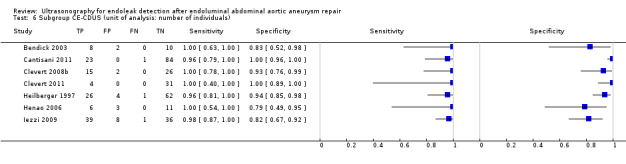
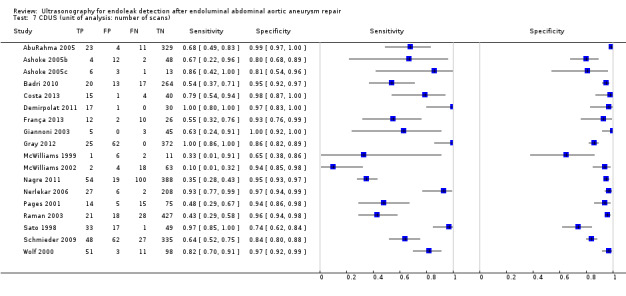
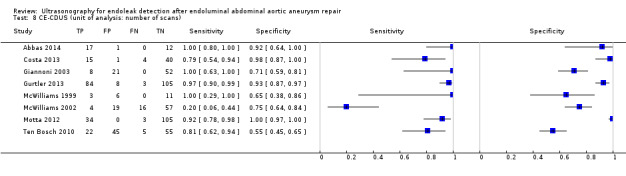
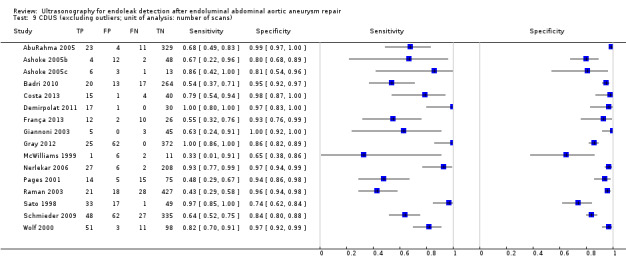
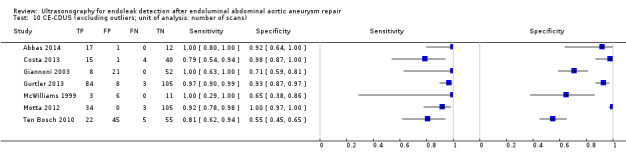
Main results: We identified 42 primary studies with 4220 participants. Twenty studies provided accuracy data based on the number of individual participants (seven of which provided data with and without the use of contrast). Sixteen of these studies evaluated the accuracy of CDUS. These studies were generally of moderate to low quality: only three studies fulfilled all the QUADAS items; in six (40%) of the studies, the delay between the tests was unclear or longer than four weeks; in eight (50%), the blinding of either the index test or the reference standard was not clearly reported or was not performed; and in two studies (12%), the interpretation of the reference standard was not clearly reported. Eleven studies evaluated the accuracy of CE-CDUS. These studies were of better quality than the CDUS studies: five (45%) studies fulfilled all the QUADAS items; four (36%) did not report clearly the blinding interpretation of the reference standard; and two (18%) did not clearly report the delay between the two tests.Based on the bivariate model, the summary estimates for CDUS were 0.82 (95% confidence interval (CI) 0.66 to 0.91) for sensitivity and 0.93 (95% CI 0.87 to 0.96) for specificity whereas for CE-CDUS the estimates were 0.94 (95% CI 0.85 to 0.98) for sensitivity and 0.95 (95% CI 0.90 to 0.98) for specificity. Regression analysis showed that CE-CDUS was superior to CDUS in terms of sensitivity (LR Chi2 = 5.08, 1 degree of freedom (df); P = 0.0242 for model improvement).Seven studies provided estimates before and after administration of contrast. Sensitivity before contrast was 0.67 (95% CI 0.47 to 0.83) and after contrast was 0.97 (95% CI 0.92 to 0.99). The improvement in sensitivity with of contrast use was statistically significant (LR Chi2 = 13.47, 1 df; P = 0.0002 for model improvement).Regression testing showed evidence of statistically significant effect bias related to year of publication and study quality within individual participants based CDUS studies. Sensitivity estimates were higher in the studies published before 2006 than the estimates obtained from studies published in 2006 or later (P < 0.001); and studies judged as low/unclear quality provided higher estimates in sensitivity. When regression testing was applied to the individual based CE-CDUS studies, none of the items, namely direction of the study design, quality, and age, were identified as a source of heterogeneity.Twenty-two studies provided accuracy data based on number of scans performed (of which four provided data with and without the use of contrast). Analysis of the studies that provided scan based data showed similar results. Summary estimates for CDUS (18 studies) showed 0.72 (95% CI 0.55 to 0.85) for sensitivity and 0.95 (95% CI 0.90 to 0.96) for specificity whereas summary estimates for CE-CDUS (eight studies) were 0.91 (95% CI 0.68 to 0.98) for sensitivity and 0.89 (95% CI 0.71 to 0.96) for specificity.
Authors' conclusions: This review demonstrates that both ultrasound modalities (with or without contrast) showed high specificity. For ruling in endoleaks, CE-CDUS appears superior to CDUS. In an endoleak surveillance programme CE-CDUS can be introduced as a routine diagnostic modality followed by CT scan only when the ultrasound is positive to establish the type of endoleak and the subsequent therapeutic management.
Conflict of interest statement
The review authors have no financial involvement with any organization or entity with a financial interest in, or financial conflict with, the subject matter or materials discussed in the review.
IA: none known. MLL: none known. RDF: none known. FC: none known. GC: none known. PD: none known. BP: none known. MO: none known. AG: none known. PE: none known. AM: none known.
Figures
Update of
References
References to studies included in this review
Abbas 2014 {published data only}
-
- Abbas A, Hansrani V, Sedgwick N, Ghosh J, McCollum CN. 3D contrast enhanced ultrasound for detecting endoleak following endovascular aneurysm repair (EVAR). European Journal of Vascular and Endovascular Surgery 2014;47(5):487‐92. [PUBMED: 24618331] - PubMed
AbuRahma 2005 {published data only}
-
- AbuRahma AF, Welch CA, Mullins BB, Dyer B. Computed tomography versus color duplex ultrasound for surveillance of abdominal aortic stent‐grafts. Journal of Endovascular Therapy 2005;12(5):568‐73. [PUBMED: 16212456] - PubMed
Arsicot 2014 {published data only}
-
- Arsicot M, Lathelize H, Martinez R, Marchand E, Picquet J, Enon B. Follow‐up of aortic stent grafts: comparison of the volumetric analysis of the aneurysm sac by ultrasound and CT. Annals of Vascular Surgery 2014;28(7):1618‐28. [PUBMED: 24709403] - PubMed
Ashoke 2005b {published data only}
-
- Ashoke R, Brown LC, Rodway A, Choke E, Thompson MM, Greenhalgh RM, et al. Color duplex ultrasonography is insensitive for the detection of endoleak after aortic endografting: a systematic review. Journal of Endovascular Therapy 2005;12(3):297‐305. - PubMed
Ashoke 2005c {published data only}
-
- Ashoke R, Brown LC, Rodway A, Choke E, Thompson MM, Greenhalgh RM, et al. Color duplex ultrasonography is insensitive for the detection of endoleak after aortic endografting: a systematic review. Journal of Endovascular Surgery 2005;12(3):297‐305. - PubMed
Badri 2010 {published data only}
-
- Badri H, Haddad M, Ashour H, Nice C, Timmons G, Bhattacharya V. Duplex ultrasound scanning (DUS) versus computed tomography angiography (CTA) in the follow‐up after EVAR. Angiology 2010;61(2):131‐6. [PUBMED: 19825870] - PubMed
Bendick 2003 {published data only}
-
- Bendick PJ, Bove PG, Long GW, Zelenock GB, Brown OW, Shanley CJ. Efficacy of ultrasound scan contrast agents in the noninvasive follow‐up of aortic stent grafts. Journal of Vascular Surgery 2003;37(2):381‐5. [PUBMED: 12563210] - PubMed
Cantisani 2011 {published data only}
-
- Cantisani V, Ricci P, Grazhdani H, Napoli A, Fanelli F, Catalano C, et al. Prospective comparative analysis of colour‐Doppler ultrasound, contrast‐enhanced ultrasound, computed tomography and magnetic resonance in detecting endoleak after endovascular abdominal aortic aneurysm repair. European Journal of Vascular and Endovascular Surgery 2011;41(2):186‐92. [PUBMED: 21095141] - PubMed
Clevert 2008b {published data only}
-
- Clevert DA, Minaifar N, Weckbach S, Kopp R, Meimarakis G, Clevert DA, et al. Color duplex ultrasound and contrast‐enhanced ultrasound in comparison to MS‐CT in the detection of endoleak following endovascular aneurysm repair. Clinical Hemorheology and Microcirculation 2008;39(1‐4):121‐32. [PUBMED: 18503118] - PubMed
Clevert 2011 {published data only}
-
- Clevert DA, Helck A, D'Anastasi M, Gürtler V, Sommer WH, Meimarakis G, et al. Improving the follow up after EVAR by using ultrasound image fusion of CEUS and MS‐CT. Clinical Hemorheology and Microcirculation 2011;49(1‐4):91‐104. - PubMed
Costa 2013 {published data only}
-
- Costa P, Bureau Du Colombier P, Lermusiaux P. Duplex ultrasound detection of type II endoleaks by after endovascular aneurysm repair: interest of contrast enhancement [Detection echo‐Doppler des endofuites de type II apres endoprotheses aortiques: interet des agents de contraste.]. Journal des Maladies Vasculaires 2013;38(6):352‐9. [PUBMED: 24113391] - PubMed
d'Audiffret 2001 {published data only}
-
- d'Audiffret A, Desgranges P, Kobeiter DH, Becquemin JP. Follow‐up evaluation of endoluminally treated abdominal aortic aneurysms with duplex ultrasonography: validation with computed tomography. Journal of Vascular Surgery 2001;33(1):42‐50. [PUBMED: 11137922] - PubMed
Demirpolat 2011 {published data only}
-
- Demirpolat G, Ozturk N, Parildar M, Posacioglu H, Tamsel S. Duplex ultrasound evaluation of endoluminally treated aortic aneurysms with emphasis on diameter measurement: a comparison with computed tomography. Journal of Clinical Ultrasound 2011;39(5):263‐9. [PUBMED: 21425274] - PubMed
França 2013 {published data only}
-
- França GJ, Baroncini LAV, Oliveira A, Vidal EA, Miyamotto M, Toregeani JF, et al. Evaluation with Doppler vascular ultrasound in postoperative endovascular treatment of abdominal aortic aneurysm: a prospective comparative study with angiotomography. Jornal Vascular Brasileiro. Sociedade Brasileira de Angiologia e Cirurgia Vascular (Avenida Venezuela 131 grupo 509/510, Cep 20081‐311 Rio de Janeiro, Brazil), 2013; Vol. 12, issue 2:102‐9.
Gargiulo 2014 {published data only}
-
- Gargiulo M, Gallitto E, Serra C, Freyrie A, Mascoli C, Bianchini Massoni C, et al. Could four‐dimensional contrast‐enhanced ultrasound replace computed tomography angiography during follow up of fenestrated endografts? Results of a preliminary experience. European Journal of Vascular and Endovascular Surgery. W.B. Saunders Ltd, 2014; Vol. 48, issue 5:536‐42. - PubMed
Giannoni 2003 {published data only}
-
- Giannoni MF, Palombo G, Sbarigia E, Speziale F, Zaccaria A, Fiorani P. Contrast‐enhanced ultrasound imaging for aortic stent‐graft surveillance. Journal of Endovascular Therapy 2003;10(2):208‐17. [PUBMED: 12877601] - PubMed
Giannoni 2007 {published data only}
-
- Giannoni MF, Fanelli F, Citone M, Cristina Acconcia M, Speziale F, Gossetti B. Contrast ultrasound imaging: the best method to detect type II endoleak during endovascular aneurysm repair follow‐up. Interactive Cardiovascular and Thoracic Surgery 2007;6(3):359‐62. [PUBMED: 17669866] - PubMed
Golzarian 2002 {published data only}
-
- Golzarian J, Murgo S, Dussaussois L, Guyot S, Said KA, Wautrecht JC, et al. Evaluation of abdominal aortic aneurysm after endoluminal treatment: comparison of color Doppler sonography with biphasic helical CT. American Journal of Roentgenology 2002;178(3):623‐8. [PUBMED: 11856687] - PubMed
Gray 2012 {published data only}
-
- Gray C, Goodman P, Herron CC, Lawler LP, O'Malley MK, O'Donohoe MK, et al. Use of colour duplex ultrasound as a first line surveillance tool following EVAR is associated with a reduction in cost without compromising accuracy. European Journal of Vascular and Endovascular Surgery 2012;44(2):145‐50. [PUBMED: 22717670] - PubMed
Gurtler 2013 {published data only}
-
- Gurtler VM, Sommer WH, Meimarakis G, Kopp R, Weidenhagen R, Reiser MF, et al. A comparison between contrast‐enhanced ultrasound imaging and multislice computed tomography in detecting and classifying endoleaks in the follow‐up after endovascular aneurysm repair. Journal of Vascular Surgery 2013;58(2):340‐5. [PUBMED: 23591188] - PubMed
Heilberger 1997 {published data only}
-
- Heilberger P, Schunn C, Ritter W, Weber S, Raithel D. Postoperative color flow duplex scanning in aortic endografting. Journal of Endovascular Surgery 1997;4(3):262‐71. [PUBMED: 9291051] - PubMed
Henao 2006 {published data only}
-
- Henao EA, Hodge MD, Felkai DD, McCollum CH, Noon GP, Lin PH, et al. Contrast‐enhanced Duplex surveillance after endovascular abdominal aortic aneurysm repair: improved efficacy using a continuous infusion technique. Journal of Vascular Surgery 2006;43(2):259‐64; discussion 264. [PUBMED: 16476596] - PubMed
Iezzi 2009 {published data only}
-
- Iezzi R, Basilico R, Giancristofaro D, Pascali D, Cotroneo AR, Storto ML. Contrast‐enhanced ultrasound versus color duplex ultrasound imaging in the follow‐up of patients after endovascular abdominal aortic aneurysm repair. Journal of Vascular Surgery 2009;49(3):552‐60. [PUBMED: 19135839] - PubMed
McLafferty 2002 {published data only}
-
- McLafferty RB, McCrary BS, Mattos MA, Karch LA, Ramsey DE, Solis MM, et al. The use of color‐flow duplex scan for the detection of endoleaks. Journal of Vascular Surgery 2002;36(1):100‐4. [PUBMED: 12096265] - PubMed
McWilliams 1999 {published data only}
-
- McWilliams RG, Martin J, White D, Gould DA, Harris PL, Fear SC, et al. Use of contrast‐enhanced ultrasound in follow‐up after endovascular aortic aneurysm repair. Journal of Vascular and Interventional Radiology 1999;10(8):1107‐14. [PUBMED: 10496715] - PubMed
McWilliams 2002 {published data only}
-
- McWilliams RG, Martin J, White D, Gould DA, Rowlands PC, Haycox A, et al. Detection of endoleak with enhanced ultrasound imaging: comparison with biphasic computed tomography. Journal of Endovascular Therapy 2002;9(2):170‐9. [PUBMED: 12010096] - PubMed
Motta 2012 {published data only}
-
- Motta R, Rubaltelli L, Vezzaro R, Vida V, Marchesi P, Stramare R, et al. Role of multidetector CT angiography and contrast‐enhanced ultrasound in redefining follow‐up protocols after endovascular abdominal aortic aneurysm repair. La Radiologia Medica 2012;117(6):1079‐92. [PUBMED: 22430681] - PubMed
Nagre 2011 {published data only}
-
- Nagre SB, Taylor SM, Passman MA, Patterson MA, Combs BR, Lowman BG, et al. Evaluating outcomes of endoleak discrepancies between computed tomography scan and ultrasound imaging after endovascular abdominal aneurysm repair. Annals of Vascular Surgery 2011;25(1):94‐100. [PUBMED: 21172584] - PubMed
Nerlekar 2006 {published data only}
-
- Nerlekar R, Warrier R, Ryke R, Miller R, Hewitt PM, Scott A. A comparative study of ultrasound and computed tomography scan for the follow‐up of abdominal aortic aneurysms after endovascular repair. Journal of Vascular Ultrasound 2006; Vol. 30, issue 2:81‐5.
Oikonomou 2012 {published data only}
-
- Oikonomou K, Ventin FC, Paraskevas KI, Geisselsoder P, Ritter W, Verhoeven EL. Early follow‐up after endovascular aneurysm repair: is the first postoperative computed tomographic angiography scan necessary?. Journal of Endovascular Therapy 2012;19(2):151‐6. [PUBMED: 22545878] - PubMed
Pages 2001 {published data only}
-
- Pages S, Favre JP, Cerisier A, Pyneeandee S, Boissier C, Veyret C. Comparison of color duplex ultrasound and computed tomography scan for surveillance after aortic endografting. Annals of Vascular Surgery 2001;15(2):155‐62. [PUBMED: 11265078] - PubMed
Parent 2002 {published data only}
-
- Parent FN, Meier GH, Godziachvili V, LeSar CJ, Parker FM, Carter KA, et al. The incidence and natural history of type I and II endoleak: a 5‐year follow‐up assessment with color duplex ultrasound scan. Journal of Vascular Surgery 2002;35(3):474‐81. [PUBMED: 11877694] - PubMed
Perini 2011 {published data only}
-
- Perini P, Sediri I, Midulla M, Delsart P, Mouton S, Gautier C, et al. Single‐centre prospective comparison between contrast‐enhanced ultrasound and computed tomography angiography after EVAR. European Journal of Vascular and Endovascular Surgery 2011;42(6):797‐802. [PUBMED: 21962588] - PubMed
Perini 2012 {published data only}
-
- Perini P, Sediri I, Midulla M, Delsart P, Gautier C, Haulon S. Contrast‐enhanced ultrasound vs. CT angiography in fenestrated EVAR surveillance: a single‐center comparison. Journal of Endovascular Therapy 2012;19(5):648‐55. [PUBMED: 23046331] - PubMed
Raman 2003 {published data only}
-
- Raman KG, Missig‐Carroll N, Richardson T, Muluk SC, Makaroun MS. Color‐flow duplex ultrasound scan versus computed tomographic scan in the surveillance of endovascular aneurysm repair. Journal of Vascular Surgery 2003;38(4):645‐51. [PUBMED: 14560207] - PubMed
Sandford 2006 {published data only}
-
- Sandford RM, Bown MJ, Fishwick G, Murphy F, Naylor M, Sensier Y, et al. Duplex ultrasound scanning is reliable in the detection of endoleak following endovascular aneurysm repair. European Journal of Vascular and Endovascular Surgery 2006;32(5):537‐41. [PUBMED: 16875850] - PubMed
Sato 1998 {published data only}
-
- Sato DT, Goff CD, Gregory RT, Robinson KD, Carter KA, Herts BR, et al. Endoleak after aortic stent graft repair: diagnosis by color duplex ultrasound scan versus computed tomography scan. Journal of Vascular Surgery 1998;28(4):657‐63. [PUBMED: 9786261] - PubMed
Schmieder 2009 {published data only}
-
- Schmieder GC, Stout CL, Stokes GK, Parent FN, Panneton JM. Endoleak after endovascular aneurysm repair: duplex ultrasound imaging is better than computed tomography at determining the need for intervention. Journal of Vascular Surgery 2009;50(5):1012‐7; discussion 1017‐8. [PUBMED: 19878784] - PubMed
Ten Bosch 2010 {published data only}
-
- Bosch JA, Rouwet EV, Peters CT, Jansen L, Verhagen HJ, Prins MH, et al. Contrast‐enhanced ultrasound versus computed tomographic angiography for surveillance of endovascular abdominal aortic aneurysm repair. Journal of Vascular and Interventional Radiology 2010;21(5):638‐43. [PUBMED: 20363153] - PubMed
Thompson 1998 {published data only}
-
- Thompson MM, Boyle JR, Hartshorn T, Maltezos C, Nasim A, Sayers RD, et al. Comparison of computed tomography and duplex imaging in assessing aortic morphology following endovascular aneurysm repair. British Journal of Surgery 1998;85(3):346‐50. [PUBMED: 9529490] - PubMed
Wolf 2000 {published data only}
-
- Wolf YG, Johnson BL, Hill BB, Rubin GD, Fogarty TJ, Zarins CK. Duplex ultrasound scanning versus computed tomographic angiography for postoperative evaluation of endovascular abdominal aortic aneurysm repair. Journal of Vascular Surgery 2000;32(6):1142‐8. [PUBMED: 11107086] - PubMed
Zannetti 2000 {published data only}
-
- Zannetti S, Rango P, Parente B, Parlani G, Verzini F, Maselli A, et al. Role of duplex scan in endoleak detection after endoluminal abdominal aortic aneurysm repair. European Journal of Vascular and Endovascular Surgery 2000;19(5):531‐5. [PUBMED: 10828236] - PubMed
References to studies excluded from this review
Almaroof 2013 {published data only}
-
- Almaroof BH, Ahanchi SS, Chen BL, Day JD, Nelms CR, Panneton JM. Comparison of duplex ultrasound and computed tomography surveillance after endovascular aneurysm repair in determining proximal endograft location. Journal for Vascular Ultrasound 2013;37(1):9‐13.
Beeman 2009 {published data only}
-
- Beeman BR, Doctor LM, Doerr K, McAfee‐Bennett S, Dougherty MJ, Calligaro KD. Duplex ultrasound imaging alone is sufficient for midterm endovascular aneurysm repair surveillance: a cost analysis study and prospective comparison with computed tomography scan. Journal of Vascular Surgery 2009;50(5):1019‐24. [PUBMED: 19656651] - PubMed
Bredahl 2013 {published data only}
-
- Bredahl K, Long A, Taudorf M, Lonn L, Rouet L, Ardon R, et al. Volume estimation of the aortic sac after EVAR using 3‐D ultrasound ‐ a novel, accurate and promising technique. European Journal of Vascular and Endovascular Surgery 2013;45(5):450‐5; discussion 456. [PUBMED: 23433497] - PubMed
Chisci 2012 {published data only}
-
- Chisci E, Setacci F, Iacoponi F, Donato G, Cappelli A, Setacci C. Surveillance imaging modality does not affect detection rate of asymptomatic secondary interventions following EVAR. European Journal of Vascular and Endovascular Surgery 2012;43(3):276‐81. [PUBMED: 22240330] - PubMed
Clevert 2008a {published data only}
-
- Clevert DA, Weckbach S, Kopp R, Meimerakis G, Clevert DA, Jauch KW, et al. Imaging of aortic lesions with color coded duplex sonography and contrast‐enhanced ultrasound versus multislice computed tomography (MS‐CT) angiography. Clinical Hemorheology and Microcirculation 2008;40(4):267‐79. [PUBMED: 19126989] - PubMed
Clevert 2013 {published data only}
-
- Clevert DA, Gurtler VM, Meimarakis G, D'Anastasi M, Weidenhagen R, Reiser MF, et al. Classification of endoleaks in the follow‐up after EVAR using the time‐to‐peak of the contrast agent in CEUS examinations. Clinical Hemorheology and Microcirculation 2013;55(1):183‐91. [PUBMED: 23455839] - PubMed
Collins 2007 {published data only}
-
- Collins JT, Boros MJ, Combs K. Ultrasound surveillance of endovascular aneurysm repair: a safe modality versus computed tomography. Annals of Vascular Surgery 2007;21(6):671‐5. [PUBMED: 17980791] - PubMed
Elkouri 2004 {published data only}
-
- Elkouri S, Panneton JM, Andrews JC, Lewis BD, McKusick MA, Noel AA, et al. Computed tomography and ultrasound in follow‐up of patients after endovascular repair of abdominal aortic aneurysm. Annals of Vascular Surgery 2004;18(3):271‐9. [PUBMED: 15354627] - PubMed
Greenfield 2002 {published data only}
-
- Greenfield AL, Halpern EJ, Bonn J, Wechsler RJ, Kahn MB. Application of duplex US for characterization of endoleaks in abdominal aortic stent‐grafts: report of five cases. Radiology 2002;225(3):845‐51. [PUBMED: 12461270] - PubMed
Han 2010 {published data only}
-
- Han SM, Patel K, Rowe VL, Perese S, Bond A, Weaver FA. Ultrasound‐determined diameter measurements are more accurate than axial computed tomography after endovascular aortic aneurysm repair. Journal of Vascular Surgery 2010;51(6):1381‐7; discussion 1387‐9. [PUBMED: 20488320] - PubMed
Harrison 2011 {published data only}
-
- Harrison GJ, Oshin OA, Vallabhaneni SR, Brennan JA, Fisher RK, McWilliams RG. Surveillance after EVAR based on duplex ultrasound and abdominal radiography. European Journal of Vascular and Endovascular Surgery 2011;42(2):187‐92. [PUBMED: 21546278] - PubMed
Hertault 2015 {published data only}
-
- Hertault A, Maurel B, Pontana F, Martin‐Gonzalez T, Spear R, Sobocinski J, et al. Benefits of completion 3D angiography associated with contrast enhanced ultrasound to assess technical success after EVAR. European Journal of Vascular and Endovascular Surgery 2015; Vol. 49, issue 5:541‐8. - PubMed
Manning 2009 {published data only}
-
- Manning BJ, O'Neill SM, Haider SN, Colgan MP, Madhavan P, Moore DJ. Duplex ultrasound in aneurysm surveillance following endovascular aneurysm repair: a comparison with computed tomography aortography. Journal of Vascular Surgery 2009;49(1):60‐5. [PUBMED: 18829237] - PubMed
Millen 2013 {published data only}
-
- Millen A, Canavati R, Harrison G, McWilliams RG, Wallace S, Vallabhaneni SR, et al. Defining a role for contrast‐enhanced ultrasound in endovascular aneurysm repair surveillance. Journal of Vascular Surgery 2013;58(1):18‐23. [PUBMED: 23490295] - PubMed
Napoli 2004 {published data only}
-
- Napoli V, Bargellini I, Sardella SG, Petruzzi P, Cioni R, Vignali C, et al. Abdominal aortic aneurysm: contrast‐enhanced US for missed endoleaks after endoluminal repair. Radiology 2004;233(1):217‐25. [PUBMED: 15454621] - PubMed
Nyheim 2013 {published data only}
-
- Nyheim T, Staxrud LE, Rosen L, Slagsvold CE, Sandbaek G, Jorgensen JJ. Review of postoperative CT and ultrasound for endovascular aneurysm repair using Talent stent graft: can we simplify the surveillance protocol and reduce the number of CT scans?. Acta Radiologica (Stockholm, Sweden: 1987) 2013;54(1):54‐8. [PUBMED: 23377874] - PubMed
Ormesher 2014 {published data only}
-
- Ormesher DC, Lowe C, Sedgwick N, McCollum CN, Ghosh J. Use of three‐dimensional contrast‐enhanced duplex ultrasound imaging during endovascular aneurysm repair. Journal of Vascular Surgery. Mosby Inc., 2014; Vol. 60, issue 6:1468‐72. - PubMed
Pfister 2009 {published data only}
-
- Pfister K, Rennert J, Uller W, Schnitzbauer AA, Stehr A, Jung W, et al. Contrast harmonic imaging ultrasound and perfusion imaging for surveillance after endovascular abdominal aneurysm repair regarding detection and characterization of suspected endoleaks. Clinical Hemorheology and Microcirculation 2009;43(1‐2):119‐28. [PUBMED: 19713606] - PubMed
Sommer 2012 {published data only}
-
- Sommer WH, Becker CR, Haack M, Rubin GD, Weidenhagen R, Schwarz F, et al. Time‐resolved CT angiography for the detection and classification of endoleaks. Radiology 2012;263(3):917‐26. [PUBMED: 22623699] - PubMed
Sorrentino 2015 {published data only}
-
- Sorrentino K, Shah PS, Bendick P. Ultrasonographic surveillance of abdominal aortic endovascular aneurysm stent graft repair in a dedicated vascular laboratory. Journal of Diagnostic Medical Sonography. SAGE Publications Inc., 2015; Vol. 31, issue 1:40‐51.
Troutman 2014 {published data only}
-
- Troutman DA, Chaudry M, Dougherty MJ, Calligaro KD. Endovascular aortic aneurysm repair surveillance may not be necessary for the first 3 years after an initially normal duplex postoperative study. Journal of Vascular Surgery. Mosby Inc., 2014; Vol. 60, issue 3:558‐62. - PubMed
Yang 2015 {published data only}
-
- Yang X, Chen Y‐X, Zhang B, Jiang Y‐X, Liu C‐W, Zhao R‐N, et al. Contrast‐enhanced ultrasound in detecting endoleaks with failed computed tomography angiography diagnosis after endovascular abdominal aortic aneurysm repair. Chinese Medical Journal. Chinese Medical Association, 2015; Vol. 128, issue 18:2491‐7. - PMC - PubMed
Additional references
Adriaensen 2002
-
- Adriaensen ME, Bosch JL, Halpern EF, Hunink MGM, Gazelle GS. Elective endovascular versus open surgical repair of abdominal aortic aneurysms: systematic review of short‐term results. Radiology 2002;224(3):739‐47. [PUBMED: 12202708] - PubMed
Arko 2003
-
- Arko FR, Filis KA, Siedel SA, Johnson BL, Drake AR, Fogarty TJ, et al. Intrasac flow velocities predict sealing of type II endoleaks after endovascular abdominal aortic aneurysm repair. Journal of Vascular Surgery 2003;37(1):8‐15. [PUBMED: 12514572] - PubMed
Ashoke 2005a
-
- Ashoke R, Brown LC, Rodway A, Choke E, Thompson MM, Greenhalgh RM, et al. Color duplex ultrasonography is insensitive for the detection of endoleak after aortic endografting: a systematic review. Journal of Endovascular Therapy 2005;12(3):297‐305. [PUBMED: 15943504] - PubMed
Bakken 2010
-
- Bakken AM, Illig KA. Long‐term follow‐up after endovascular aneurysm repair: is ultrasound alone enough?. Perspectives in Vascular Surgery and Endovascular Therapy 2010;22(3):145‐51. [PUBMED: 21098495] - PubMed
Bashir 2009
-
- Bashir MR, Ferral H, Jacobs C, McCarthy W, Goldin M. Endoleaks after endovascular abdominal aortic aneurysm repair: management strategies according to CT findings. American Journal of Roentgenology 2009;192(4):W178‐86. [PUBMED: 19304678] - PubMed
Beales 2011
-
- Beales L, Wolstenhulme S, Evans JA, West R, Scott DJ. Reproducibility of ultrasound measurement of the abdominal aorta. British Journal of Surgery 2011;98(11):1517‐25. [PUBMED: 21861264] - PubMed
Becquemin 1999
-
- Becquemin JP, Lapie V, Favre JP, Rousseau H. Mid‐term results of a second generation bifurcated endovascular graft for abdominal aortic aneurysm repair: the French Vanguard trial. Journal of Vascular Surgery 1999;30(2):209‐18. [PUBMED: 10436440] - PubMed
Brenner 2007
-
- Brenner DJ, Hall EJ. Computed tomography ‐ an increasing source of radiation exposure. New England Journal of Medicine 2007;357(22):2277‐84. [PUBMED: 18046031] - PubMed
Brown 2012
-
- Brown LC, Powell JT, Thompson SG, Epstein DM, Sculpher MJ, Greenhalgh RM. The UK EndoVascular Aneurysm Repair (EVAR) trials: randomised trials of EVAR versus standard therapy. Health Technology Assessment (Winchester, England) 2012; Vol. 16, issue 9:1‐218. [PUBMED: 22381040]] - PubMed
Bush 2001
-
- Bush RL, Lumsden AB, Dodson TF, Salam AA, Weiss VJ, Smith RB 3rd, et al. Mid‐term results after endovascular repair of the abdominal aortic aneurysm. Journal of Vascular Surgery 2001;33(2 Suppl):S70‐6. [PUBMED: 11174815] - PubMed
Cejna 2002
-
- Cejna M, Loewe C, Schoder M, Dirisamer A, Holzenbein T, Kretschmer G, et al. MR angiography vs CT angiography in the follow‐up of nitinol stent grafts in endoluminally treated aortic aneurysms. European Radiology 2002;12(10):2443‐50. [PUBMED: 12271383] - PubMed
Cuypers 1999
-
- Cuypers P, Buth J, Harris PL, Gevers E, Lahey R. Realistic expectations for patients with stent‐graft treatment of abdominal aortic aneurysms. Results of a European multicentre registry. European Journal of Vascular and Endovascular Surgery 1999;17(6):507‐16. [PUBMED: 10377023] - PubMed
De Bruin 2010
-
- Bruin JL, Baas AF, Buth J, Prinssen M, Verhoeven EL, Cuypers PW, et al. Long‐term outcome of open or endovascular repair of abdominal aortic aneurysm. New England Journal of Medicine 2010;362(20):1881‐9. [PUBMED: 20484396] - PubMed
Engellau 1998
-
- Engellau L, Larsson EM, Albrechtsson U, Jonung T, Ribbe E, Thörne J, et al. Magnetic resonance imaging and MR angiography of endoluminally treated abdominal aortic aneurysms. European Journal of Vascular and Endovascular Surgery 1998;15(3):212‐9. - PubMed
Erbel 2014
-
- Erbel R, Aboyans V, Boileau C, Bossone E, Bartolomeo R, Eggebrecht H, et al. 2014 ESC guidelines on the diagnosis and treatment of aortic diseases. European Heart Journal 2014;35(41):2873‐926. - PubMed
Fagan 1975
-
- Fagan TJ. Letter: nomogram for Bayes theorem. New England Journal of Medicine 1975;293(5):257. [PUBMED: 1143310] - PubMed
Faries 2003
-
- Faries PL, Cadot H, Agarwal G, Kent KC, Hollier LH, Marin ML. Management of endoleak after endovascular aneurysm repair: cuffs, coils, and conversion. Journal of Vascular Surgery 2003;37(6):1155‐61. [PUBMED: 12764258] - PubMed
Forsdahl 2009
-
- Forsdahl SH, Singh K, Solberg S, Jacobsen BK. Risk factors for abdominal aortic aneurysms: a 7‐year prospective study: the Tromso Study, 1994‐2001. Circulation 2009;119(16):2202‐8. [PUBMED: 19364978] - PubMed
Franco 2000
-
- Franco TJ, Zajko AB, Federle MP, Makaroun MS. Endovascular repair of the abdominal aortic aneurysm with the Ancure endograft: CT follow‐up of perigraft flow and aneurysm size at 6 months. Journal of Vascular and Interventional Radiology 2000;11(4):429‐35. [PUBMED: 10787200] - PubMed
Gilling‐Smith 2000
-
- Gilling‐Smith GL, Martin J, Sudhindran S, Gould DA, McWilliams RG, Bakran A, et al. Freedom from endoleak after endovascular aneurysm repair does not equal treatment success. European Journal of Vascular and Endovascular Surgery 2000;19(4):421‐5. [PUBMED: 10801377] - PubMed
Golzarian 1997
-
- Golzarian J, Struyven J, Abada HT, Wery D, Dussaussois L, Madani A, et al. Endovascular aortic stent‐grafts: transcatheter embolization of persistent perigraft leaks. Radiology 1997;202(3):731‐4. [PUBMED: 9051026] - PubMed
Gorich 2000
-
- Gorich J, Rilinger N, Sokiranski R, Kramer SC, Ermis C, Schutz A, et al. Treatment of leaks after endovascular repair of aortic aneurysms. Radiology 2000;215(2):414‐20. [PUBMED: 10796918] - PubMed
Gorich 2001
-
- Gorich J, Rilinger N, Sokiranski R, Soldner J, Kaiser W, Kramer S, et al. Endoleaks after endovascular repair of aortic aneurysm: are they predictable? ‐ initial results. Radiology 2001;218(2):477‐80. [PUBMED: 11161165] - PubMed
Greenhalgh 2004
-
- Greenhalgh RM, Brown LC, Kwong GP, Powell JT, Thompson SG. Comparison of endovascular aneurysm repair with open repair in patients with abdominal aortic aneurysm (EVAR trial 1), 30‐day operative mortality results: randomised controlled trial. Lancet 2004;364(9437):843‐8. [PUBMED: 15351191] - PubMed
Greenhalgh 2010
-
- United Kingdom EVAR Trial Investigators. Greenhalgh RM, Brown LC, Powell JT, Thompson SG, Epstein D, Sculpher MJ. Endovascular versus open repair of abdominal aortic aneurysm. New England Journal of Medicine 2010;362(20):1863‐71. [PUBMED: 20382983] - PubMed
Harris 2000
-
- Harris PL, Vallabhaneni SR, Desgranges P, Becquemin JP, Marrewijk C, Laheij RJ. Incidence and risk factors of late rupture, conversion, and death after endovascular repair of infrarenal aortic aneurysms: the EUROSTAR experience. European Collaborators on Stent/graft techniques for aortic aneurysm repair. Journal of Vascular Surgery 2000;32(4):739‐49. [PUBMED: 11013038] - PubMed
Haulon 2001
-
- Haulon S, Lions C, McFadden EP, Koussa M, Gaxotte V, Halna P, et al. Prospective evaluation of magnetic resonance imaging after endovascular treatment of infrarenal aortic aneurysms. European Journal of Vascular and Endovascular Surgery 2001;22(1):62‐9. - PubMed
Hechelhammer 2005
-
- Hechelhammer L, Wildermuth S, Lachat ML, Pfammatter T. Endovascular repair of inflammatory abdominal aneurysm: a retrospective analysis of CT follow‐up. Journal of Vascular and Interventional Radiology 2005;16(5):737‐41. [PUBMED: 15872330] - PubMed
Hemminki 2006
-
- Hemminki K, Li X, Johansson SE, Sundquist K, Sundquist J. Familial risks of aortic aneurysms among siblings in a nationwide Swedish study. Genetics in Medicine 2006;8(1):43‐9. [PUBMED: 16418598] - PubMed
Hinchliffe 2001
-
- Hinchliffe RJ, Singh‐Ranger R, Davidson IR, Hopkinson BR. Rupture of an abdominal aortic aneurysm secondary to type II endoleak. European Journal of Vascular and Endovascular Surgery 2001;22(6):563‐5. [PUBMED: 11735209] - PubMed
Iezzi 2006
-
- Iezzi R, Cotroneo AR, Filippone A, Fabio F, Quinto F, Colosimo C, et al. Multidetector CT in abdominal aortic aneurysm treated with endovascular repair: are unenhanced and delayed phase enhanced images effective for endoleak detection?. Radiology 2006;241(3):915‐21. [PUBMED: 17032909] - PubMed
Insko 2003
-
- Insko EK, Kulzer LM, Fairman RM, Carpenter JP, Stavropoulos SW. MR imaging for the detection of endoleaks in recipients of abdominal aortic stent‐grafts with low magnetic susceptibility. Academic Radiology 2003;10(5):509‐13. [PUBMED: 12755539] - PubMed
Karch 1999
-
- Karch LA, Henretta JP, Hodgson KJ, Mattos MA, Ramsey DE, McLafferty RB, et al. Algorithm for the diagnosis and treatment of endoleaks. American Journal of Surgery 1999;178(3):225‐31. [PUBMED: 10527444] - PubMed
Karthikesalingam 2012
-
- Karthikesalingam A, Al‐Jundi W, Jackson D, Boyle JR, Beard JD, Holt PJ, et al. Systematic review and meta‐analysis of duplex ultrasonography, contrast‐enhanced ultrasonography or computed tomography for surveillance after endovascular aneurysm repair. British Journal of Surgery 2012;99(11):1514‐23. [PUBMED: 23001681] - PubMed
Kristmundsson 2014
-
- Kristmundsson T, Sonesson B, Dias N, Malina M, Resch T. Anatomic suitability for endovascular repair of abdominal aortic aneurysms and possible benefits of low profile delivery systems. Vascular 2014;22(2):112‐5. [PUBMED: 23518837] - PubMed
Lawrence‐Brown 2009
-
- Lawrence‐Brown MM, Sun Z, Semmens JB, Liffman K, Sutalo ID, Hartley DB. Type II endoleaks: when is intervention indicated and what is the index of suspicion for types I or III?. Journal of Endovascular Therapy 2009;16 Suppl 1:I106‐18. [PUBMED: 19317572] - PubMed
Leeflang 2014
-
- Leeflang MM. Systematic reviews and meta‐analyses of diagnostic test accuracy. Clinical Microbiology and Infection 2014;20(2):105‐13. [PUBMED: 24274632] - PubMed
Leurs 2004
-
- Leurs LJ, Hobo R, Buth J. EUROSTAR Collaborators. The multicenter experience with a third‐generation endovascular device for abdominal aortic aneurysm repair. A report from the EUROSTAR database. Journal of Cardiovascular Surgery 2004;45(4):293‐300. [PUBMED: 15365511] - PubMed
Macaskill 2010
-
- Macaskill P, Gatsonis C, Deeks J, Harbord R, Takwoingi Y. Chapter 10: Analysing and presenting results. In: Deeks JJ, Bossuyt PM, Gatsonis C, editor(s). Cochrane Handbook for Systematic Reviews of Diagnostic Test Accuracy Version 1.0.0. The Cochrane Collaboration, 2013. Available from srdta.cochrane.org.
Makaroun 1999
-
- Makaroun M, Zajko A, Sugimoto H, Eskandari M, Webster M. Fate of endoleaks after endoluminal repair of abdominal aortic aneurysms with the EVT device. European Journal of Vascular and Endovascular Surgery 1999;18(3):185‐90. [PUBMED: 10479624] - PubMed
Mirza 2010
-
- Mirza TA, Karthikesalingam A, Jackson D, Walsh SR, Holt PJ, Hayes PD, et al. Duplex ultrasound and contrast‐enhanced ultrasound versus computed tomography for the detection of endoleak after EVAR: systematic review and bivariate meta‐analysis. European Journal of Vascular and Endovascular Surgery 2010;39(4):418‐28. [PUBMED: 20122853] - PubMed
Moll 2011
-
- Moll FL, Powell JT, Fraedrich G, Verzini F, Haulon S, Waltham M, et al. Management of abdominal aortic aneurysms clinical practice guidelines of the European society for vascular surgery. European Journal of Vascular and Endovascular Surgery 2011;41 Suppl 1:S1‐S58. [PUBMED: 21215940] - PubMed
Ogata 2005
-
- Ogata T, MacKean GL, Cole CW, Arthur C, Andreou P, Tromp G, et al. The lifetime prevalence of abdominal aortic aneurysms among siblings of aneurysm patients is eightfold higher than among siblings of spouses: an analysis of 187 aneurysm families in Nova Scotia, Canada. Journal of Vascular Surgery 2005;42(5):891‐7. [PUBMED: 16275443] - PMC - PubMed
Pippin 2016
-
- Pippin K, Hill J, He J, Johnson P. Outcomes of type II endoleaks after endovascular abdominal aortic aneurysm (AAA) repair: a single‐center, retrospective study. Clinical Imaging 2016;40(5):875‐9. [PUBMED: 27179957] - PubMed
Prinssen 2004
-
- Prinssen M, Verhoeven EL, Buth J, Cuypers PW, Sambeek MR, Balm R, et al. A randomized trial comparing conventional and endovascular repair of abdominal aortic aneurysms. New England Journal of Medicine 2004;351(16):1607‐18. [PUBMED: 15483279] - PubMed
Rayt 2009
-
- Rayt HS, Sandford RM, Salem M, Bown MJ, London NJ, Sayers RD. Conservative management of type 2 endoleaks is not associated with increased risk of aneurysm rupture. European Journal of Vascular and Endovascular Surgery 2009;38(6):718‐23. [PUBMED: 19767222] - PubMed
Reitsma 2005
-
- Reitsma JB, Glas AS, Rutjes AW, Scholten RJ, Bossuyt PM, Zwinderman AH. Bivariate analysis of sensitivity and specificity produces informative summary measures in diagnostic reviews. Journal of Clinical Epidemiology 2005;58(10):982‐90. [PUBMED: 16168343] - PubMed
RevMan 2014 [Computer program]
-
- The Nordic Cochrane Centre, The Cochrane Collaboration. Review Manager (RevMan). Version 5.3. Copenhagen: The Nordic Cochrane Centre, The Cochrane Collaboration, 2014.
Rhee 2003
-
- Rhee SJ, Ohki T, Veith FJ, Kurvers H. Current status of management of type II endoleaks after endovascular repair of abdominal aortic aneurysms. Annals of Vascular Surgery 2003;17(3):335‐44. [PUBMED: 12712372] - PubMed
Sampram 2003
-
- Sampram ES, Karafa MT, Mascha EJ, Clair DG, Greenberg RK, Lyden SP, et al. Nature, frequency, and predictors of secondary procedures after endovascular repair of abdominal aortic aneurysm. Journal of Vascular Surgery 2003;37(5):930‐7. [PUBMED: 12756335] - PubMed
SAS 2008 [Computer program]
-
- SAS Institute Inc.. SAS. Version 9.2. Cary, NC: SAS Institute Inc., 2008.
Schurink 1998
-
- Schurink GW, Aarts NJ, Wilde J, Baalen JM, Chuter TA, Schultze Kool LJ, et al. Endoleakage after stent‐graft treatment of abdominal aneurysm: implications on pressure and imaging ‐ an in vitro study. Journal of Vascular Surgery 1998;28(2):234‐41. [PUBMED: 9719318] - PubMed
Singh 2001
-
- Singh K, Bonaa KH, Jacobsen BK, Bjork L, Solberg S. Prevalence of and risk factors for abdominal aortic aneurysms in a population‐based study: the Tromso Study. American Journal of Epidemiology 2001;154(3):236‐44. [PUBMED: 11479188] - PubMed
Stengel 2003
-
- Stengel D, Bauwens K, Sehouli J, Ekkernkamp A, Porzsolt F. A likelihood ratio approach to meta‐analysis of diagnostic studies. Journal of Medical Screening 2003;10(1):47‐51. [PUBMED: 12790315] - PubMed
Stolzmann 2008
-
- Stolzmann P, Frauenfelder T, Pfammatter T, Peter N, Scheffel H, Lachat M, et al. Endoleaks after endovascular abdominal aortic aneurysm repair: detection with dual‐energy dual‐source CT. Radiology 2008;249(2):682‐91. [PUBMED: 18780822] - PubMed
Sun 2006
-
- Sun Z. Diagnostic value of color duplex ultrasonography in the follow‐up of endovascular repair of abdominal aortic aneurysm. Journal of Vascular and Interventional Radiology 2006;17(5):759‐64. [PUBMED: 16687740] - PubMed
Tolia 2005
-
- Tolia AJ, Landis R, Lamparello P, Rosen R, Macari M. Type II endoleaks after endovascular repair of abdominal aortic aneurysms: natural history. Radiology 2005;235(2):683‐6. [PUBMED: 15758193] - PubMed
Vallabhaneni 2001
-
- Vallabhaneni SR, Harris PL. Lessons learnt from the EUROSTAR registry on endovascular repair of abdominal aortic aneurysm repair. European Journal of Radiology 2001;39(1):34‐41. [PUBMED: 11439229] - PubMed
Van der Laan 2006
-
- Laan MJ, Bartels LW, Viergever MA, Blankensteijn JD. Computed tomography versus magnetic resonance imaging of endoleaks after EVAR. European Journal of Vascular and Endovascular Surgery 2006;32(4):361‐5. [PUBMED: 16630731] - PubMed
Whiting 2003
Wilson 2004
-
- Wilson WR, Fishwick G, Bell PRG, Thompson MM. Suitability of ruptured AAA for endovascular repair. Journal of Endovascular Therapy 2004;11(6):635‐40. [PUBMED: 15615554] - PubMed
Zarins 2000
-
- Zarins CK, White RA, Hodgson KJ, Schwarten D, Fogarty TJ. Endoleak as a predictor of outcome after endovascular aneurysm repair: AneuRx multicenter clinical trial. Journal of Vascular Surgery 2000;32(1):90‐107. [PUBMED: 10876210] - PubMed
References to other published versions of this review
Publication types
MeSH terms
Substances
Grants and funding
LinkOut - more resources
Full Text Sources
Other Literature Sources
Miscellaneous
