


Long-term effects of bariatric surgery in patients with obesity and chromosome 16 p11.2 microdeletion
- PMID: 28600117
- PMCID: PMC5656385
- DOI: 10.1016/j.soard.2017.04.024
Long-term effects of bariatric surgery in patients with obesity and chromosome 16 p11.2 microdeletion
Abstract
Background: Chromosome 16 p11.2 microdeletion is associated with early-onset obesity. Information is limited about the effect of bariatric surgery in patients with genetic obesity.
Objective: To examine the effects of bariatric surgery in obese patients with chromosome 16 p11.2 microdeletion.
Setting: Academic research institution.
Methods: The Swedish Obese Subjects study is a prospective study with 2010 participants receiving bariatric surgery. DNA was available for 1843 participants. Multiplex ligation-dependent probe amplification was used to identify 16 p11.2 microdeletion carriers. Follow-up time was 10 years. In carriers and noncarriers, follow-up rate was 86% and 82%, respectively, at 10 years.
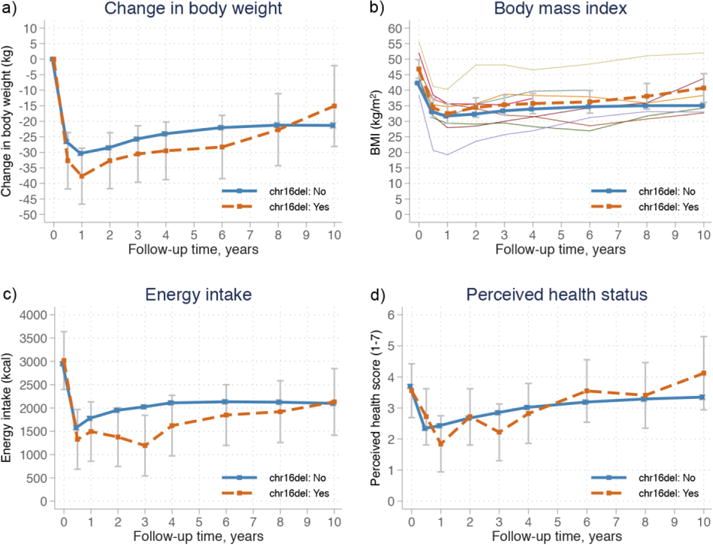
Results: Nine carriers of the chromosome 16 p11.2 microdeletion (9/1843, .49%) were found. At baseline, most risk factors were similar; however, carriers had higher body mass index (BMI), insulin levels, and systolic blood pressure compared to noncarriers. At the 1-year examination, the percent excess BMI lost (%EBMIL) in carriers and noncarriers was 71.9 and 62.2, respectively; P = .031 (37.9 and 30.6 kg). This was followed by partial weight regain in both groups, and after 10 years %EBMIL was 25.5 and 41.5 (15.7 and 21.3 kg), respectively (P = .377). Changes in risk factors were similar in the carriers and noncarriers. Two carriers who had type 2 diabetes at baseline were both in remission at 2-year follow-up but relapsed at 10-year follow-up. Perceived health status was similar in carriers and noncarriers during follow-up (overall P = .198).
Conclusions: Despite a small sample size, our results indicate that bariatric surgery is a treatment option for obese patients with chromosome 16 p11.2 microdeletion.
Keywords: Bariatric surgery; Chromosome 16 p11.2 microdeletion; Obesity.
Copyright © 2017 American Society for Bariatric Surgery. Published by Elsevier Inc. All rights reserved.
Conflict of interest statement
LMSC has obtained lecture fees from AstraZeneca, Johnson&Johnson and MSD. BC is employed by AstraZeneca and holds stocks in the same company. No other conflict of interest relevant to this study was reported.
Figures
Comment in
-
Comment on Long-term effects of bariatric surgery on patients with obesity and chromosome 19.11-2 microdeletion.Surg Obes Relat Dis. 2017 Aug;13(8):1325-1326. doi: 10.1016/j.soard.2017.05.006. Epub 2017 May 11. Surg Obes Relat Dis. 2017. PMID: 28579203 No abstract available.
References
Publication types
MeSH terms
Grants and funding
LinkOut - more resources
Full Text Sources
Other Literature Sources
Medical
