


Review
doi: 10.1182/blood-2017-03-735654.
Epub 2017 Jun 9.
The NCI Genomic Data Commons as an engine for precision medicine
Affiliations
- PMID: 28600341
- PMCID: PMC5533202
- DOI: 10.1182/blood-2017-03-735654
Item in Clipboard
Review
The NCI Genomic Data Commons as an engine for precision medicine
Blood.
.
Abstract
The National Cancer Institute Genomic Data Commons (GDC) is an information system for storing, analyzing, and sharing genomic and clinical data from patients with cancer. The recent high-throughput sequencing of cancer genomes and transcriptomes has produced a big data problem that precludes many cancer biologists and oncologists from gleaning knowledge from these data regarding the nature of malignant processes and the relationship between tumor genomic profiles and treatment response. The GDC aims to democratize access to cancer genomic data and to foster the sharing of these data to promote precision medicine approaches to the diagnosis and treatment of cancer.
Figures
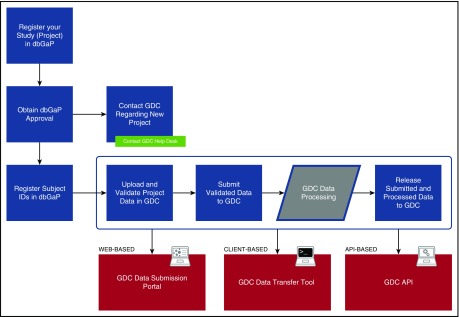
GDC data registration and submission. The diagram indicates the high-level steps an investigator takes to register and submit a cancer genomic data set to GDC. The final step “Release Submitted and Processed Data to GDC” is the point at which the investigator indicates final approval to release data to the public; data in prior steps are accessible only to GDC and the investigator.
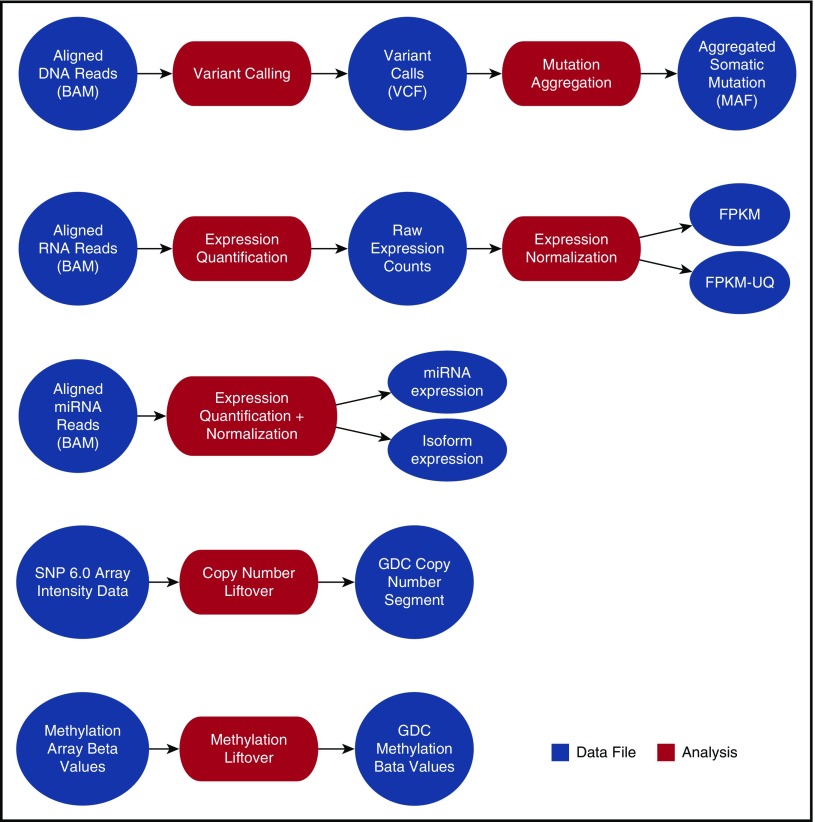
Current GDC bioinformatics pipelines. High-level processes indicating the GDC analysis and resulting data products created from GDC hg38-aligned data, submitted SNP 6.0 array data, or submitted methylation array data. BAM, binary alignment map; FPKM, fragments per kilobase of transcript per million mapped reads; FPKM-UQ, FPKM-upper quartile; MAF, mutation annotation format; miRNA, microRNA; VCF, variant calling format.
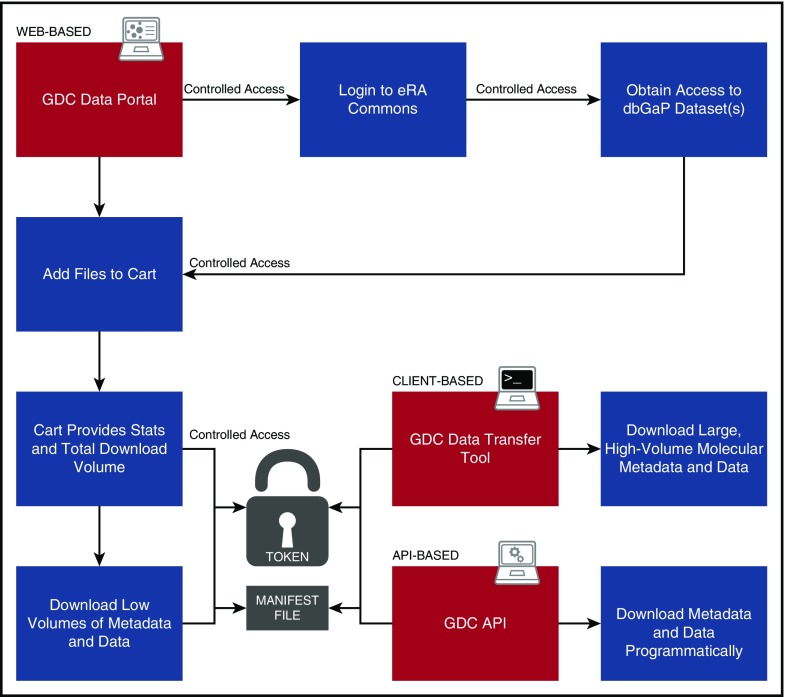
User workflow. Diagram indicating user steps to authenticate and download GDC data. Red panels indicate the 3 means for accessing data: the Web-based Data Portal, the standalone Data Transfer Tools, and the programmatic API. “Token” is a short text file provided to an authenticated user that acts like a password to enable secure transfer of authorized controlled data, such as sequence alignments.
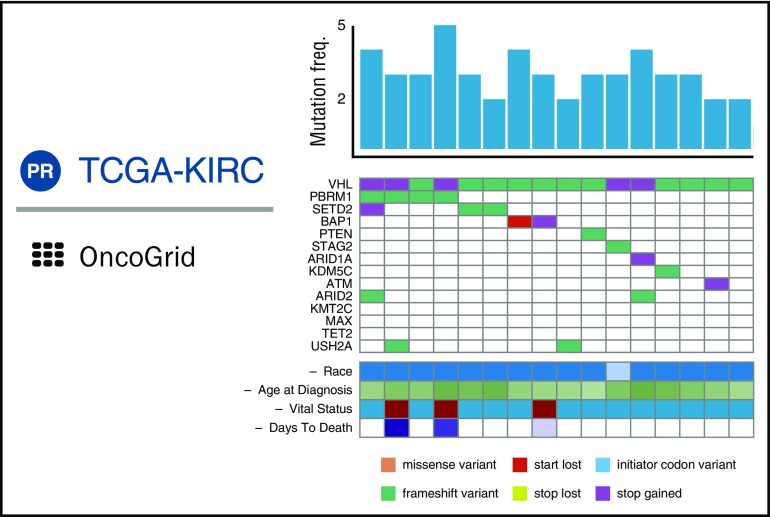
Composite of principal features of GDC OncoGrid. Each column represents a single case; the histogram indicates total number of somatic variants in the case. Rows are genes; colored cells indicate types of variants (colored according to the legend) present in these genes for the given case’s tumor sample. Clinical data for each case are presented in analogous fashion. freq., frequency; TCGA-KIRC, Cancer Genome Atlas Kidney Renal Clear Cell Carcinoma.
References
-
- Garraway LA, Lander ES. Lessons from the cancer genome. Cell. 2013;153(1):17-37. - PubMed
-
- Dang L, Su SM. Isocitrate dehydrogenase mutation and (R)-2-hydroxyglutarate: from basic discovery to therapeutics development [published online ahead of print 3 April 2017]. Annu Rev Biochem. doi:10.1146/annurev-biochem-061516-044732. - PubMed
-
- Stein EM, Fathi AT, DiNardo CD, et al. Enasidenib (AG-221), a potent oral inhibitor of mutant isocitrate dehydrogenase 2 (IDH2) enzyme, induces hematologic responses in patients with myelodysplastic syndromes (MDS) [abstract]. Blood. 2016;128(22). Abstract 343.
Publication types
MeSH terms
Grants and funding
LinkOut - more resources
Full Text Sources
Other Literature Sources
