


Validation of Demographics, Etiology, and Risk Factors for Chronic Pancreatitis in the USA: A Report of the North American Pancreas Study (NAPS) Group
- PMID: 28600657
- PMCID: PMC6040886
- DOI: 10.1007/s10620-017-4621-z
Validation of Demographics, Etiology, and Risk Factors for Chronic Pancreatitis in the USA: A Report of the North American Pancreas Study (NAPS) Group
Abstract
Background/objectives: Our aim was to validate recent epidemiologic trends and describe the distribution of TIGAR-O risk factors in chronic pancreatitis (CP) patients.
Methods: The NAPS-2 Continuation and Validation (NAPS2-CV) study prospectively enrolled 521 CP patients from 13 US centers from 2008 to 2012. CP was defined by definitive changes in imaging, endoscopy, or histology. Data were analyzed after stratification by demographic factors, physician-defined etiology, participating center, and TIGAR-O risk factors.
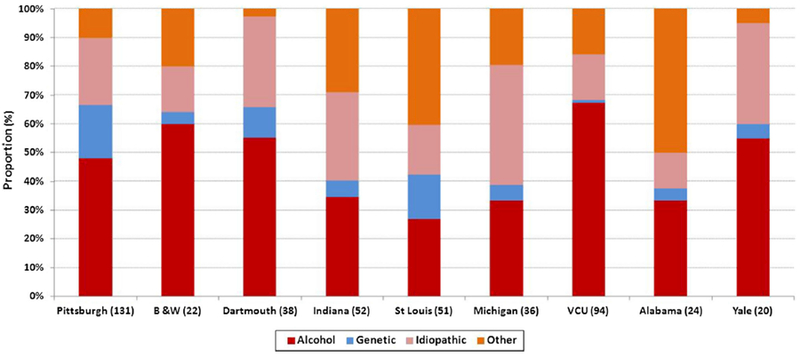
Results: Demographics and physician-defined etiology in the NAPS2-CV study were similar to the original NAPS2 study. Mean age was 53 years (IQR 43, 62) with 55% males and 87% white. Overall, alcohol was the single most common etiology (46%) followed by idiopathic etiology (24%). Alcohol etiology was significantly more common in males, middle-aged (35-65 years), and non-whites. Females and elderly (≥65 years) were more likely to have idiopathic etiology, while younger patients (<35 years) to have genetic etiology. Variability in etiology was noted by participating centers (e.g., alcohol etiology ranged from 27 to 67% among centers enrolling ≥25 patients). Smoking was the most commonly identified (59%) risk factor followed by alcohol (53%), idiopathic (30%), obstructive (19%), and hyperlipidemia (13%). The presence of multiple TIGAR-O risk factors was common, with 1, 2, ≥3 risk factors observed in 27.6, 47.6, and 23.6% of the cohort, respectively.
Conclusion: Our data validate the current epidemiologic trends in CP. Alcohol remains the most common physician-defined etiology, while smoking was the most commonly identified TIGAR-O risk factor. Identification of multiple risk factors suggests CP to be a complex disease.
Keywords: Chronic pancreatitis; Epidemiology; Risk factors.
Conflict of interest statement
Compliance with ethical standards
Figures
References
-
- Somogyi L, Martin SP, Venkatesan T, et al. Recurrent acute pancreatitis: an algorithmic approach to identification and elimination of inciting factors. Gastroenterology. 2001;120:708–717. - PubMed
-
- Steer ML, Waxman I, Freedman S. Chronic pancreatitis. N Engl J Med. 1995;332:1482–1490. - PubMed
-
- Forsmark CE. Management of chronic pancreatitis. Gastroenterology. 2013;144:1282–1291. e3. - PubMed
Publication types
MeSH terms
Grants and funding
LinkOut - more resources
Full Text Sources
Other Literature Sources
Miscellaneous
